
Juji-gatame
Official name: Ude-hishigi-juji-gatame
腕挫十字固うでひしぎじゅうじがため
Cross armbar
- Kansetsu-waza
- Katame-no-kata
Key idea
Juji-gatame is the common short name for ude-hishigi-juji-gatame, a Kodokan kansetsu-waza based on controlled elbow isolation in a cross-shaped body relationship.
Kodokan official demonstration
Kodokan technique list (opens in a new tab)YouTube (opens in a new tab)
VISUAL GUIDE
How to read the movement
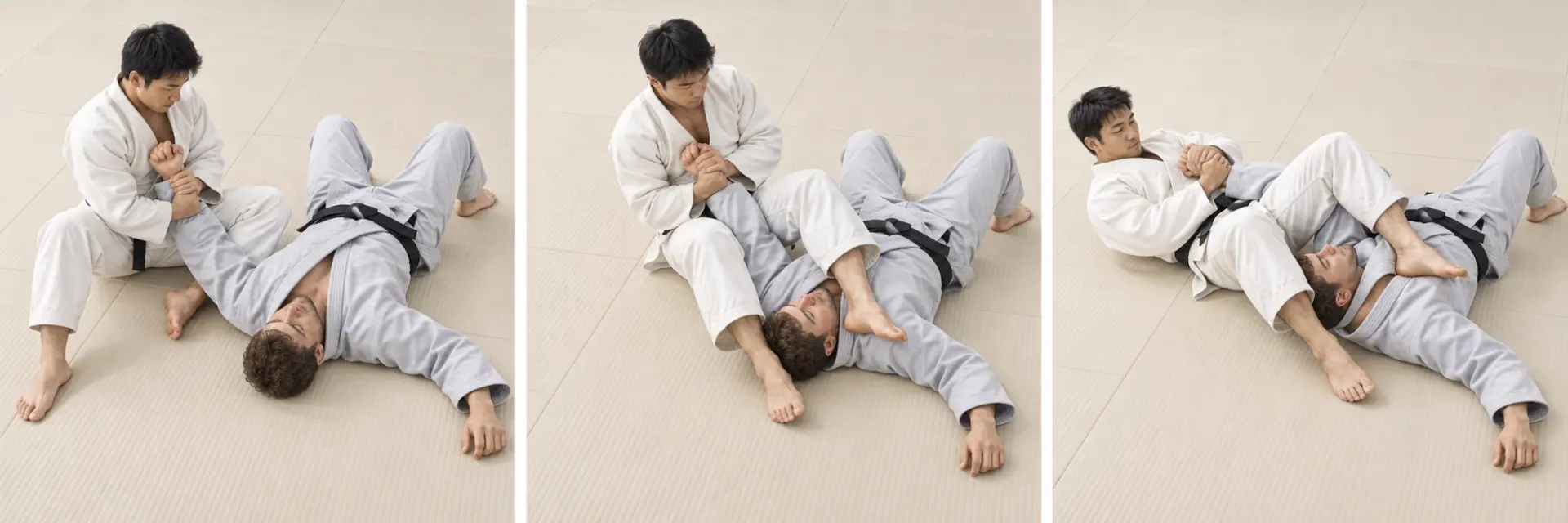
Look for a cross-shaped body relationship that controls uke’s arm and carefully limits movement through the elbow line.
Practise kansetsu-waza only under qualified supervision. Uke should submit early, and tori must release immediately.
- Tori
- the person applying the technique
- Uke
- the person receiving the technique
- Red line
- main direction or point of contact
AT A GLANCE
Technique shape
IN SEQUENCE
Three-frame concept
- 1Secure the arm
- 2Control the shoulder line in a cross shape
- 3Manage extension at the elbow
Original AI-generated educational illustration for TokyoWaltz, 2026. A simplified three-stage concept; practise under qualified instruction.
PLAY WHEN NEEDED
Watch the movement slowly
- 1Starting pointSecure the arm
- 2Decisive actionControl the shoulder line in a cross shape
- 3CompletionManage extension at the elbow
1 / 3Starting point— Secure the arm
Follow the red line and phase indicator. The guide does not autoplay or loop.
How it works
The technique first limits rotation of the arm and shoulder line, then uses only controlled application to obtain submission.
Entry
Move into control
Enter from a controlled ground position or transition and secure the arm slowly enough for uke to respond.
Position
Limit rotation
Use the legs and torso to control the shoulder-and-elbow line while maintaining the cross-shaped body relationship.
Controlled application
Obtain a safe submission
Apply only enough controlled extension to obtain a clear submission. Uke should submit early, and tori must release immediately.
Key points
- Establish positional control before any application.
- Keep the wrist, elbow, and shoulder line from rotating free.
- Use a clear submission signal and release immediately.
Common mistakes
- Applying before the arm and shoulder line are controlled. Reset the position and establish stable control first.
- Increasing speed or resistance too early. Progress only under qualified supervision and at a pace both partners can control.
- Waiting for pain or ignoring a submission signal. Uke submits early; tori releases at once.
Similar techniques
| Technique | Japanese name | Key difference |
|---|---|---|
| Ude-hishigi-ude-gatame | 腕挫腕固 | It uses a different whole-body relationship to control the elbow line; it is a separate Kodokan technique, not another name for juji-gatame. |
| Ude-hishigi-hiza-gatame | 腕挫膝固 | It uses the knee within a different controlling relationship to the elbow line. |
| Ude-hishigi-sankaku-gatame | 腕挫三角固 | It uses a leg-triangle relationship around the neck-and-arm line while controlling the captured elbow. |
Reference
Open the detailed source material when you need definitions, technical distinctions, training context, or references.
Name and classification
Overview
| Japanese | 腕挫十字固 |
|---|---|
| Reading | うでひしぎじゅうじがため |
| Romanisation | ude-hishigi-juji-gatame; short form: juji-gatame |
| English search term | Judo armbar; cross armbar |
| Martial art | Judo |
| Official classification | Kodokan kansetsu-waza |
| Kata | Katame-no-kata, kansetsu-waza set |
Juji-gatame and kansetsu-waza
The Kodokan lists ude-hishigi-juji-gatame among ten kansetsu-waza. The category includes techniques defined by control of a joint; the current Kodokan syllabus and current IJF contest rules are not identical lists of permitted actions.
In contemporary IJF contest, kansetsu-waza may be applied only to the elbow joint. A Kodokan name can therefore remain part of Judo’s technical classification even when a related joint action is restricted or prohibited in a particular ruleset.
Name and meaning
Ude means arm, hishigi indicates bending or locking pressure, jūji means cross, and gatame means control or hold. The full name describes an arm-locking control formed in a cross-like body relationship.
English-speaking judoka commonly shorten the name to juji-gatame. “Armbar” is a useful search and comparison term, but it is broader than the precise Kodokan name and is used across several grappling sports.
Detailed execution
Position
In the representative Kodokan position, the holder is beside the opponent, controls one wrist and upper arm, and uses the legs and torso to prevent the shoulder and elbow line from turning free. The bodies form the cross relationship named by jūji.
Juji-gatame can arise from several ground positions and transitions. The official name follows the final elbow-control mechanism rather than one compulsory starting position.
Principle
The principle is positional isolation and controlled extension of the elbow. Effective control limits rotation of the wrist, elbow, and shoulder line before pressure is applied. This is why the technique is studied as a whole-body relationship rather than as a pull on the forearm.
Training descriptions should stop at that principle. Rapid or excessive extension can injure the elbow, so mechanical detail must be taught directly by a qualified instructor with a cooperating partner.
Juji-gatame in Katame-no-kata
Ude-hishigi-juji-gatame is the second technique in the kansetsu-waza set of Katame-no-kata. It follows ude-garami and precedes ude-hishigi-ude-gatame, ude-hishigi-hiza-gatame, and ashi-garami.
The kata studies approach, control, resistance, and submission in a formal sequence. Inclusion in the kata establishes technical and educational significance; it does not make every historical kata action legal in current contest.
Randori
In randori, juji-gatame is commonly studied after a transition from a hold, turnover, or incomplete throw. The goal is to recognise control and submit safely, not to test how much joint pressure a partner can withstand.
Partners should use a clear tap or maitta and release at once. Resistance, entry speed, and transition complexity should increase only under qualified supervision.
Variations
The Judo armbar and other grappling sports
Closely related cross-armbar positions appear in Brazilian jiu-jitsu, sambo, and mixed martial arts. Shared appearance does not erase differences in scoring, legal transitions, uniforms, time limits, or safety rules.
For TokyoWaltz, juji-gatame refers first to the Kodokan technique and its Judo context; “armbar” is treated as the broader English comparison term.
Training and safety
Safety
The Kodokan has emphasised that kansetsu-waza is used to obtain submission, not to injure. The receiver should signal as soon as control is effective; waiting for pain or visible damage is unsafe. The holder must release on the signal, the referee’s command, or any loss of safe control.
Juji-gatame should be practised on appropriate mats with direct instruction. Children, beginners, injured athletes, and competitors under different national rules require additional limits.
Competition rules
Competition restrictions
Current IJF rules researched: 14 August 2026. A contestant can win by ippon when the opponent submits by tapping at least twice or saying maitta because of kansetsu-waza. The technique must target the elbow joint; joint locks directed elsewhere are prohibited and can bring direct hansoku-make.
Standing applications and transitions are also regulated according to continuity, control, and risk. IJF events are not held for competitors under 15, while national and youth bodies may prohibit or further limit joint locks. The applicable event rules must therefore be checked.
Sources
Sources
- Kodokan Judo Institute, Judo Technique Names.
- Kodokan Judo Institute, Definitions of Judo Techniques, 2022.
- Kodokan Judo Institute, Katame-no-kata.
- Kodokan Judo Institute, New Year Message on Safe Practice, 2025.
- Kodokan Judo Institute, Bulletin of the Association for the Scientific Studies on Judo, Volume 9, 2002.
- International Judo Federation, Sport and Organisation Rules, 14 August 2026.
- Sato and Kudo, Historical Development of Judo Techniques, Research Journal of Budo.