Crafts & Skills
Kasuri
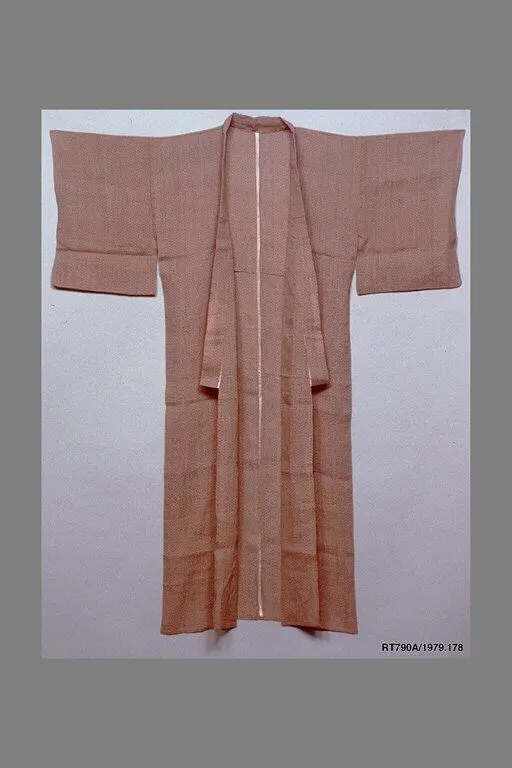
Image: Unknown Japanese maker / The Metropolitan Museum of Art · Public domain / Open Access
Kasuri (絣) is a Japanese form of yarn-resist patterning related to the textile family widely called ikat. Selected sections of warp or weft yarn are bound, otherwise resisted, or directly controlled during dyeing before the cloth is woven. The dyer and weaver then arrange the coloured yarns so that a geometric or pictorial motif emerges through their intersections. Slight shifts during weaving create the softly feathered edges associated with many kasuri fabrics; they are evidence of the process rather than poor printing. Warp kasuri, weft kasuri, and double kasuri use different combinations of patterned yarn. The technique reached Japan through wider Asian networks, with the Ryukyu Kingdom playing an important role in its transmission and development. Cotton, ramie, and silk kasuri appear in regional clothing, kimono, and modern textiles. It should not be confused with Shibori, which resists the cloth itself.
Overview
| Japanese name | 絣 |
|---|---|
| Romanization | Kasuri |
| International textile family | Ikat |
| Resist stage | Yarn is patterned before weaving |
| Main structures | Warp, weft, and double kasuri |
| Common fibres | Cotton, ramie, and silk |
Name and definition
The written form kasuri evokes a blurred or grazed appearance. English-language museums commonly add “ikat” so the method can be compared across textile cultures. The Japanese term covers varied regional processes; it does not mean that every irregular or mottled pattern is kasuri. Identification requires evidence that the yarn carried a planned resist pattern before weaving.
Yarn-resist process
A design is translated into positions along bundles of yarn. Selected sections are protected by tying, wrapping, clamping, stencil systems, or other controlled dyeing methods. After dyeing and unbinding, the coloured and undyed intervals are arranged on the loom. Accurate registration requires planning and repeated adjustment because tension and yarn movement can displace the pattern.
Warp, weft, and double kasuri
Warp kasuri places the resist pattern mainly in the lengthwise yarns; weft kasuri carries it mainly across the cloth. Double kasuri patterns both systems so motifs form through their intersection. The visual result depends on weave density, motif scale, contrast, fibre, and the degree of alignment. A printed imitation may reproduce the blurred look without sharing this structure.
Asian and Ryukyuan routes
Ikat technologies developed across several regions of Asia. Japanese government sources describe a route from India and Southeast Asia through the Ryukyu Islands, where local forms such as Ryūkyū kasuri developed, and onward to the main islands. This history complicates narratives of an isolated national invention and highlights maritime trade, political relations, and the movement of craftspeople and patterns.
Regional textiles
Named traditions include Kurume kasuri in Fukuoka, Ryūkyū kasuri in Okinawa, and kasuri structures within several tsumugi silk industries. Honba Ōshima tsumugi is especially known for detailed pre-dyed silk patterning and exact registration. Regional names can involve designated production areas, materials, and technical rules; they are not interchangeable labels for the same cloth.
Fibre, colour, and design
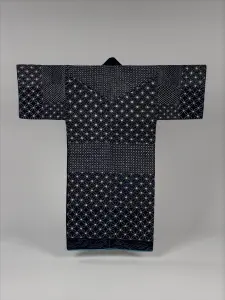
Indigo-dyed cotton kasuri became important for durable everyday garments, while ramie supported light summer cloth and silk enabled fine kimono textiles. Geometric crosses, checks, and pictorial motifs all occur. Natural and synthetic dyes have both been used. The familiar blue-and-white palette represents an important stream, not the full chromatic or material range.
Comparison with shibori and print
Kasuri resists yarn first and constructs the image during weaving. Shibori shapes and resists an already woven cloth, while stencil or roller printing places colour on its surface. These techniques may look related from a distance, and a textile can combine processes, but magnification reveals whether the motif follows individual warp or weft yarns.
Modern production and care
Hand tying and hand weaving survive alongside calculated stencil dyeing, mechanical assistance, and contemporary design. Labour, training, and market demand affect every production centre differently. Historic textiles can be weakened by light, wear, washing, or unstable dyes, and misalignment should not be “corrected” as if it were damage. Provenance, fibre testing, and weave analysis support reliable attribution.
Sources
- Government of Japan, The Textile Patterns of Okinawa.
- Traditional Crafts Aoyama Square, Honba Ōshima Tsumugi.
- Traditional Crafts Aoyama Square, Shinshū Tsumugi.
- The Metropolitan Museum of Art, Summer Kimono with Kasuri Patterning.
- Government of Japan, Japanese Fabrics and the Evolution of the Kimono.
- Kyoto National Museum, Past Textile Exhibitions.
- Victoria and Albert Museum, Kimono.
- Traditional Crafts Aoyama Square, Textiles.
Last updated: