Shrines & Temples
Eishoji Temple
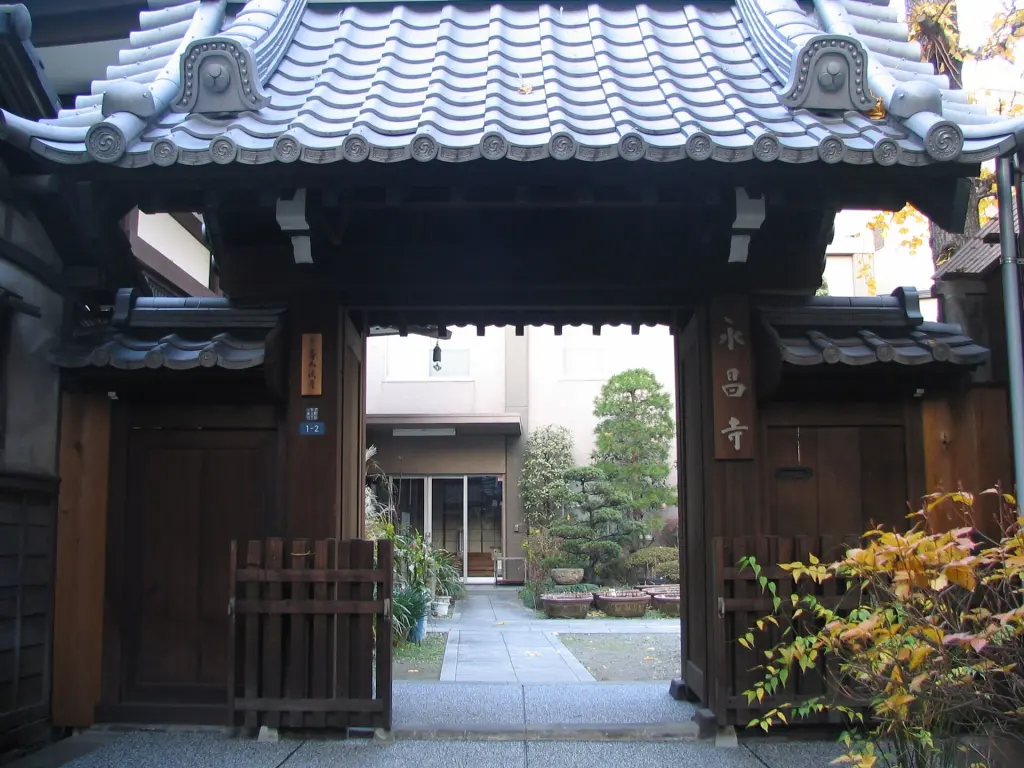
Image: Gotcha2 / Wikimedia Commons · Public domain dedication
Eishoji is a Jodo Buddhist temple in Higashi-Ueno, Taito City, Tokyo, best known in martial-arts history as the birthplace of the Kodokan. Jigoro Kano used a small room on the temple grounds in 1882 for the first training of the school that developed into Kodokan Judo. Contemporary reconstructions describe an initial practice space of roughly twelve tatami and only a small group of students. The Kodokan soon moved, so Eishoji was a beginning rather than its permanent headquarters. The temple itself has a much longer religious history: it was founded in 1558 and moved to its present area in the seventeenth century. The original buildings connected with Kano were destroyed in the 1923 Great Kanto Earthquake; a later monument preserves the site's judo association.
Overview
| Japanese name | 永昌寺 |
|---|---|
| Religious affiliation | Jodo Buddhist temple |
| Founded | 1558 |
| Present area | Higashi-Ueno, Taito, Tokyo |
| Judo connection | First Kodokan training site, 1882 |
| Surviving memorial | Kodokan Judo birthplace monument, erected in 1968 |
Name and identity
Eishoji is written 永昌寺. The final character ji means Buddhist temple. The temple is sometimes misspelled Eijoshi in older English image captions, but Eishoji or Eisho-ji more accurately reflects the Japanese reading.
Its importance extends beyond judo. Eishoji remains a religious institution within the Jodo school, and its martial association should not eclipse the temple's own history and present function.
Temple history
Jodo temple records date Eishoji's foundation to 1558. It moved to the area of its present site in 1637, placing its history within the development of Edo's temple districts long before Kano arrived.
The present buildings are not the exact structures used in 1882. Fire and earthquake repeatedly transformed Tokyo, and the Great Kanto Earthquake of 1923 destroyed the original hall associated with the first Kodokan.
Kano and the first Kodokan
In 1882, Jigoro Kano began teaching his developing system at Eishoji. He was drawing especially on Tenjin Shinyo-ryu and Kito-ryu jujutsu while reorganising technique, practice, and educational purpose under the name Kodokan Judo.
Calling Eishoji the birthplace of Kodokan Judo refers to this institutional opening. Judo did not appear fully formed on one day; its curriculum, rules, principles, and organisation continued to develop after the school left the temple.
The small first dojo
Accounts describe an initial room of about twelve or twelve-and-a-half tatami, later adjusted as a practice space. The first membership was very small, making the contrast with today's multi-storey Kodokan Judo Institute especially striking.
The space was not a purpose-built modern dojo. Adapting a temple room illustrates how new Meiji-era organisations often began through personal relationships and borrowed premises before acquiring permanent buildings.
Relocation and institutional growth
The Kodokan remained at Eishoji only briefly, from 1882 into 1883, before moving through a series of larger Tokyo premises. Each relocation reflected growing membership and Kano's widening educational ambitions.
Eishoji therefore represents the modest beginning of an institution rather than a complete summary of its later history. The site's significance depends on the network of teachers, students, and subsequent locations that made expansion possible.
Earthquake, rebuilding, and memorial
The 1923 earthquake and fires destroyed the temple structures associated with Kano's period. Visitors see a later temple environment, so historical photographs and documentary reconstruction are necessary when imagining the 1882 setting.
A monument commemorating the birthplace of Kodokan Judo was erected in 1968. It marks cultural memory at the location without claiming that the original dojo survives physically.
Visiting a living temple
Eishoji belongs to the layered religious landscape of Kamakura, a modern coastal city whose temple valleys also preserve memories of medieval warrior government and later pilgrimage.
Eishoji is a functioning Buddhist temple, not a judo museum. Visitors should respect worship, ceremonies, private areas, photography restrictions, and current opening conditions.
The memorial is most meaningful when read alongside other Kano sites, including the modern Kodokan, because together they show the shift from a borrowed temple room to an international educational and sporting institution.
Sources
Last updated: