Jujutsu
Shibukawa-ryū Jūjutsu

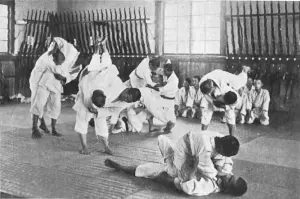
Image: Okada Kasen (editor) / National Diet Library / Wikimedia Commons · Public domain
Overview
A school name travels through teachers, places, and documents.
Shibukawa-ryū Jūjutsu (澁川流柔術 or 渋川流柔術) is a classical Japanese martial tradition founded in the late seventeenth century by Shibukawa Bangorō Yoshikata. He studied Sekiguchi-ryū before establishing a distinct school in Edo; later teachers carried Shibukawa-ryū into the Hiroshima domain, Kōshū, and Osaka. This regional history matters because a martial tradition is not a fixed technique list moving unchanged through time. Teachers, domain appointments, local networks, texts, and institutions shape what survives. The publicly described curriculum places jujutsu or taijutsu at the foundation of weapon use and develops timing, posture, control, resolve, and character through paired kata. Shibukawa Ichi-ryū shares a documented historical connection and part of the name, but it is a separate tradition rather than another label for the Osaka Shibukawa-ryū line.
Sekiguchi Hachirōzaemon Ujinari
→Late 17th century · Edo
- Japanese
- 澁川流柔術 / 渋川流柔術
- Founder
- Shibukawa Bangorō Yoshikata (1652–1704)
- Parent tradition
- Sekiguchi-ryū
- Established
- Late 17th century · Edo
- Historical centres
- Edo · Hiroshima · Kōshū · Osaka
- Primary lens
- Body method as a foundation for jujutsu and weapons
01Name & record variants
Variant characters are evidence to record, not noise to erase.
澁 is an older form of 渋. Biographical dictionaries usually write the founder’s personal name as 義方 and read it Yoshikata, while a lineage source uses 代喬. Such variation is common in early-modern records.
- 澁川流
- Older character form commonly encountered in historical or formal presentation.
- 渋川流
- Modern character form; it does not indicate a different school by itself.
- Bangorō
- A professional name inherited by later generations; the number or personal name helps identify the person.
- Yoshikata / variant characters
- Record the source’s written form rather than forcing every document into one spelling.
- Jujutsu / taijutsu
- Terms used to describe the body-method centre of the curriculum.
- Koryū bujutsu
- A classical martial tradition, not a single modern sport ruleset.
02Founder & parent tradition
Transmission from a teacher precedes the creation of a new school.
Biographical accounts place Shibukawa Bangorō under Sekiguchi Hachirōzaemon Ujinari and describe full transmission before Bangorō organised a distinct curriculum and institutional identity.
Sekiguchi Ujinari
Second-generation representative of the Sekiguchi tradition.
Shibukawa Bangorō
Entered training as a young man and is reported to have received full transmission.
Shibukawa-ryū
A distinct school with its own curriculum, documents, priorities, and professional name.
03Urban-to-regional timeline
Edo was the starting hub, not the whole geography.
The movement of named practitioners makes the lineage easier to test than a single uninterrupted arrow.
- 1652
Founder is born
Accounts usually connect Bangorō’s birth with Kii Province, while some also associate it with Yamato.
- Early 1680s
Move to Edo
Bangorō established himself as a teacher; a dojo in the Shiba district is recorded by 1698.
- 18th century
Fourth Bangorō systematises
Tokihide is associated with scholarship and transmission texts including Jūjutsu Taiseiroku and Jūjutsu Taii.
- Meiji period
Osaka transmission
Ōyama Zentarō Masakatsu opened the Seishinkan dojo in Kunijima, forming the basis of the association-recognised Osaka line.
04Regional transmission
The route changes with the institution carrying it.
Domain service, appointments, local teachers, shrines, physicians, village networks, and later dojo each leave different kinds of evidence.
Morishima Motome Katsutoyo
A founder’s student who received permission to teach and instructed members of the domain.
Carrier: domain serviceYakushiji Masa Masatoshi
Research identifies another founder’s student in a network documented through local records.
Carrier: teachers and local institutionsŌyama Zentarō Masakatsu
The Seishinkan dojo anchors the modern Osaka transmission recognised by the Nihon Kobudo Association.
Carrier: modern dojo lineage05Curriculum relationship
The body is trained first; weapons extend its organisation.
The association’s public account describes hands and feet as the foundation from which a weapon becomes an extension of the body. Historical regional lists may differ.
Posture · balance · timing · control
Throws & controls
Paired forms develop entry, balance disruption, restraint, and tactical judgement.
Short-sword taking
Body method must account for blades, access, distance, and decisive control.
Kusarigama & other material
Public demonstrations show line-specific weapon work built on coordinated movement.
06Training principles
Technique, composure, and responsibility are trained together.
The current lineage account emphasises kiryoku and tanryoku alongside physical skill. These ideals belong to the branch’s presentation and should be attributed accordingly.
Kiryoku · directed energy
Maintain intent and the capacity to act without letting tension replace coordination.
Tanryoku · resolve
Remain composed enough to make a responsible decision under pressure.
Jū · adaptability
Use structure, timing, and force responsively rather than treating softness as passivity.
07Name comparison
Shibukawa-ryū and Shibukawa Ichi-ryū are related, not interchangeable.
The Nihon Kobudo Association lists them as separate member traditions in Osaka and Hiroshima.
Shibukawa-ryū Jūjutsu
Traces its school identity to Shibukawa Bangorō and the later Osaka transmission.
Shibukawa Ichi-ryū Jūjutsu
Attributes its formation to Shutō Kuranoshin after study of Shibukawa-ryū, Nanba Ippo-ryū, and Asayama Ichiden-ryū.
Practical conclusion: similar name + documented input ≠ identical organisation, curriculum, or succession.
08Provenance checklist
Four details make a lineage claim testable.
Use these fields before linking a text, demonstration, or artefact to “Shibukawa-ryū”. They distinguish evidence from resemblance.
- 1Branch or transmission line
Name the organisation or historical route being discussed.
- 2Teacher or custodian
Record the person who transmitted, demonstrated, copied, or preserved the material.
- 3Place and date
Locate the claim in Edo, a domain, a region, or a modern dojo and give its period.
- 4Object identifier
Keep the title, publisher, catalogue number, licence, or archival reference.
Sources and further reading
Last updated: