Jujutsu
Kitō-ryū Jūjutsu

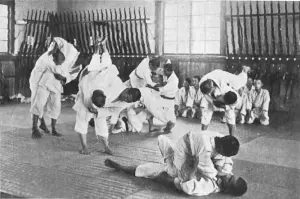
Image: Unknown photographer; published by Nippon Tosho Center / Wikimedia Commons · Public domain
Overview
A throw begins before the body leaves the ground.
Kitō-ryū Jūjutsu (起倒流柔術) is a classical Japanese martial tradition associated with throwing, posture, balance-breaking, paired kata, and forms shaped by the conditions of armour. Its early genealogy is preserved through several lineages and texts rather than one uncontested chronology, so founder claims require attribution. By the nineteenth century it was an established school. Jigoro Kano began studying under Iikubo Tsunetoshi in 1881 after training in Tenjin Shin’yō-ryū. Lessons from both traditions entered Kano’s development of Kodokan Judo, but the result was a new system rather than a renamed Kitō-ryū. The clearest living institutional connection is Koshiki-no-kata: Kodokan forms derived from Kitō-ryū material whose upright posture and deliberate movement make more sense when their armoured context is remembered.
Maintain usable structure while reading the opponent’s alignment.
Act during transition rather than after force has fully settled.
Guide force where the opponent’s structure cannot support it.
Disturb balance, enter, and complete the fall with efficient coordination.
- Japanese
- 起倒流柔術
Kitō-ryū Jūjutsu - Classification
- Classical Japanese jujutsu tradition
- Historical frame
- Early Edo period onward
- Technical lens
- Posture, balance, timing, and throwing
- Contextual clue
- Forms associated with training in armour
- Modern connection
- Kodokan Judo and Koshiki-no-kata
01Name & classification
起 and 倒 point towards a relationship, not a dictionary definition.
The paired ideas of rising and falling are a useful entry point. Historical explanations also belong to the school’s transmitted teachings and should not be compressed into one English slogan.
Rise
Recovery, organisation, initiative, and the changing condition of posture.
Fall
Loss of structure, redirection, throwing, and the condition created in the opponent.
Transmitted school
A lineage of teaching and practice—not simply a technique category.
02Historical frame
The later route is clearer than the earliest genealogy.
Accounts commonly connect the school with Ibaraki Toshifusa and Terada Kan’emon Mitsuhide. Details vary, so a careful summary separates lineage tradition from the well-documented nineteenth-century study route.
- Early Edo
Formation traditions
Several texts and lineages preserve accounts of the school’s early development rather than one complete contemporary record.
- Later transmission
Established jujutsu school
Kitō-ryū developed recognisable form, teaching documents, branches, and a reputation for throwing and body principles.
- 1881
Kano studies under Iikubo
After Tenjin Shin’yō-ryū training, Kano continued with Iikubo Tsunetoshi in Kitō-ryū.
- 1882 onward
Kodokan reorganisation
Kano established a new educational and martial system while retaining selected older material and principles.
03Curriculum & training
Throwing is prominent; the learning problem is larger.
Paired kata coordinate posture, distance, rhythm, force, and falling. Surviving materials and interpretations differ by line, so this is a conceptual map rather than a universal catalogue.
Posture & balance
Organise your structure while locating where the opponent’s support can be weakened.
Timing & direction
Use the changing encounter rather than treating a throw as a static strength test.
Paired kata
Preserve roles, entries, tactical conditions, and principles through repeatable practice.
04Armour context
Koshiki-no-kata is a window, not the whole house.
Kodokan Koshiki-no-kata preserves Kitō-ryū-derived forms. Their posture and measured quality become more legible when imagined under the weight and movement limits of armour.
Movement with armour
Added weight, rigid surfaces, weapons, and restricted articulation alter posture, distance, and safe ways to fall.
Koshiki-no-kata
A Kodokan set derived from Kitō-ryū forms and retained as a study of older principles.
The kata is strong evidence of technical inheritance. It is not a complete reconstruction of every historical Kitō-ryū branch or syllabus.
05Documented route to Judo
Two deep study routes met in Kano’s new system.
The diagram shows documented training and reorganisation. It does not claim that only two schools contributed to every aspect of Judo.
Fukuda Hachinosuke · Iso Masatomo
Iikubo Tsunetoshi
Selection · comparison · modification · pedagogy
Kata · randori · education · institution
06Present-day transmission
Survival takes more than one form.
Kitō-ryū material is encountered through organisations using the school name, through documents and historical study, and through Kitō-ryū-derived kata inside Kodokan Judo. These channels overlap without being interchangeable.
Groups using the Kitō-ryū name
Authority, genealogy, and curriculum should be attributed to the specific group.
Kodokan kata
Koshiki-no-kata keeps selected forms in active Judo practice.
Scrolls & research
Historical texts and scholarship allow comparison beyond one current demonstration.
07Common misconceptions
Three statements need a narrower claim.
Throwing is prominent, but kata, tactics, texts, posture, and mental or ethical teachings broaden the curriculum.
It preserves important derived material, not every element of every branch.
Kano drew on multiple traditions and created a distinct system, institution, and educational purpose.
Sources and further reading
Last updated: