Karate
Gyaku-zuki
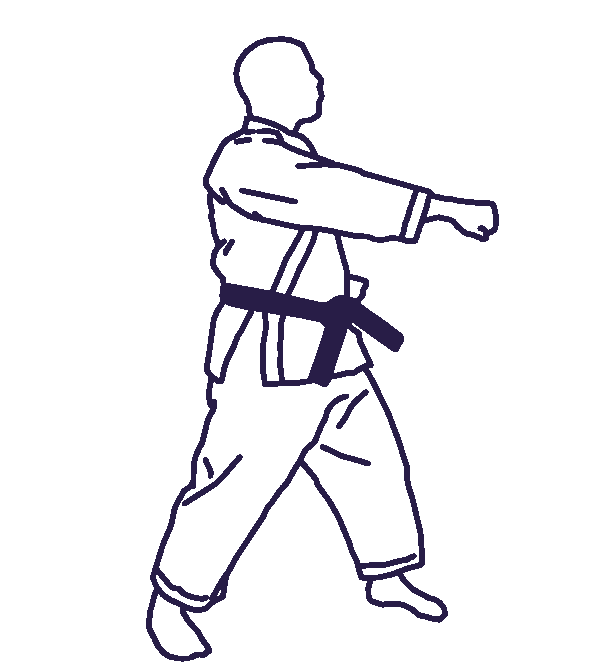
Image: Judcosta / Wikimedia Commons · CC BY-SA 3.0
Overview
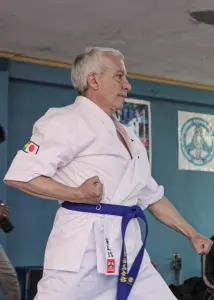
Gyaku-zuki joins the rear-side arm to a base led by the opposite leg.
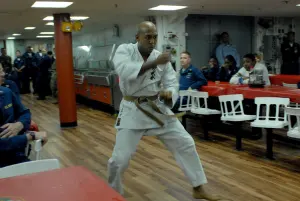
Gyaku-zuki (逆突き) is a Karate thrust delivered with the arm opposite the forward leg. The JKF definition links movement from the feet through the hips, torso, and arm, but stance length, rear-heel use, pelvic range, shoulder position, guard, and recovery remain organisation- and context-specific. The opposite-side relationship allows substantial whole-body coordination; it does not mean that more rotation automatically creates a better technique. Distance, balance, target, timing, and the ability to continue are as important as the visible finishing position.
Distance and support organise the line.
Foot, hip, trunk, shoulder, and fist coordinate.
The finish remains balanced and ready to continue.
- Japanese
- 逆突き
- Reading
- ぎゃくつき
- Reference meaning
- Reverse or opposite-side thrust
- Classification
- Tsuki · hand technique
- Defining relation
- Arm opposite the forward leg
- Common contexts
- Kihon · kata · kumite
01Name & official definition
“Reverse” describes the arm–leg relationship, not a single universal punch.
The federation definition is a reference point; a school supplies the remaining detail.
Common spellings include gyakuzuki and gyaku zuki. The JKF page writes the reading as ぎゃくつき, while English Karate normally voices the compound as gyaku-zuki.
02Whole-body chain
The rear-side fist is the visible end of a sequence beginning at the floor.
Speed and structure come from coordination, not one isolated body part.
Manage pressure, stability, and direction.
Coordinate rotation within a usable base.
Carry the selected line without overreaching.
Modern electromyographic work can measure rapid activation across lower limb, trunk, and upper-limb muscles. Small specialist samples help analyse timing but do not establish one ideal execution for every Karate tradition.
03Distance, stance & line
Functional range changes the elbow, posture, and measured impact.
A universal centimetre rule cannot be separated from body size, stance, target, equipment, and method.
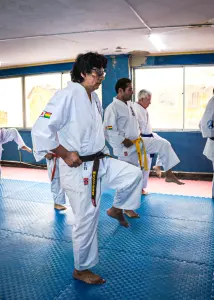
Zenkutsu-dachi with a clear hip turn
The longer base and segmented action make opposite-side coordination easy to inspect.
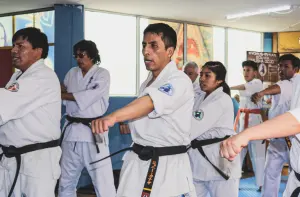
Shorter base and compressed phases
Guard, distance, and recovery may be less visibly formal while the defining arm–leg relation remains.
A 1990 Research Journal of Budo study found that changing distance altered measured impact and elbow angle for its participants. It demonstrates that range matters, not that one distance fits everyone.
04Guard, kime & recovery
The endpoint is a transition, not a place to remain rigid.
Formal hikite and a higher partner guard serve different training contexts.
Hikite or active guard
Basic form may make withdrawal pronounced; kumite may keep the hand higher for protection and continuation.
Kime
Coordinate the action without carrying unnecessary tension before or after it.
Recover or connect
Return to guard, change distance, or flow into the next technique with balance intact.
05Compare the tsuki family
The forward leg is the quickest reference for distinguishing gyaku-zuki.
Same-side and opposite-side are more precise than relying only on “lunge” and “reverse”.
Names straightness rather than a fixed arm–leg relationship.
Same-side advanceOi-zuki追突きThe thrusting hand and advancing or forward leg finish on the same side.
Opposite-side relationGyaku-zuki逆突きThe thrusting hand is opposite the forward leg.
Leading-hand entryKizami-zuki刻み突きThe front hand attacks as the front foot enters and the rear leg follows.
06Kihon, kata & kumite
One relation appears in several training problems.
Tactical role is not limited to a counterattack even when defence–punch combinations are common for beginners.
07Research, competition & safety
Recognition as gyaku-zuki does not by itself create a score.
Technique identity, measured mechanics, and rule validity answer different questions.
Opposite-side relation
The name describes arm and forward leg.
Task-specific measurement
Distance and muscle timing depend on the study design and sample.
Hand technique: normally one point
The specified three-point exception concerns an opponent whose torso is on the floor.
Target, timing, form, distance, control
Current rules determine whether the action scores.
Sources and further reading
- All Japan Karatedo Federation, Karate Terminology Dictionary.
- Japan Karate Association, Instructor Technical Manual.
- Japan Karate Association, Techniques: Kihon, Kata and Kumite.
- Okinawa Prefecture, School Physical Education Karate Teaching Guide.
- National Diet Library, Funakoshi Gichin, Karate-do Kyohan.
- All Japan Karatedo Federation, Gyaku-zuki.
- Japan Karate Association, Dan Ranking and Grading Syllabus.
- Toyoshima et al., Impact Force and Elbow Angle at Different Distances in Jodan Gyaku-zuki, Research Journal of Budo.
- A Novel Sport-specific EMG-based Method to Evaluate Movement Efficiency in Karate Punching, PubMed.
- All Japan Karatedo Federation, Summary of Competition Rule Changes Effective 1 April 2026.
Last updated: