
Karate
Uke
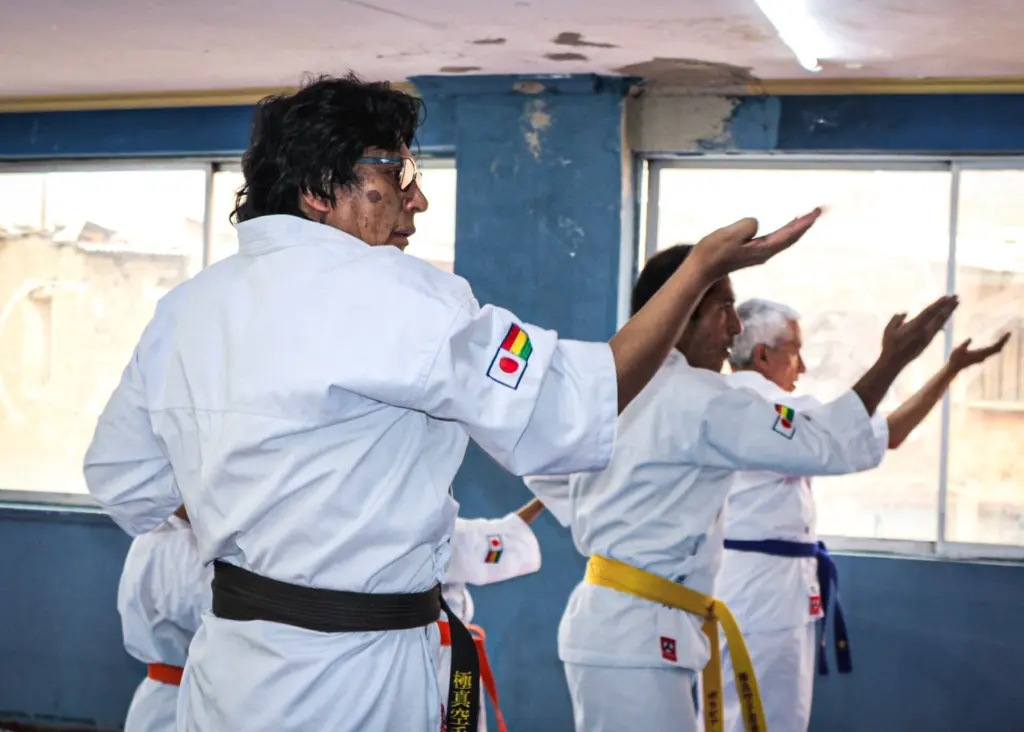
Image: Norkiña / Wikimedia Commons · CC BY-SA 4.0
Overview
Uke means receiving: manage the line, then remain able to continue.
Uke (受け) is the Karate family of receiving actions, commonly translated as blocks or defensive techniques. The literal idea is broader than a head-on collision. An uke may intercept, redirect, cover, clear a line, manage contact, or establish a counterattacking position. Named actions such as age-uke, gedan-barai, shutō-uke, soto-uke, and uchi-uke organise level, direction, path, or contact surface. Their preparation, stance, scale, and application vary across styles. In Judo, uke instead names the person receiving a technique, so context is essential.
Identify what must be managed.
The final posture is useful because another action remains available.
- Japanese
- 受け
- Base verb
- Ukeru · to receive
- Common English
- Block or defensive technique
- Functional range
- Intercept · redirect · cover · control
- Name variables
- Level · direction · path · surface
- Main caution
- Uchi/soto conventions can reverse
01Name & technical category
“Block” names a familiar teaching category; “receive” keeps its functions open.
The term derives from ukeru, to receive, and does not require force to be stopped head-on.
Block = collide and halt
This translation can make the arm appear passive and separate from footwork, angle, timing, and continuation.
Uke = receive and reorganise
Interception, redirection, cover, clearing, contact management, positional control, and counterattack can all be relevant.
The JKF dictionary gives receiving techniques their own section; JKA manuals use the English category “blocks” within a Shotokan syllabus. Neither framework makes defence passive or universal.
02Functional model
An uke changes a relationship while preserving posture and initiative.
The contact surface works with stance and body movement rather than acting as an isolated arm.
Line, timing, and distance
Recognise what is arriving and where the body can safely move.
Use stance, footwork, and angle
Reduce the force that must be managed and create a better relationship.
Intercept, redirect, cover, or control
Choose a contact and path suitable for the exercise.
Counter, control, disengage, or reset
The endpoint matters because it enables what follows.
Basic practice may enlarge preparation and finish so the pathway can be corrected. Partner distance often compresses the motion; the large training form is not automatically one literal application.
03Common receiving actions
Names describe level, direction, path, surface, or use of the second hand.
Each link opens a fuller guide; the cards are a selected reference, not a complete cross-style syllabus.
Rises from below to receive an upper-level attack.
Lower sweepGedan-barai下段払いLower-level sweeping relationship; the JKF gives a front kick as one example.
Knife handShutō-uke手刀受けUses the knife-hand area in a receiving pathway.
JKF inside-to-outside pathChūdan soto-uke中段外受けMiddle-level action whose label reverses in some lineages.
JKF outside-to-inside pathChūdan uchi-uke中段内受けMiddle-level action whose label reverses in some lineages.
Two-hand relationMorote-uke諸手受けCoordinates both hands; commonly called an augmented block in Shotokan English.
04Why uchi and soto can reverse
The same visible movement can be named from two different viewpoints.
The JKF explicitly warns about this reversal; an English “inside/outside block” label does not settle it.
Name the arm’s travel
Inside and outside refer to the direction the receiving arm moves across the practitioner’s body.
Name the attack’s side
The label instead reflects whether the attack is received from an inner or outer relation.
For international writing, give the Japanese term, identify the organisation, and describe the actual path. That preserves difference without declaring one convention universally correct.
05Stance, footwork & angle
Moving the body can solve part of the problem before the arm completes its path.
Angle changes reduce the force to be managed and establish a new position for continuation.
Karate Stances
Provide temporary support rather than a fixed platform.
Step · turn · shift
Changes line and distance before or during contact.
Manage less force, create more options
The arm and body finish in a position suited to counter, control, or exit.
Shotokan basics often pair named uke with zenkutsu-dachi or kōkutsu-dachi. Other systems may use shorter bases, circular movement, or close-range structure.
06Kata & bunkai
Kata preserves a movement relationship; bunkai tests possible functions with a person.
A useful modern application is not automatically the unique historical intention of the kata’s creator.
Kata
Connects uke with turns, stance changes, hand positions, rhythm, and other actions.
Bunkai
Places the movement against a partner and asks what line, contact, and continuation could mean.
Keep multiple credible readings visible
A familiar “block” can also support clearing, striking, controlling, or positional interpretations.
07Kumite, variation & safety
Partner movement compresses the form and makes communication part of the technique.
Competition does not normally score uke itself; its value is preventing a valid attack and improving the next position.
Kumite
Uses hand or forearm with guard, distance, evasion, timing, and immediate continuation.
Intercept or redirect
Preparation, surface, forearm rotation, stance, scale, and close-range use vary by lineage.
Attack, target, and intensity
Partners need a shared exercise and stopping condition before contact rises.
Forearm contact is not self-justifying
Force must not increase faster than technical accuracy, distance control, recovery, and supervision.
Sources and further reading
- All Japan Karatedo Federation, Karate Terminology Dictionary.
- Japan Karate Association, Instructor Technical Manual.
- Japan Karate Association, Techniques: Kihon, Kata and Kumite.
- Okinawa Prefecture, School Physical Education Karate Teaching Guide.
- National Diet Library, Funakoshi Gichin, Karate-do Kyohan.
- All Japan Karatedo Federation, Ayumi Vol. 4: Jodan-uke and Gedan-uke.
- Japan Karate Association, Dan Ranking and Grading Syllabus.
- Research Journal of Budo, A Study of Karate Instruction in Junior High School.
Last updated:
_y_Kihon_en_Musha_Dojo,.jpg)