
Martial Arts
Dōjō Etiquette
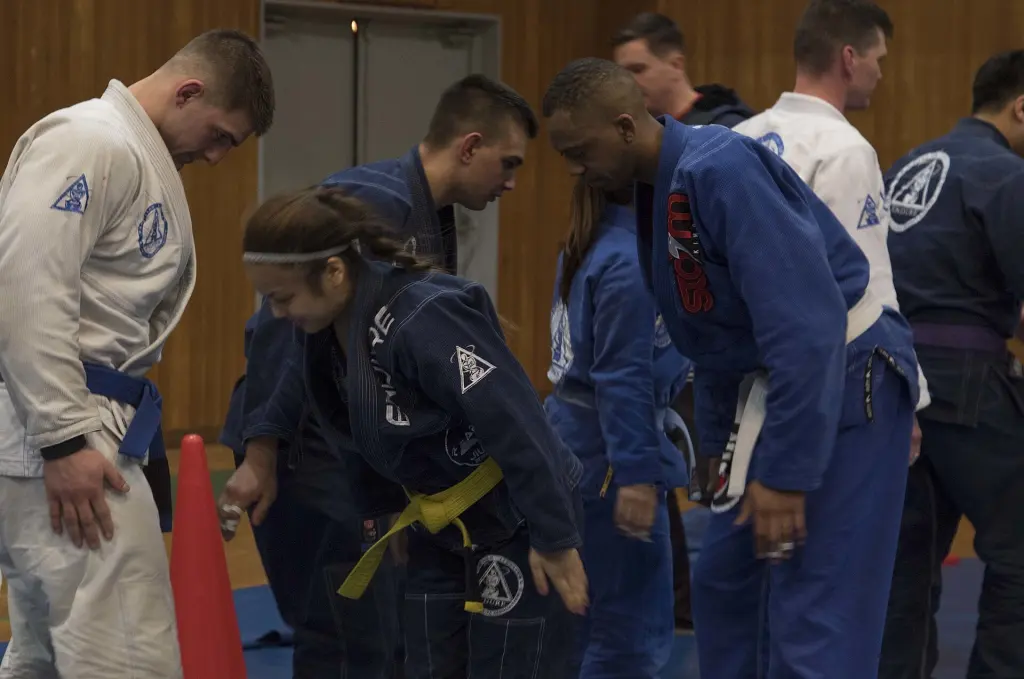
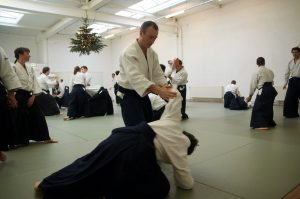
Image: Senior Airman Jordyn Fetter, U.S. Air Force / U.S. Air Force via Wikimedia Commons · Public domain (U.S. Government work)
Dōjō etiquette is the set of practices that organise respectful, safe and attentive behaviour in a Japanese martial-arts training space. Japanese often calls it dōjō reihō (道場礼法), the etiquette or forms of courtesy of the dōjō. It may include standing or seated bows, orderly entry, care of equipment, clean clothing, punctuality, quiet observation and appropriate conduct toward partners and instructors. These customs matter because martial practice depends on cooperation and controlled risk. They are not a single timeless script shared by every art. Karate, Judo, Kendo and individual schools differ in commands, seating order, use of shōmen and the degree of formality.
Overview
| Japanese | 道場礼法 |
|---|---|
| Reading | どうじょうれいほう |
| Romanisation | dōjō reihō |
| Meaning | Etiquette or forms of courtesy in the place of practice |
| Context | Japanese martial arts |
| Core purposes | Respect, attention, safety, order and care of the training space |
| Common forms | Ritsurei, zarei, greetings and equipment care |
| Important distinction | Exact etiquette varies by art, school, instructor and venue |
Dōjō and reihō
The use of terms such as rei, sonkyo and dōjō within one discipline is explained in Kendo Terminology.
Dōjō (道場) literally combines “way” and “place.” In modern budō it means the place where an art is practised, whether a permanent hall or a temporarily designated training area. Reihō (礼法) means forms or methods of courtesy.
Etiquette makes roles and transitions legible: practice begins and ends, partners acknowledge one another, instructions receive attention and dangerous activity stops on command. Its practical and ethical functions are closely connected.
Entering and leaving the dōjō
Many dōjō expect a bow when entering or leaving the practice area. Footwear is removed or arranged according to the building, and students avoid crossing the training surface with outdoor shoes. Local instructions take priority over assumptions imported from another school.
Arriving early enough to change, check equipment and prepare the floor is commonly treated as part of practice. A late arrival may require waiting for permission to join, especially where warm-up and safety checks have begun.
Ritsurei and zarei
Ritsurei (立礼) is a standing bow; zarei (座礼) is a seated bow. JKF terminology describes both in technical detail for Karate. Other arts regulate hand position, gaze, distance and timing differently.
A bow acknowledges the practice relationship and is not evidence by itself of religious worship. The meaning of bows toward a partner, instructor or front of the room depends on the institution and context. Visitors should follow the host’s explanation without inventing a universal ritual.
Opening and closing practice
Formal classes may line up by grade, sit in seiza, practise mokusō (quiet reflection), and exchange bows or greetings with the instructor. The sequence and commands vary. Some dōjō use only a standing bow and concise announcement.
Line order can help organise instruction, but it should not be mistaken for a complete social hierarchy outside practice. Seniority terms such as senpai and kōhai are relational and should not justify unsafe or abusive conduct.
Conduct toward partners and instructors
Partners rely on one another to learn safely. Common expectations include listening to the drill, using the agreed intensity, acknowledging discomfort, stopping promptly and avoiding unsolicited escalation or correction.
Respect for an instructor includes attention and honest questions. It does not remove professional boundaries or the student’s right to decline unsafe practice. Institutional authority should remain accountable to safeguarding and law.
Clothing and equipment
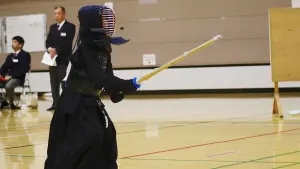
Correct fitting, fastening and inspection of Bōgu are both etiquette and safety responsibilities in Kendo practice.
In Kendo, safe handling includes frequent inspection of the shinai for damaged bamboo and loose fittings.
Training clothing should be clean, secure and appropriate to the art. Jewellery, long nails or damaged equipment may create avoidable risk. Weapons and protective equipment are handled only as the instructor and venue permit.
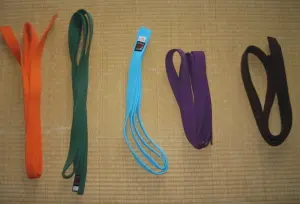
Belts and uniforms carry organisation-specific meanings, but care for them is also practical hygiene. Folklore that a belt must never be washed should not override sanitation, manufacturer instructions or dōjō policy.
Cleanliness and safety
The Budō Charter published by Nippon Budokan and the Japanese Budō Association states that a dōjō should maintain discipline, courtesy, quiet, cleanliness and safety. Cleaning the floor and shared equipment can therefore be both routine maintenance and communal responsibility.
Infection control, first-aid access, hydration and reporting an injury are not secondary to tradition. Contemporary safety requirements should be integrated with etiquette rather than suppressed for the sake of appearing stoic.
Shōmen, kamiza and local variation
Shōmen means the front. Kamiza can refer to the upper or honoured side of a room. Some dōjō display calligraphy, an association emblem, the national flag, a photograph of a founder or a Shinto-style shelf; others do not.
These arrangements reflect architecture, school history and institutional culture. It is inaccurate to claim that every dōjō is a shrine or that all practitioners attach the same religious meaning to the front of the room.
Differences among martial arts
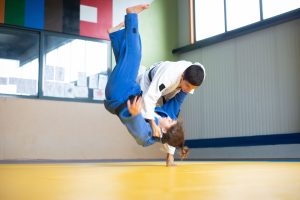
Judo etiquette is shaped by tatami practice and partner safety; Kendo adds detailed treatment of shinai and armour; Aikido schools may organise seated and standing bows differently; Karate practice ranges from highly formal line-ups to simpler association or university-club customs.
Competition venues also use codified bows that may differ from ordinary dōjō routine. A referee’s procedural bow is an event rule, not proof that every training session follows the same sequence.
Historical development
Courtesy has deep roots in Japanese social and martial practice, but the group etiquette now associated with school budō was also organised and standardised through modern education and institutions. Historical research traces changes rather than one unbroken, uniform ritual.
Claims that a particular line-up, bow or command has existed unchanged since the samurai era require evidence. Modern practices can be meaningful without being presented as ancient.
Guidance for visitors
International visitors can use the Okinawa Karate Kaikan and its Information Center to learn about facilities, introductions and local dōjō access before arranging training.
A visitor should ask where to change, whether photography is allowed, how to enter the floor and what form of address is preferred. Watching one class before joining can clarify the local rhythm and level of formality.
Good etiquette begins with observation and consent. When a custom is unfamiliar, a polite question is more appropriate than performing a memorised ritual from another art.
Sources
- Nippon Budokan and Japanese Budo Association, Budo Charter.
- Ministry of Education, Culture, Sports, Science and Technology, Budo Charter.
- All Japan Kendo Federation, The Concept and Purpose of Kendo.
- Japan Karate Association, Philosophy.
- All Japan Karatedo Federation, Ritsurei.
- All Japan Karatedo Federation, Zarei.
- A Historical Study of Etiquette in Modern Budo Education, Research Journal of Budo.
- A Study of Karate Instruction in Junior High School, Research Journal of Budo.
Last updated:

.jpg)