Karate
Karate Belt Ranks
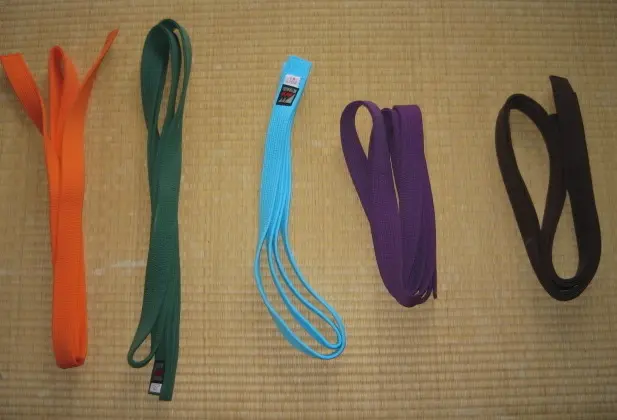
Image: Gotcha2 / Wikimedia Commons · CC BY-SA 3.0
Overview
The institution awards the grade; the belt makes it visible.
Karate belt ranks combine kyū (級) and dan (段) grades with an organisation’s curriculum, examination rules, and visible belt system. They structure learning and responsibility inside a federation, association, or dōjō, but they are not one worldwide measurement of ability. Two practitioners can wear the same colour while holding different grades, and the same grade may be represented differently between organisations. A black belt normally marks entry into the dan sequence—not universal mastery, instructor status, or competition superiority.
Defines and awards the recognised grade.
Names the level inside that system.
Displays the grade according to local convention.
- Japanese
- 空手の段級位
- Reading
- からてのだんきゅうい
- Grade systems
- Kyū and dan
- Visible symbols
- Coloured belts and black belt
- Authority
- Named federation, association, or dōjō
- Main caution
- No universal colour order or standard
01Grade, belt & curriculum
Three related objects answer three different questions.
Separating them prevents a visible colour from being mistaken for universal authority or ability.
What has the organisation awarded?
A kyū or dan level recorded by a named institution under its rules.
How is that grade displayed?
A visible convention whose colours, stripes, and divisions vary.
What was assessed?
The organisation’s combination of techniques, kata, kumite, control, etiquette, theory, and eligibility.
02Kyū & dan
Kyū normally counts down toward first kyū; dan then counts upward from shodan.
The number of kyū grades and the requirements at each step depend on the organisation.
A person without dan rank may be called mudansha (無段者); a dan holder is a yūdansha (有段者).
03Historical development
The familiar belt system belongs to Karate’s modern institutional development.
It should not be projected unchanged onto early Okinawan practice.
Kyū–dan structure develops in Japan
The grading model shaped arts including Judo and Karate.
Karate adopts ranks and belts
Associations use grades to organise teaching, examination, and authority.
Colours, youth grades, and governance diverge
Modern organisations develop different curricula, symbols, and recognition policies.
04JKF & JKA examples
National federation and style association systems overlap without becoming identical.
Each example describes its issuing body, not Karate as a whole.
Japan Karatedo Federation
JKF kyū regulations establish official grades from fifth kyū through first kyū; member bodies may create sixth kyū and lower levels. Separate rules govern dan and junior dan, with eligibility and authority changing by level.
Japan Karate Association
The JKA publishes ten kyū and ten dan grades with technique, kata, and kumite requirements. Examination location and authority change at higher ranks.
Other Shotokan organisations, Okinawan schools, and national federations may recognise different syllabuses or require separate registration.
05Colour belts, black belt & junior grades
Colour gives orientation inside a system; it does not translate reliably between systems.
Children’s programmes often add intermediate stages so progress can be recognised more frequently.
Sequences vary
White often marks a beginner, while yellow, orange, green, blue, purple, brown, stripes, and extra divisions are used in different orders.
Entry into dan
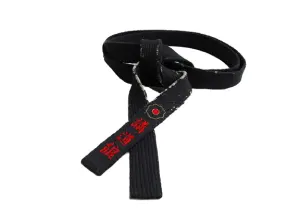
Shodan is the first dan. A black belt does not by itself prove teaching authority, federation membership, or competition record.
Policy varies by age
Intermediate grades, stripes, colours, junior dan, age limits, and conversion procedures belong to the issuing organisation.
06Grading examinations
A grading makes the curriculum visible.
The balance of movement, control, conduct, and knowledge reveals what an organisation values at that stage.
Kihon
Selected stances, movement, receiving actions, thrusts, strikes, kicks, and combinations.
Karate Kata
Organisation-specific forms, sequence, body method, and performance requirements.
Kumite
Agreed or freer formats, distance, timing, control, and safety.
Eligibility and conduct
Age, time in grade, theory, etiquette, fees, examiner licences, recommendations, and retesting intervals may apply.
An old syllabus is valuable historical evidence, but current administrative questions must be checked in the current regulations.
07Recognition, transfer & terminology
The awarding body and date are part of the rank claim.
A federation may recognise, document, equate, re-examine, or decline an outside grade.
Menjō (免状) can refer to the certificate.
The new body checks documents, equivalence, eligibility, and transfer rules.
There is no automatic worldwide result.
Shinsa (審査) means examination or assessment. Sensei means teacher; senpai and kōhai express relative seniority. None is a universal belt grade. A biography should say who awarded a dan rank and when, especially for high ranks.
Sources and further reading
- All Japan Karatedo Federation, Kyu Regulations.
- All Japan Karatedo Federation, Dan Regulations, amended 6 December 2024.
- All Japan Karatedo Federation, Junior Dan Regulations.
- All Japan Karatedo Federation, Kids' Guide to Karate Belts.
- Japan Karate Association, Dan Ranking and Grading Syllabus.
- Research Journal of Budo, A Historical Study of the Dan and Kyu Grading System.
Last updated: