Kendo
Shinai
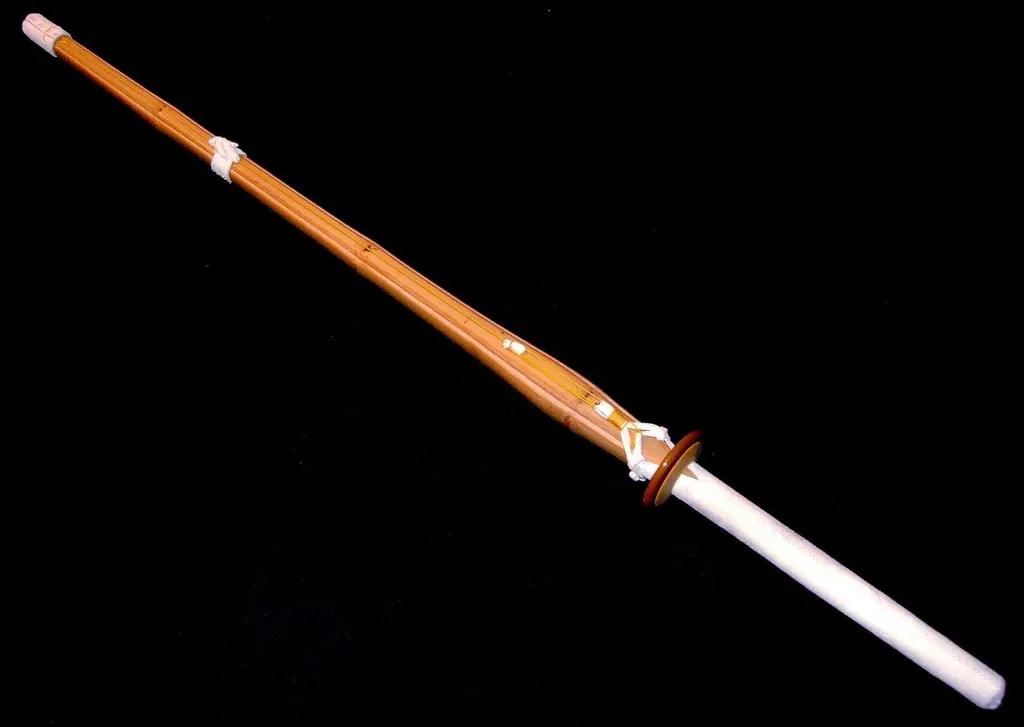
Image: Pacifier / Wikimedia Commons · CC BY-SA 3.0
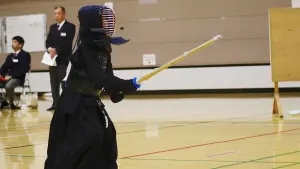
A shinai (竹刀) is the resilient practice sword used for armoured training and competition in Kendo. It is normally assembled from four bamboo slats with leather fittings and a cord, although current rules also permit approved synthetic substitutes. The shinai made committed paired practice safer than training with wooden or metal swords, but it is not harmless and is not simply a sporting stick. Its orientation represents a sword blade, its permitted striking portion is defined by rule, and its length, weight and diameter are regulated for competition. Regular inspection is essential because damaged bamboo, loose fittings or a broken tip can cause serious injury. Shinai standards vary by age, sex and one- or two-sword competition, so a single specification is not universal.
Overview
| Japanese | 竹刀 |
|---|---|
| Reading | しない |
| Romanisation | shinai |
| Meaning | Bamboo practice sword |
| Martial art | Kendo |
| Usual construction | Four bamboo slats with leather fittings and cord |
| Competition authority | AJKF and FIK regulations |
Name and meaning
The characters 竹刀 mean bamboo and blade or sword. “Bamboo sword” is the usual English gloss, although the completed implement combines bamboo or approved synthetic material with leather, cord and internal fittings.
The reading shinai is conventional and should not be replaced by the regular character reading chikutō. English sometimes calls it a “kendo stick,” but that wording obscures the blade orientation and sword-based conventions built into its use.
Construction and parts
The standard one-sword shinai has four longitudinal slats. The AJKF and FIK rules prohibit additional internal objects except the specified core inside the tip leather and the chigiri at the end of the handle.
Named parts include the sakigawa at the tip, sakishin inside it, tsuru cord, nakayui binding, tsukagawa handle leather, tsubadome and tsuba. The ken-sen is the point and the monouchi is the forward striking region.
Blade orientation and datotsu-bu
The cord marks the back of the represented blade. The jin-bu, or blade side, lies opposite the tsuru. Competition rules define the Yūkō-datotsu striking portion as the jin-bu centred on the monouchi.
This convention makes hasuji, the direction of the represented cutting edge, relevant even though a shinai has no sharpened edge. Correct orientation is therefore a technical and rules concept, not decorative terminology.
Historical development
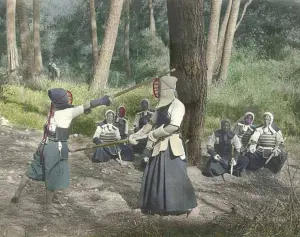
Japanese sword schools used earlier flexible training weapons, including covered split-bamboo forms. The AJKF history associates the spread of armoured bamboo-sword striking practice with eighteenth-century developments by teachers including Naganuma Shirōzaemon Kunisato and Nakanishi Chūzō Kotake.
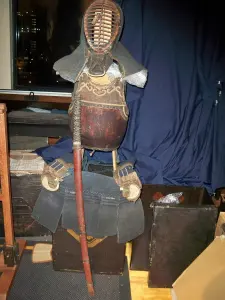
No single surviving design should be projected backward as the original shinai. Historical research shows changes in length, weight, protective equipment and technique through the late Edo and modern periods.
Shinai practice and kata
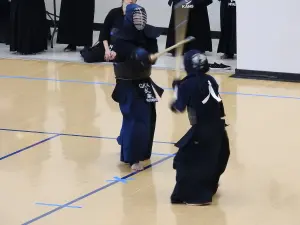
Shinai make free paired practice, drills and competition possible with Bōgu. They flex and distribute contact differently from wooden or metal swords, so their safety depends on controlled practice and correctly fitted equipment.
Nihon Kendō Kata normally uses bokutō rather than shinai. The two instruments support related but distinct training formats; competence with one does not erase the mechanical and safety differences of the other.
Competition standards
AJKF and FIK subsidiary rules regulate structure, total length, weight without the tsuba, tip diameter and the diameter of the bamboo body near the tip. Separate tables apply to age groups, men and women, and one-sword or two-sword use.
The tsuba must be circular, made from leather or synthetic material, no more than nine centimetres in diameter and fixed in place. Tournament inspection applies the current table, so practitioners should consult the event authority rather than rely on an undated universal number. Current standards researched: 2 September 2026.
One sword and two swords
Most practitioners use one shinai held with both hands. Nitō practice uses a long and short shinai and is recognised in the rules, with different size and weight standards from ittō or one-sword competition.
Nitō is not a separate scoring system: valid targets and yūkō-datotsu requirements still apply, while FIK and AJKF guidance addresses how the swords are held, inspected and judged. Local teaching access and age policies can differ.
Inspection and maintenance
The AJKF warns that broken slats can pass through the bars of a men and cause severe injury. Practitioners are asked to inspect for splinters, cracks, distortion, insect damage, loose accessories and incorrect nakayui position before, during and after use.
Inspection is not limited to a pre-tournament check. A shinai that has developed damage or deformation should be removed from practice and assessed by a qualified instructor or equipment specialist; improvised rearrangement of weakened slats can conceal rather than restore safety.
Relationship to the Japanese sword
The shinai represents a sword closely enough for blade line, point, monouchi and tsuba to retain technical meaning. Kendo rules and teaching use that convention to connect contact with principles of sword handling.
It does not reproduce the mass, rigidity, edge or injury potential of a Japanese sword. Claims that shinai competition directly demonstrates historical cutting performance should therefore be treated with caution.
Sources
- All Japan Kendo Federation, Regulations and Subsidiary Rules of Kendo Shiai and Shinpan.
- All Japan Kendo Federation, Junior High School Kendo Club Instruction Guide, revised edition.
- International Kendo Federation, Regulations of Kendo Shiai and Shinpan, revised 26 July 2023.
- All Japan Kendo Federation, Preventing Serious Accidents Involving Shinai Safety, 6 February 2026.
- All Japan Kendo Federation, Thorough Inspection of Shinai.
- Yoshio Kobayashi, An Introduction to the Historical Changes in Kendo Technique: Equipment and Technique, Research Journal of Budo.
Last updated: