
Karate
Karate Stances
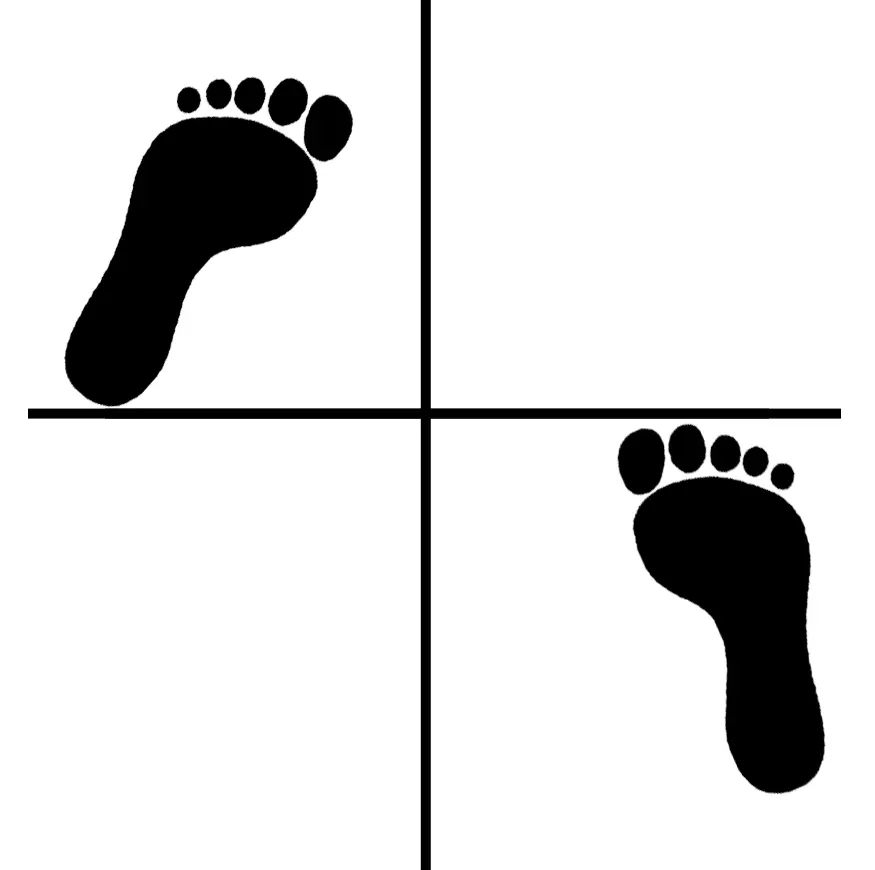
Image: Ben Bathen / Wikimedia Commons · CC0 1.0
Overview
A Karate stance is a temporary base inside movement—not a frozen pose.
Karate stances are named ways of organising the feet, legs, pelvis, and torso to support movement, technique, and balance. Japanese commonly describes the field as tachikata (立ち方, ways of standing), while individual compound names use -dachi. Foot position, weight distribution, and body orientation affect reach, stability, turning, force transfer, and the ability to continue. No single list or exact geometry is shared by all Karate schools. A diagram or paused posture is therefore an attributed teaching reference, not a universal template.
Support is created across the whole body.
The stance answers one technical moment and prepares the next.
- General term
- 立ち方 · tachikata
- Compound ending
- -dachi · stance
- Primary functions
- Support · balance · orientation
- Movement links
- Stepping · turning · weight transfer
- Training contexts
- Kihon · kata · kumite
- Variation comes from
- Style · body · purpose · period
01Tachi, dachi & names
The sound changes inside a compound; the teaching meaning still depends on context.
Names describe orientation, appearance, or association—not a complete set of instructions.
Tachi · 立ち
Standing or stance. Tachikata means ways of standing or stance methods.
-dachi
Voicing produces names such as zenkutsu-dachi, kiba-dachi, and sanchin-dachi; romanisation may be joined or hyphenated.
The same label may refer to different foot angles or weight distributions in different schools. Always identify the organisation or lineage behind a diagram.
02Function of a stance
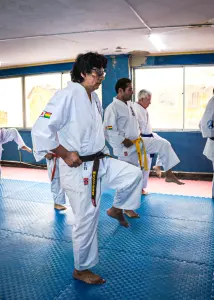
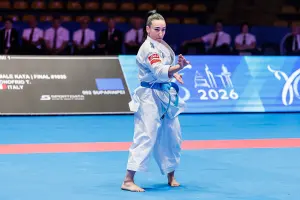
A stance is judged by what it supports before and after the photograph.
Length or depth may be exaggerated in basics to develop control.
Manage the centre
Keep the body organised over a usable base.
Connect ground and action
Feet, legs, and torso coordinate force without trapping movement.
Face line and angle
Reach, target access, and receiving change with body direction.
Prepare the next action
A paused stance is incomplete if it prevents the next step, turn, or response.
Kumite may use a higher, narrower, and more mobile posture. That adaptation does not make clear basic stance training irrelevant; the formats expose different movement problems.
03Front- and back-weighted stances
Direction of support is a tendency, not a universal percentage.
Length, width, foot angle, pelvis, and tactical purpose differ among methods.
Zenkutsu-dachi · 前屈立ち
Commonly places greater support toward the front leg and is widely used for advancing fundamentals.
Kōkutsu-dachi · 後屈立ち
Places greater emphasis toward the rear leg in Shotokan and related systems; comparable positions may be named or organised differently elsewhere.
04Lateral and square stances
Similar width does not make two stances interchangeable.
Foot direction, knees, pelvis, loading, and intended movement distinguish the method.
Kiba-dachi · 騎馬立ち
A broad lateral position whose alignment and depth vary by style.
Shikō-dachi · 四股立ち
Turns the feet outward and is especially prominent in several Okinawan-derived systems.
Naihanchi Shodan provides a wider kata context for Naihanchi-dachi and shows why proportion must be tied to a lineage.
05Short and specialised stances
Some positions develop a particular body method or mark a transition.
They need not be everyday fighting postures to be technically meaningful.
Sanchin-dachi
Central to Sanchin practice in Gōjū-ryū and related traditions; the JKF notes style-specific foot placement.
Neko-ashi-dachi
Lightens the forward foot and prepares direction change or a specific technique.
Sagi-ashi-dachi
Supports the body mainly on one leg and develops balance or a kata transition.
Seishan-dachi
The page’s lead diagram is explicitly one Wadō-ryū model, not a universal geometry.
06Stances and movement
The transition may contain the most important technical information.
The centre of mass must travel while the next action remains available.
Unsoku
Stepping, sliding, turning, and changes of height connect named positions.
Tai sabaki
The body changes relation to line, angle, and partner.
Arrive ready to continue
Support should enable receiving, attacking, or moving again.
07Kihon, kata, kumite & biomechanics
Different settings select different proportions from the same movement resources.
Research informs training without establishing one optimal stance for every body.
Kihon
Isolates stance form and transition for clear observation.
Kata
Preserves style-specific stepping, turning, and weight shift.
Kumite
Uses mobile posture against a changing partner and distance.
Balance and joint demand
Studies model whole-body demands but do not prescribe one safe depth for everyone.
Age, mobility, injury history, anatomy, and purpose affect safe depth and duration. Instruction should be adapted rather than forcing a student into a visual template.
Sources and further reading
- All Japan Karatedo Federation, Karate Terminology Dictionary.
- All Japan Karatedo Federation, Ayumi Vol. 3: Basic Karate Techniques.
- Japan Karate Association, Instructor Technical Manual.
- Japan Karate Association, Dan Ranking and Grading Syllabus.
- Vando et al., Effectiveness of Karate Training on Dynamic Balance, PubMed.
- PubMed, Biomechanical and Functional Analysis of Gōjū-ryū Karate Stances, 2025.
Last updated:
.jpg)