
Karate
Yoko-geri
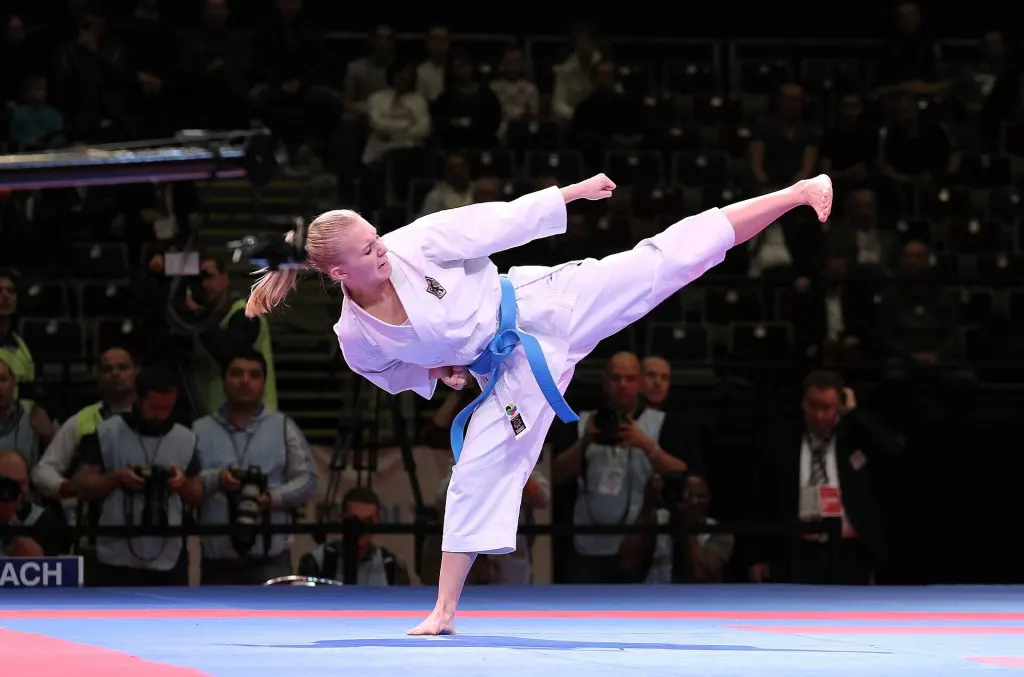
Image: Claus Michelfelder / Wikimedia Commons · CC BY-SA 4.0
Overview
Yoko-geri is a side-directed family, not one mechanically identical kick.
Yoko-geri (横蹴り) means side kick. The broad name establishes a sideward relationship between the practitioner and the target, while detailed mechanics belong to the named style and version. The Japan Karate Association separates yoko-keage, a side snap kick, from yoko-kekomi, a side thrust kick, and identifies sokutō, the outer edge of the foot, in both models. That distinction is a useful documented reference, not a universal rule for every Karate school. Support, chamber, sideward path, contact, retraction, and landing must be read as one organised sequence.
The broad direction is the stable point of comparison.
The lower leg releases and retracts quickly.
The leg drives along a more penetrating line.
- Japanese
- 横蹴り
- Reading
- よこげり
- Reference meaning
- Side kick
- Classification
- Geri · kicking technique
- JKA variants
- Yoko-keage · yoko-kekomi
- JKA surface
- Sokutō · outer edge of the foot
01Name & scope
“Side kick” gives the orientation before it gives the mechanism.
A complete description should name the version, school, drill, or competitive context.
Common spellings include yoko geri and yokogeri. The broad compound does not decide whether the action snaps, thrusts, appears in kata, begins from a formal stance, or adapts to a moving opponent.
02Snap & thrust models
The JKA distinction is precise when its institutional boundary remains visible.
Both versions travel sideward, but their release and intended line are not interchangeable.
Side snap kick
The lower leg releases and retracts quickly from an organised chamber. The path is taught as a sharper snapping action.
Side thrust kick
The leg drives along a more penetrating line before controlled retraction. The supporting side must remain recoverable.
These definitions come from the JKA technical manual. Other traditions may choose different surfaces, paths, or terminology even when they use the same broad name.
03Supporting side & balance
The standing leg creates room for the kicking hip to face the side.
Foot, knee, hip, trunk, and vision organise the line before the leg extends.
Turns as the version requires
No single angle fits every body, school, target, or training task.
Carries the moving centre
Comfortable alignment matters more than forcing a decorative endpoint.
Open without losing recovery
The JKA cautions against excessive backward lean in its model.
Keep the target relationship
A side-facing action still belongs to a larger tactical and safety problem.
04Chamber, surface & recovery
The chamber changes shape with the version, but control remains continuous.
Contact surface and return path should be taught with the direction rather than added afterwards.
Shorten and organise the leg
Height and shape differ among keage, kekomi, kata, and school-specific forms.
Sokutō in the JKA model
The outer edge of the foot is organisation-specific, not a universal prescription.
Retract before landing or continuing
Control preserves balance and prevents the endpoint from becoming a fall through the target.
05Compare the geri family
Sideward is different from forward, curved, and directly backward.
Direction is the first distinction; school mechanics supply the second.
The knee folds before the lower leg opens toward a target in front.
Sideward lineYoko-geri横蹴りA side-directed family that may separate snapping and thrusting models.
Curved approachMawashi-geri回し蹴りThe kicking leg approaches the target along an arc from the side.
Backward lineUshiro-geri後ろ蹴りThe body turns and the leg or heel drives directly behind the practitioner.
06Kihon, kata & kumite
Each training format reorganises the same sideward problem.
The visible chamber and trunk angle reflect the task as well as the technique name.
07Curriculum, evidence & safety
A syllabus documents one organisation; a competition study documents one sample.
Neither establishes a worldwide sequence or universal popularity.
Keage and kekomi appear from 7th kyu
Later combinations continue to use yoko-geri kekomi. This shows one Shotokan organisation’s progression, not a requirement for all Karate.
One of nine coded techniques
A JKF research abstract analysed 56 men’s matches. Its bounded dataset records competitive presence without prescribing ideal mechanics.
Sources and further reading
Last updated:
_019.JPG)