Karate
Ushiro-geri
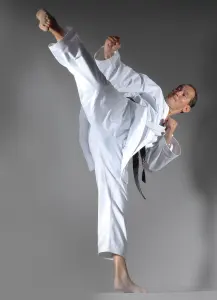
Image: Sdcsabac / Wikimedia Commons (video frame) · CC BY-SA 4.0
Overview
Ushiro-geri combines a turn with a direct backward kick—not a circular return.
Ushiro-geri (後ろ蹴り) is Karate’s back kick. The All Japan Karatedo Federation describes a practitioner who begins facing an opponent, turns the body, and attacks backward with the kicking leg or heel. Its defining line is direct rather than circular, which distinguishes it from ushiro-mawashi-geri. The turn also creates a real trade-off: visual contact may be interrupted and the back may be exposed before the kick or after a miss. Orientation, target awareness, chamber, backward drive, retraction, landing, and restored vision therefore form one movement problem.
Distance, target, and partner role are established first.
The leg or heel follows a back line rather than a circle.
Balance and awareness complete the action.
- Japanese
- 後ろ蹴り
- Reading
- うしろげり
- Reference meaning
- Back kick
- Classification
- Geri-waza · kicking technique
- Defining relation
- Turn, then direct backward line
- Important distinction
- Not ushiro-mawashi-geri
01Name & direction
The compound identifies a kick delivered behind the practitioner.
Direction is stable; chamber, contact, entry, and landing remain contextual.
The common spaced spelling is ushiro geri. The name does not prescribe one chamber height, stance, heel position, amount of torso inclination, or tactical entry for every Karate tradition.
02Turn & orientation
The turn must create a backward line without turning awareness into guesswork.
Head, foot, pelvis, and target relationship need to be coordinated before speed is added.
Know the target and distance
The JKF reference begins from a face-to-face relationship, giving the turn a clear point of departure.
Coordinate head, pivot, and hip
A larger spin is not automatically better; the aim is a usable line with balanced support.
Recover visual contact
Retraction and landing should return awareness as well as stance.
03Direct line & support
Backward does not mean circular.
The supporting side carries the body while the chambered leg extends behind.
Permits the change of orientation
Pivot and angle vary with the person, version, and starting stance.
Carry the turn
Forced rotation or excessive lean can make the landing unstable.
Drive along a back line
The JKF wording allows both while schools refine foot position differently.
Stay connected to recovery
The trunk should not outrun the base or leave the practitioner unable to stop.
04Retraction, landing & vision
The kick is incomplete until stance and awareness return.
Recovery limits the exposure identified in the official description.
Bring the leg back under control
Do not let extension carry the centre beyond the support that remains available.
Choose a stable continuation
School and drill determine whether the foot returns, steps through, or connects elsewhere.
Restore the partner relationship
Visual awareness and guard matter after a miss as much as after contact.
05Compare the geri family
Ushiro-geri is the direct backward member of the four-way comparison.
Its turn distinguishes the entry; its straight back line distinguishes the path.
The knee folds before the lower leg opens toward a target in front.
Sideward lineYoko-geri横蹴りA side-directed family that may separate snapping and thrusting models.
Curved approachMawashi-geri回し蹴りThe kicking leg approaches the target along an arc from the side.
Backward lineUshiro-geri後ろ蹴りThe body turns and the leg or heel drives directly behind the practitioner.
06Kihon & partner practice
Training should separate orientation, extension, and recovery before recombining them.
A controlled sequence makes balance and temporary loss of vision observable.
Kihon
Practise turn, chamber, direct extension, retraction, landing, and restored guard without contact first.
Partner practice and kumite
Define target, range, speed, equipment, and stopping point before the turn reduces visual contact.
JKA grading material places ushiro-geri in moving basics at 3rd Dan and a kicking sequence at 4th Dan. This is one Shotokan organisation’s syllabus, not a universal rank requirement.
07Technical literature & distinction
Evidence about ushiro-mawashi-geri must not be reassigned to direct ushiro-geri.
The similar names describe different paths and therefore different evidence.
Classifies ushiro-geri as a direct back kick
The review illustrates leg- and heel-led versions while placing timing findings inside their stated participants and methods.
One world-level ushiro-mawashi-geri athlete
Its phase analysis concerns the circular reverse-roundhouse technique and cannot define the direct back kick on this page.
Sources and further reading
Last updated: