Martial Arts
Sambo
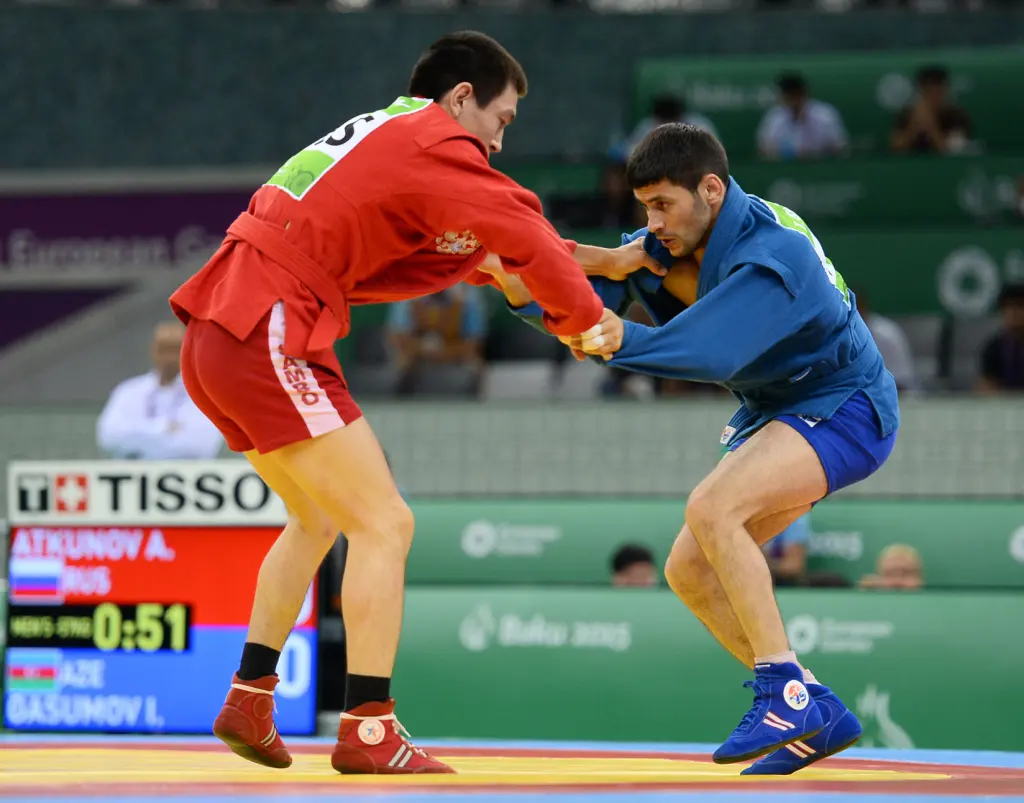
Image: Presidential Press and Information Office (President.az) / Wikimedia Commons / President.az · CC BY 4.0
Overview
Several sources entered one Soviet synthesis.
Sambo is a Soviet-developed martial art and combat sport whose name abbreviates a Russian phrase meaning “self-defence without weapons”. It took institutional form in the 1920s and 1930s through several teachers and organisers, especially Viktor Spiridonov, Vasily Oshchepkov, and Anatoly Kharlampiev. Judo was an important source: Oshchepkov trained at the Kodokan in Japan and later taught and adapted its methods in Russia. Sambo also drew on applied self-defence, regional wrestling traditions, and other combat systems within Soviet physical culture. Modern international competition distinguishes Sport Sambo, Combat Sambo, and Beach Sambo, whose equipment, permitted actions, and winning conditions differ. The Kodokan connection is direct, but it is one input—not the whole ancestry.
Carried by Oshchepkov’s study and teaching.
Associated especially with Spiridonov’s work.
Regional and international techniques studied in Soviet settings.
State sport, pedagogy, organisation, and continued technical comparison.
- Russian
- самбо
Sambo - Name derived from
- Samozashchita bez oruzhiya
self-defence without weapons - Formed in
- Soviet Union
- Key early figures
- Spiridonov, Oshchepkov, and Kharlampiev
- Official formation date
- 16 November 1938
- International body
- International SAMBO Federation (FIAS)
01Formation frame
Related projects converged through Soviet institutions.
Early programmes did not begin with one fixed name or one jointly designed syllabus. “Sambo” became the stable label after several streams of wrestling, pedagogy, self-defence, and state organisation had interacted.
- 1913–1914
Oshchepkov’s Kodokan bridge
FIAS records Oshchepkov’s first dan in 1913 and a Judo group opened in Vladivostok after his return from Japan.
- 1920s–1930s
Comparative programmes
Oshchepkov taught broader jacket wrestling while Spiridonov developed applied self-defence for security and military contexts.
- 16 Nov 1938
Official recognition
A Soviet state sports order recognised the development of the system then described as free-style wrestling; this date is commemorated as Sambo’s official birthday.
- 1940s onward
Name, sport, and institutions
The Sambo label stabilised, while teaching, competition, international exchange, and specialised formats continued to develop.
02Contributor map
“Founder” becomes clearer when divided into contributions.
Institutional histories and commemorations often privilege different figures. A contribution map preserves their importance without forcing a single-parent genealogy.
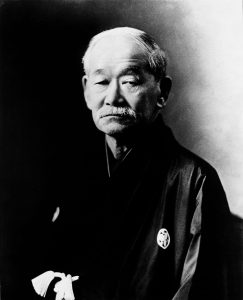
Vasily Oshchepkov
Connected Kodokan study to teaching, experimentation, and jacket wrestling in the Russian Far East and Moscow.
Viktor Spiridonov
Developed practical methods in military and security settings through a related but not identical project.
Anatoly Kharlampiev
Studied under Oshchepkov and became an influential teacher, systematiser, organiser, and public advocate.
Official histories also name many other participants and sources. Lists of Georgian chidaoba, Armenian kokh, Mongolian bökh, French wrestling, savate, Jujutsu, and Judo indicate comparative study—not a precise family tree for every technique.
03Three competitive forms
Shared name, different permitted actions.
FIAS publishes current documents for each form. The descriptions below orient the reader; they do not replace the latest rulebook.
Sport Sambo
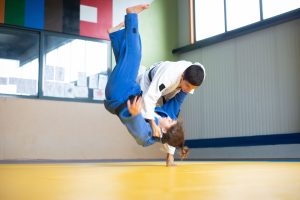
Throws, positional control, pins, and permitted submissions. Clean controlled throws and leg attacks give the format a distinctive profile.
Combat Sambo
Adds regulated strikes, further protective equipment, and a broader combat framework under its own competition rules.
Beach Sambo
A shorter-format contest on sand with different clothing, bout structure, and winning conditions.
For current scoring, equipment, age divisions, technical restrictions, and event procedure, use the FIAS documents and rules hub.
04Uniform & technical chain
Standing attacks and groundwork form one continuous contest.
Sport Sambo’s red or blue kurtka, matching shorts, belt, and soft shoes create grips and movement options distinct from a Judo gi. Combat and Beach formats use their own equipment.
Grip or body lock
Use jacket openings, belt, posture, and direct body control to organise the attack.
Trip, throw, or counter
Combine leverage, rotation, sacrifice, and reaction rather than isolate one named throw.
Transition immediately
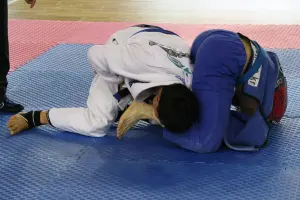
Maintain control as the standing exchange becomes a pin or submission opportunity.
Pin, lock, or restart
Apply what the specific format and current rules permit.
A Japanese study of elite competition found frequent standing-to-ground combinations and cautioned that familiar Judo technique names do not make the sports tactically identical.
05Sambo & Judo
The historical link is direct; the modern rules are independent.
Oshchepkov’s Kodokan education establishes more than a resemblance between throwing systems. Subsequent Soviet organisation, other sources, and competition rules make Sambo its own tradition.
Judo contribution
Jacket grips, throwing principles, pins, joint control, pedagogy, and a documented teacher’s education entered the developing Soviet project.
The connection belongs in a lineage map as transmission and reorganisation.
Sambo development
Regional wrestling, self-defence programmes, Soviet physical culture, kurtka grips, scoring, transitions, and legal submissions changed the tactical system.
The comparison is strongest when it names the exact ruleset and period.
06International development & Japan
Knowledge travelled from Japan, changed abroad, and returned as a new sport.
FIAS’s institutional chronology makes Sambo a useful example of circulation rather than one-way export.
- 1963
Association in Japan
FIAS records the establishment of a Sambo association in Japan, bringing the Soviet-developed sport into a country central to one of its source traditions.
- 1966
International wrestling recognition
The International Federation of Associated Wrestling Styles recognised Sambo as an international wrestling style.
- 1973
First World Championship
A world championship strengthened the sport’s international competition structure.
- 1984 onward
Independent federation pathway
An international Sambo federation was created, and later governance developed through FIAS and national bodies.
Later contact with Mixed Martial Arts in Japan is better described as a network of athletes, techniques, and contest formats than as one founder-to-student succession.
Sources and further reading
- International SAMBO Federation, History of SAMBO.
- International SAMBO Federation, Vasily Sergeevich Oschepkov.
- International SAMBO Federation, Documents and Current Competition Rules.
- Matsumoto, Hiro, and Hamano, A Study on the Skills of the Russian Martial Art Sambo—Comparison of Sambo and Judo.
- Enemy at the Gates: Soviet Sambo and the US Martial Arts Community, 1964–1980.
Last updated: