Judo
Shichitei Judo
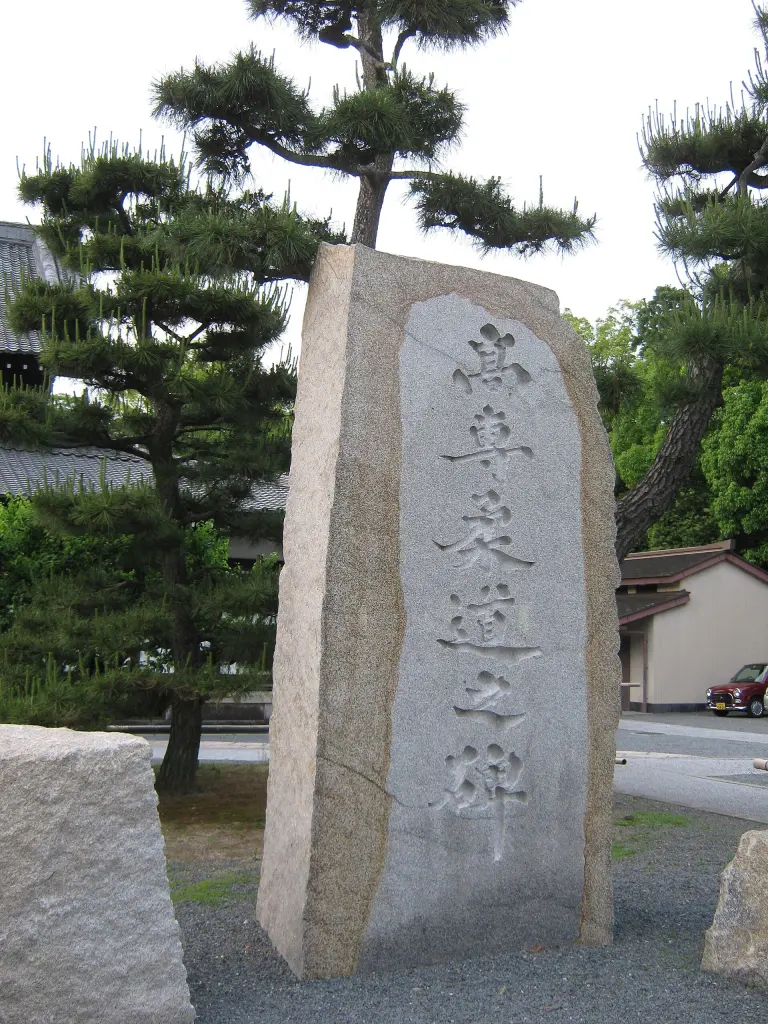
Image: mariemon / Wikimedia Commons · CC BY 3.0
Overview
A team queue changes what one Judo bout is worth.
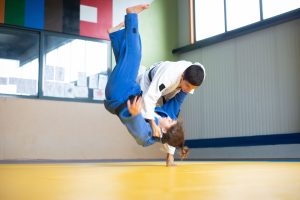
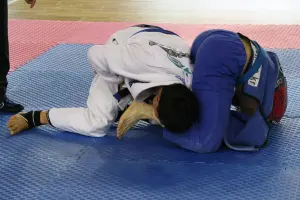
Shichitei Judo is the university Judo tradition maintained by Japan’s seven former Imperial Universities. Its annual competition descends from prewar Kosen Judo and gives considerably more room to enter and continue ne-waza than mainstream international contests. A team selects fifteen competitors: after a decisive win, the winner remains to meet the opponent’s next player; after a draw, both leave the contest. This makes order, specialist roles, stamina, and the ability to hold or remove a particular opponent central to team strategy. Guard work, turnovers, pins, strangles, elbow locks, and standing throws all belong to the game. Shichitei Judo is not a separate classical school—it is a collegiate rules culture within modern Kodokan Judo.
A1 · A2 · A3 · … · captain
Decisive winner remains
Draw → both leaveB1 · B2 · B3 · … · captain
- Japanese
- 七帝柔道
Shichitei Jūdō - Also known as
- Seven Universities Judo
- Historical root
- Prewar Kosen Judo competition
- Participants
- Seven former Imperial Universities
- Typical contest
- 15-person elimination teams
- Technical emphasis
- Ne-waza and team strategy
01Historical frame
Competition rules carried Kosen practice into a new university system.
The continuity is institutional and embodied: students, alumni, club coaching, annual contests, rules, books, and monuments transmit a distinctive interpretation of Judo’s ground game.
- Early 20th c.
Kosen Judo contests
Japan’s higher-school competitions became known for rules that allowed freer entry into groundwork and longer continuation than many later formats.
- Postwar
School-system reorganisation
The old higher schools disappeared, but practitioners and alumni carried tactics, terminology, and competitive memory into successor universities.
- 1952
Seven-university competition begins
The rules’ preamble dates the Seven Universities Judo Competition from 1952 and identifies the older Kosen tournament as its foundation.
- Present
Living annual practice
Rotating hosts, student teams, alumni, published regulations, and recurring competition keep the tradition active rather than merely archival.
02The seven universities
Seven clubs maintain one shared rule community.
Each university has its own coaching relationships and training culture. The annual contest joins them through common regulations, hosting, rivalry, and alumni memory.
- 01Hokkaido University
- 02Tohoku University
- 03The University of Tokyo
- 04Nagoya University
- 05Kyoto University
- 06Osaka University
- 07Kyushu University
03Elimination-team format
The result decides who appears in the next bout.
The commonly described men’s contest selects fifteen competitors from a twenty-player team registration. Year-specific regulations and division formats take precedence over any short summary.
Winner remains
A bout is decided by ippon, two waza-ari, or specified rule decisions. The winner faces the next opposing player.
Both competitors leave
Removing a dangerous opponent can therefore be strategically valuable even without an individual win.
Exhaust the opposing order
The team with an eligible competitor after the other side’s order is depleted takes the match, subject to current rules.
The linked Seven Universities competition rules are the controlling reference for bout time, scoring, eligibility, representative contests, and technical restrictions.
04Rules & ne-waza
Longer ground exchanges make preparation visible.
Shichitei rules preserve routes into groundwork and allow sustained action when a credible technical exchange continues. Standing throws remain decisive, but competitors must be able to attack and defend through extended positions.
Adopt a low posture, connect after a throw, or use a permitted route into ground engagement.
Build frames and attacks underneath, or clear the legs and settle top pressure.
Reverse the relationship or expose an opponent to immobilisation.
Apply the scoring and submission methods permitted by the current rules.
“More groundwork” does not mean “no standing Judo”. A clean throw can still remove an opponent immediately, and poor standing preparation can concede the initiative before ne-waza begins.
05Team strategy
A draw can be a job well done.
Because the next pairing depends on the result, team need can outweigh an individual preference for an open attacking match.
An attacking specialist may be placed where one decisive run can change the entire order.
A defensive specialist can protect a lead or trade themselves for a dangerous opponent through a draw.
Body type, fatigue, bout length, and the remaining queue affect the desired matchup.
Positional rounds, escapes, transitions, and team scenarios prepare decisions beyond isolated technique.
Coaches weigh probable matchups, specialist functions, and the score before submitting the sequence.
06Judo context
One technical tradition can support several competitive expressions.
Uniform, rank, throwing, falling, pins, chokes, and joint-control concepts belong to modern Judo. Rules select and intensify different parts of that broad curriculum.
Mainstream Judo
Current federation scoring, grips, transitions, penalties, and stoppages create a faster contest rhythm and a different strategic balance.
Shichitei Judo
Elimination teams and sustained ne-waza reward guard, positional patience, specialist roles, and strategic draws.
Brazilian Jiu-Jitsu
Technical overlap makes comparison useful, but origin, scoring, clothing rules, rank culture, and team strategy are not identical.
Sources and further reading
- Hokkaido University Judo Club, Introduction to Shichitei Judo.
- Hokkaido University Judo Club, Training and Rules.
- Seven Universities Judo Competition Rules.
- University of Tokyo Judo Club, What Is Shichitei Judo?.
- National Diet Library, History of the National Seven Universities Judo Competition.
- Japan Society of Sport Sociology, Old Higher School Sports and Kosen Judo.
- All Japan Judo Federation, History.
Last updated: