Judo
Brazilian Jiu-Jitsu
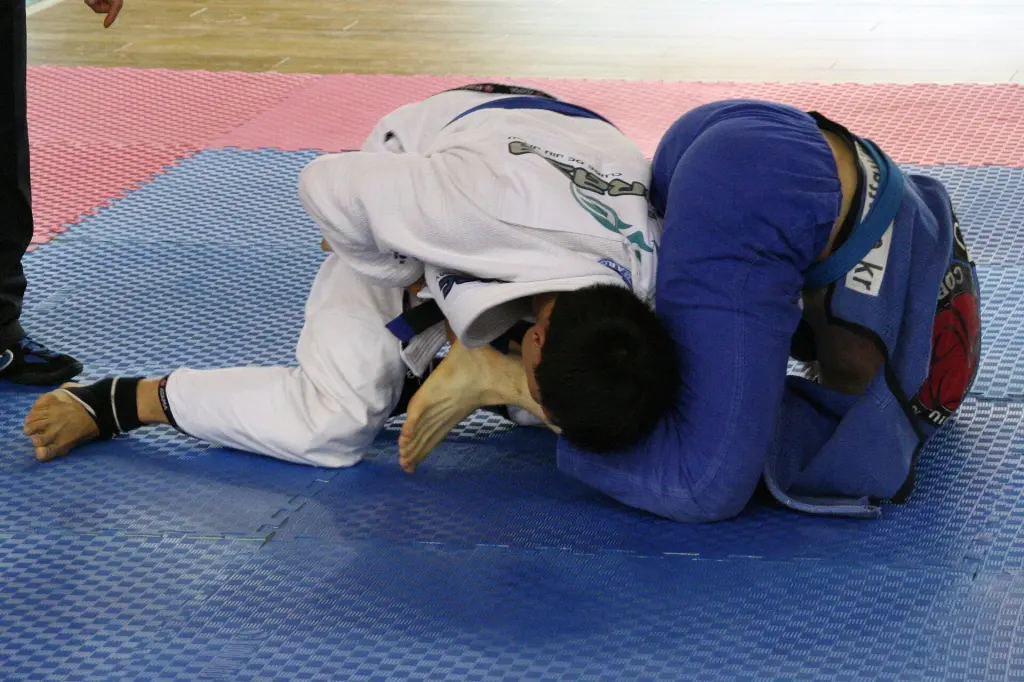
Image: parhessiastes / Wikimedia Commons / Flickr · CC BY-SA 2.0
Overview
Position creates choices; control makes them usable.
Brazilian Jiu-Jitsu (BJJ) is a Brazilian grappling art and combat sport built around positional control, ground fighting, and submission holds. Its strongest Japanese connection runs through Kodokan judoka such as Mitsuyo Maeda, who reached Brazil in the early twentieth century, but Brazilian teachers, academies, rules, challenge culture, and competitors transformed the material locally. In practice, students connect standing entries to guard, passing, sweeps, dominant positions, escapes, and submissions through drilling and resistant sparring. Gi and no-gi formats share many problems while rewarding different grips and pacing. BJJ is therefore neither unchanged Japanese jūjutsu nor the invention of one person, and no single rules organisation governs every academy or tournament.
Use stance, grips, clinch, takedown, or a deliberate guard entry.
Change the position before the opponent settles their advantage.
Use side control, mount, back control, or a strong guard structure.
Finish legally, consolidate points, or survive and rebuild position.
- Portuguese name
- Jiu-jitsu brasileiro
- Developed in
- Brazil
- Japanese roots
- Kodokan Judo and wider jūjutsu transmission
- Early transmitter
- Mitsuyo Maeda and other Japanese practitioners
- Technical focus
- Position, ground control, chokes, and joint locks
- Common formats
- Gi and no-gi practice and competition
01Transnational frame
Japanese transmission became a Brazilian reinvention.
A useful history follows people, institutions, language, rules, and promotion rather than treating familiar techniques as proof of one uninterrupted lineage.
- 1882 onward
Kodokan Judo develops
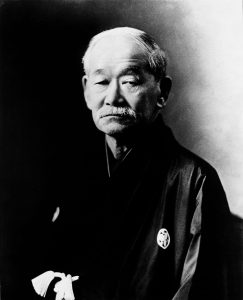
Jigoro Kano reorganised older jūjutsu study into the Kodokan’s educational, technical, and competitive system.
- 1914
Maeda reaches Brazil
Mitsuyo Maeda, a widely travelled Kodokan judoka and professional fighter, became an important bridge into Brazilian combat culture.
- 20th century
Academies and challenge culture
Carlos and Hélio Gracie and their relatives became influential teachers and promoters, while other Japanese and Brazilian groups also shaped the field.
- 1990s onward
Global sport and MMA
Early Ultimate Fighting Championship success increased international visibility; tournaments and submission-grappling circuits accelerated gi and no-gi specialisation.
02Positional landscape
“Top” and “bottom” describe problems, not fixed winners.
Rules commonly reward positional improvement, but every position combines attack, defence, transition, and time. Naming the position helps partners isolate the problem.
Standing & clinch
Balance, grips, takedowns, throws, and guard entries decide how the ground exchange begins.
Guard & passing
The lower player frames, controls distance, sweeps, or submits; the upper player clears legs and consolidates control.
Side · mount · back
Pressure, alignment, wedges, and hooks limit escape while creating scoring or submission opportunities.
Submissions
Chokes, strangles, arm locks, and ruleset-dependent leg locks end a bout when applied and acknowledged legally.
Being underneath is not automatically equivalent to being pinned in Judo. A working guard may still control distance and create sweeps or submissions, while a passed guard can expose stronger top control.
03Training loop
Reduce the problem, add resistance, then reconnect the whole game.
Class structure varies by academy. The common logic is to move between explanation, constrained repetition, positional resistance, and open sparring rather than learn technique only as choreography.
Technical study
Identify purpose, grips, alignment, safety, and likely reactions.
Drilling
Build a reliable pathway with a cooperative partner and clear stopping points.
Positional rounds
Start from one defined situation and repeat attack, defence, escape, or control.
Rolling
Connect standing, transitions, positions, and submissions against adaptive resistance.
04Two clothing systems
Removing the gi changes the control vocabulary, not the need for control.
Many academies teach both. Training balance, event rules, wrestling emphasis, and available submissions can differ considerably.
Gi
Collars, sleeves, trousers, and jacket fabric create additional handles for posture breaking, passing, guard retention, and submissions.
Slower-looking exchanges can still contain intense grip fighting and incremental positional pressure.
No-gi
Without clothing grips, practitioners rely more on body locks, underhooks, overhooks, head position, and direct limb control.
Pacing and wrestling exchanges often change, while rulesets may give leg attacks a different place.
05Competition & rank
One sport name contains several rule environments.
The International Brazilian Jiu-Jitsu Federation is highly influential, but it does not govern every event or lineage. Always check the current organiser’s rules for uniform, scoring, match length, penalties, and legal submissions.
Takedowns, sweeps, passing, mount, and back control may carry points when the rules’ control criteria are met.
A legal choke or joint lock normally overrides the current point total.
Age, rank, clothing format, and organiser can change which attacks are permitted.
Adult belts commonly progress white, blue, purple, brown, and black, but promotion is instructor- and organisation-mediated.
Points, advantages, boundaries, and time can make the same position strategically different across events.
06Origin cautions
A bridge is not the whole city.
Maeda is a well-documented bridge, and the Gracie family was central to promotion and development. Neither fact requires a one-teacher, one-family origin story.
Kodokan transmission
Maeda’s Judo education, travel, professional contests, and Brazilian activity connect the Kodokan world to later Brazilian practice.
Brazilian reinvention
Academies, rivalries, publicity, race, class, immigration, rules, and competition reshaped what counted as jiu-jitsu in Brazil.
One straight lineage
The route Fusen-ryū → Mataemon Tanabe → Maeda → BJJ is too simple to explain all Kodokan groundwork or Brazilian development.
Sources and further reading
- International Judo Federation, History: Maeda Mitsuyo and Judo Abroad.
- José Cairus, Nationalism, Immigration and Identity: The Gracies and the Making of Brazilian Jiu-Jitsu.
- Ben Penglase, The Invisibility of Race in Brazilian Jiu-jitsu.
- International Brazilian Jiu-Jitsu Federation, Rule Book and Rules Resources.
Last updated: