Performing Arts
Kanadehon Chūshingura
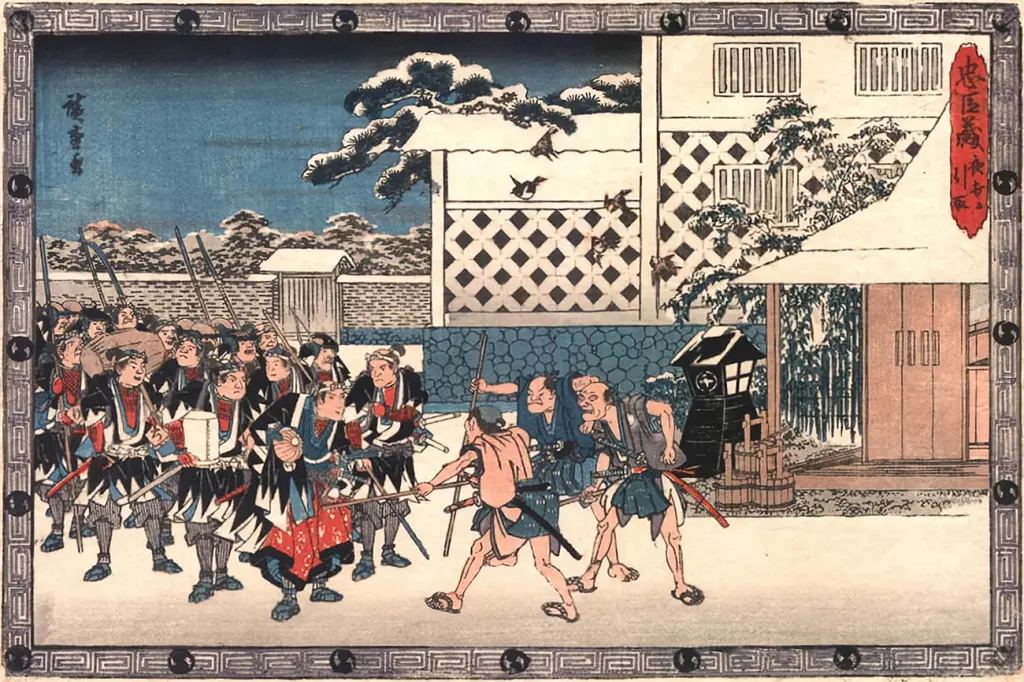
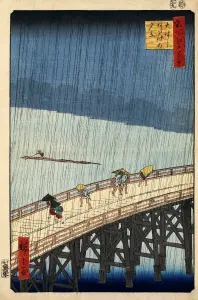
Image: Utagawa Hiroshige / Wikimedia Commons · Public domain
Overview
A revenge plot with many lives at stake.
Kanadehon Chūshingura (仮名手本忠臣蔵) is an eleven-act Japanese drama first performed by the puppet theatre in Osaka in 1748 and adapted for kabuki within the same year. Written by Takeda Izumo II, Miyoshi Shōraku, and Namiki Senryū I, it draws on the Akō affair of 1701–1703 while relocating events to an earlier historical world and changing the participants’ names. The plot follows dispossessed retainers preparing revenge, but much of its dramatic force comes from the consequences for families, lovers, and other people around them. Its long life in both puppet theatre and kabuki makes it a major example of a story transmitted through different performance traditions.
The Akō affair provides a historical point of departure.
Changed names and family stories create a theatrical world.
Puppet theatre and kabuki transmit the work in different forms.
At a glance
- Japanese title
- 仮名手本忠臣蔵
- First production
- Osaka puppet theatre, 1748
- Authors
- Takeda Izumo II, Miyoshi Shōraku, Namiki Senryū I
- Structure
- Eleven acts
- Dramatic setting
- An earlier world associated with the Taiheiki
- Historical background
- The Akō affair of 1701–1703
01
The 1748 play
The drama premiered at Osaka’s Takemoto-za in 1748. Kabuki versions followed within months, beginning a history in which the work belonged to both actor-centred and puppet-based performance. Its collaborative authorship and movement between theatres are important: the familiar title identifies a dramatic work and repertory, not a direct transcript of the historical incident that inspired it.
02
History and transformation
The play transforms the Akō affair through substituted names and a setting associated with the fourteenth-century Taiheiki world. Enya Hangan corresponds to Asano Naganori, Kō no Moronō to Kira Yoshinaka, and Ōboshi Yuranosuke to Ōishi Kuranosuke. These correspondences help orient a reader, but theatrical motives and episodes must not automatically be treated as evidence about the historical people.
Asano Naganori
- Dramatic counterpart
- Enya Hangan
- Role in the play
- Lord whose punishment sets the crisis in motion
Kira Yoshinaka
- Dramatic counterpart
- Kō no Moronō
- Role in the play
- Antagonist and eventual target
Ōishi Kuranosuke
- Dramatic counterpart
- Ōboshi Yuranosuke
- Role in the play
- Leader of the revenge preparations
03
The dramatic arc
Moronō’s provocation leads Hangan to draw his sword. Hangan is compelled to die by seppuku, leaving his retainers without their lord. Yuranosuke then conceals his preparations for revenge. The final raid supplies the outward resolution, but the route to it is deliberately indirect: misunderstandings, divided obligations, and private losses occupy much of the eleven-act structure.
04
Lives around the revenge
Kanpei and Okaru’s story makes the consequences of the crisis intimate and painful. Other episodes follow Honzō, Tonase, and Konami through obligations involving marriage and family. These characters are essential to the work’s emotional scale. A summary concerned only with loyal warriors and the final attack misses the play’s sustained attention to people who bear costs without controlling the larger plan.
05
Puppets and kabuki
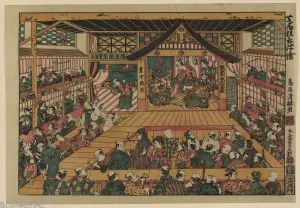
The kabuki adaptation retains visible connections with puppet drama. The Japan Arts Council identifies it as gidayū kyōgen and describes the formal opening sequence in which actors raise their heads as their characters are introduced, recalling puppet presentation. Narration, music, and the actor’s controlled response work together. The relationship is therefore more substantial than two theatres simply using the same plot. The Bunraku entry explains the narrator, shamisen, and puppeteers in greater detail.
06
Selected acts on stage
Modern programmes frequently present selected acts rather than all eleven. The seventh act, set at the Ichiriki teahouse in Gion, turns Yuranosuke’s apparent pleasure-seeking into a scene of concealment and observation. Knowing which act is being performed helps a spectator follow the immediate relationships without expecting the entire revenge story to unfold in one sitting.
07
Afterlives and interpretation
The play helped make the Akō story a lasting cultural narrative, but its popularity does not establish a single timeless meaning of loyalty. Historical inquiry, theatre history, and later retellings ask different questions. Hiroshige’s print shown here belongs to the work’s visual afterlife: it illustrates a scene associated with the concluding act and should be read as an interpretation of drama, not an eyewitness record of the 1702 raid.
Sources
Last updated: