Japanese Writing
Hiragana
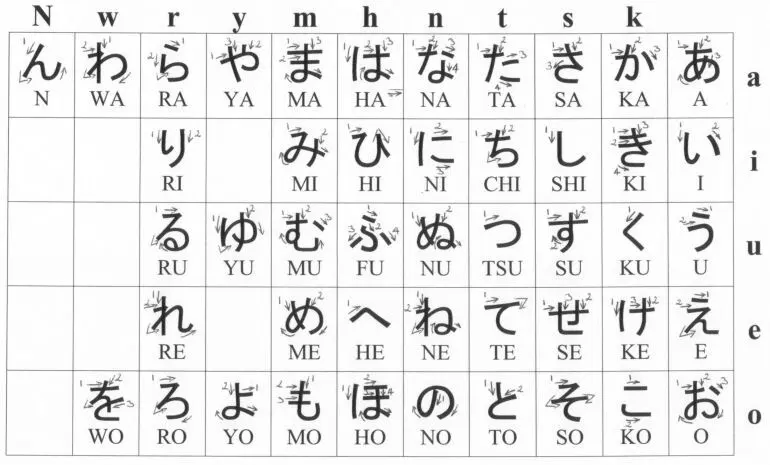
Image: Karine WIDMER / Wikimedia Commons · CC BY-SA 2.0
Hiragana is one of the two kana scripts in the Japanese writing system. Its signs represent morae rather than individual consonant and vowel letters. Hiragana developed gradually from cursive forms of Chinese characters used phonetically, especially Man’yōgana, and became prominent in Heian-period writing. In modern mixed text it commonly marks particles, inflectional endings, function words, words without usual kanji, and readings supplied as furigana. It is also central to early literacy. Hiragana and katakana normally encode corresponding sound units, but they are not freely interchangeable: convention, genre, emphasis, and history shape the choice. The standard chart simplifies a longer history containing variant kana, obsolete signs, changing spellings, and calligraphic forms.
Overview
| Japanese name | 平仮名 or ひらがな |
|---|---|
| Romanization | Hiragana |
| Script type | Moraic kana script |
| Historical basis | Cursive forms of phonographically used kanji |
| Basic modern inventory | 46 commonly taught base signs |
| Common roles | Particles, okurigana, readings, and phonetic word writing |
Name, form, and scope
Hiragana means “plain” or “ordinary kana,” distinguishing it historically from other character practices. Its rounded and flowing appearance reflects cursive writing traditions, but modern printed fonts range from brush-like forms to geometric screen designs.
Calling hiragana an alphabet is convenient for beginners but technically imprecise. Most signs represent a mora such as ka, shi, or mo; the five vowel signs represent vowel morae, and ん represents the moraic nasal. Small signs and combining marks extend the basic inventory.
Development from cursive characters
Hiragana emerged through highly cursive forms of kanji used for sound. Different source characters could represent the same mora, producing many alternative shapes later called hentaigana. The process was gradual and distributed rather than the invention of one named person at a precise date.
By the early Heian period, recognizable phonographic forms circulated in poetry, letters, diaries, and narrative writing. Their relationship to kanji remained visible in calligraphy and scribal practice even as kana became a more independent script.
Heian writing and gender
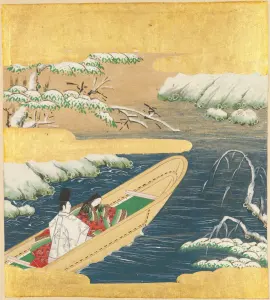
Hiragana supported extensive writing in Japanese at the Heian court and is strongly associated with works by women, including diaries and narratives connected with The Tale of Genji. The historical label onnade, “women's hand,” reflects this social association.
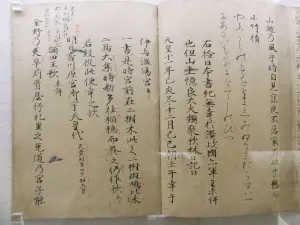
The contrast between men's Chinese writing and women's kana is not absolute. Men also wrote kana, women engaged with Chinese texts, and many documents mixed scripts. Surviving manuscripts are often later copies, so modern printed spellings should not be assumed to reproduce an author's original page.
Sounds, marks, and combinations
The modern gojūon table organizes base signs by vowel and consonant-vowel rows. Dakuten and handakuten create voiced and p-sounds, as in か to が and は to ぱ. Small や, ゆ, and よ form contracted sequences such as きゃ, while small っ marks a following geminate consonant.
The written categories do not map perfectly onto phonetic detail. Pronunciation changes by context, dialect, and speech style; は, へ, and を have special particle readings in standard modern usage. Historical kana orthography records older sound distinctions not preserved in contemporary pronunciation.
Grammar, words, and readings
Hiragana writes particles, auxiliary elements, and okurigana attached to kanji stems. It also writes many function words, children's vocabulary, informal expressions, and terms whose kanji would be rare, difficult, stylistically heavy, or unnecessary for the intended audience.
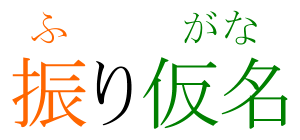
As furigana, hiragana commonly supplies the pronunciation of kanji in children's books, dictionaries, names, signs, and texts with uncommon characters. Writers can choose hiragana instead of kanji to soften tone, foreground sound, avoid ambiguity, or match a house style, but these effects depend on context.
Learning, order, and handwriting
Hiragana is usually the first full Japanese script taught to children and many second-language learners. The gojūon order provides the standard dictionary and classroom sequence, while the older iroha poem preserves another culturally important ordering.
Stroke order, proportion, and handwritten joins aid legibility, yet handwriting is not identical to a typeface. Historical calligraphy may connect several signs in flowing renmen, and printed educational forms may emphasize distinctions that are subtler in adult handwriting.
Standardization, variants, and digital text
Modern schooling and print standardization selected one principal hiragana form for each mora, while ゐ and ゑ became obsolete in ordinary postwar spelling. Hentaigana survive in historical documents, calligraphy, shop signs, and specialist study rather than forming part of the everyday basic chart.
Unicode provides a Hiragana block and additional ranges for historic or small kana. Digital text also uses combining and spacing versions of dakuten and handakuten. Correct encoding, fonts, and ruby markup matter for search, copying, pronunciation support, and accessibility.
Sources
- Yoko Hasegawa, Writing System, in Japanese: A Linguistic Introduction.
- The Unicode Standard, Chapter 18: East Asia.
- Bjarke Frellesvig, Writing and Sources, in A History of the Japanese Language.
- NINJAL, A Discovery in the History of Research on Japanese Kana Orthography.
- National Diet Library, The World of Calligraphy.
Last updated: