Food Culture
Japanese Noodles

Image: Mainichi Shimbun / Wikimedia Commons / Lavenberg Collection of Japanese Prints · Public domain
Japanese noodles are not one uniform food category. Udon and sōmen are principally wheat noodles made by different processes; soba commonly contains buckwheat; and ramen uses wheat dough treated with alkaline salts. Other names, including hiyamugi, kishimen, Okinawa soba, and yakisoba, show that everyday terminology does not follow one simple ingredient rule. Noodle traditions in Japan developed through repeated movement of crops, techniques, seasonings, and restaurant forms across East Asia and within the Japanese archipelago. They became temple food, regional food, urban fast food, household cooking, industrial food, and global popular cuisine. Classification therefore depends on ingredients, manufacture, serving method, region, and historical context rather than thickness alone.
Overview
| Japanese | Nihon no menrui (日本の麺類) |
|---|---|
| Main starches | Wheat and buckwheat |
| Major families | Udon, soba, sōmen, and ramen |
| Common service | Hot broth, chilled with dipping sauce, stir-fried, or in hot pots |
| Important seasonings | Dashi, soy sauce, miso, salt, and tare |
| Classification caution | Names do not always identify the grain or process |
Scope and classification
The English phrase “Japanese noodles” groups foods that Japanese cooks and diners may treat as separate traditions. Classification can refer to raw material, dough chemistry, method of shaping, legal product standard, or the completed dish. Thickness is useful within some manufactured categories but cannot by itself distinguish udon, soba, ramen, pasta, and regional noodles.
Historical formation
Wheat and noodle-making methods reached Japan through long exchanges with the Asian continent. Elite, temple, and regional practices helped transmit early forms, while milling, urban markets, transport, and commercial shops expanded access. Soba and udon became conspicuous urban foods during the Edo period; ramen developed much later from Chinese noodle traditions in treaty-port and modern city settings.
Udon
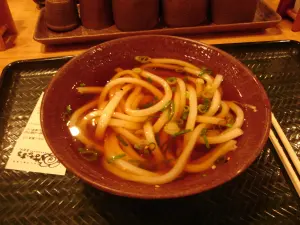
Udon is a diverse wheat-noodle family whose regional forms differ in width, firmness, production, broth, and service.
Udon is generally made by kneading wheat flour with salted water, resting and rolling the dough, and cutting it. It ranges from thick Sanuki udon to thin Inaniwa and flat kishimen. Texture, wheat, salt, water, broth, condiments, and service vary regionally, so udon cannot be defined only as “thick white noodles.”
Soba
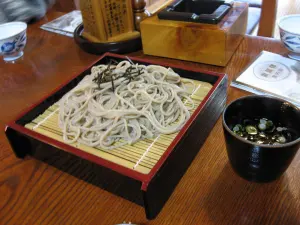
Soba usually contains buckwheat flour, often blended with wheat, and has distinct chilled, hot, regional, and ritual forms.
Soba most often denotes noodles containing buckwheat flour, frequently mixed with wheat flour to improve binding. The word also appears in names such as yakisoba, chūka soba, and Okinawa soba whose noodles are primarily wheat. Chilled zaru soba and hot kake soba illustrate two common serving families rather than the full range.
Sōmen and related wheat noodles
Sōmen are fine wheat noodles traditionally stretched with the aid of oil and commonly dried. They are strongly associated with chilled summer service, although warm regional dishes also exist. Hiyamugi, hand-stretched noodles, dried noodles, and machine-made products are distinguished through combinations of manufacture and dimensions under commercial standards; ordinary culinary usage may be less exact.
Ramen and Chinese-style noodles
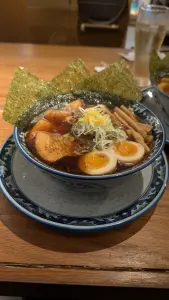
Ramen developed in modern Japan from Chinese wheat-noodle traditions and is distinguished by alkaline noodles, while its soups, seasonings, and regional styles became highly diverse.
Ramen is made from wheat dough treated with alkaline salts that affect colour, aroma, and texture. It emerged in Japan through Chinese migration and modern urban food culture, then developed extensive Japanese regional styles. Chūka men also appear in yakisoba, chilled hiyashi chūka, and other dishes, so ramen is one use of a broader noodle family.
Broth, sauce, and toppings
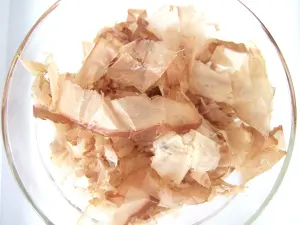
Noodles acquire much of their identity from the liquid and condiments around them. Dashi, soy sauce, mirin, miso, salt, meat or fish stock, aromatic oils, and concentrated tare can be combined in different proportions. Cold dipping sauce, hot kakejiru, ramen soup, and stir-fry seasoning are not interchangeable even when related ingredients appear.
Regional, everyday, and industrial life
Noodles connect climate and crops with workshops, street stalls, railway counters, restaurants, home cooking, tourism, frozen foods, and instant products. Regional labels can describe established local traditions, later branding, or both. Convenience does not make a noodle historically simple: even inexpensive bowls depend on agricultural supply, milling, preservation, energy, distribution, and changing labour.
Sources
- Ministry of Agriculture, Forestry and Fisheries, Grain Products in Traditional Foods.
- Ministry of Agriculture, Forestry and Fisheries, Japanese Food Culture.
- Japan National Tourism Organization, The Art of Noodles.
- Oxford Research Encyclopedia of Food Studies, Noodle Nation Japan.
- Kikkoman Food Forum, Japanese Noodles No. 1: Sōmen.
- Kikkoman Food Forum, Japanese Noodles No. 2: Udon.
- Kikkoman Food Forum, Japanese Noodles No. 3: Soba.
- Kikkoman Food Forum, Japanese Noodles No. 4: Ramen.
Last updated: