Social Customs
Tatami
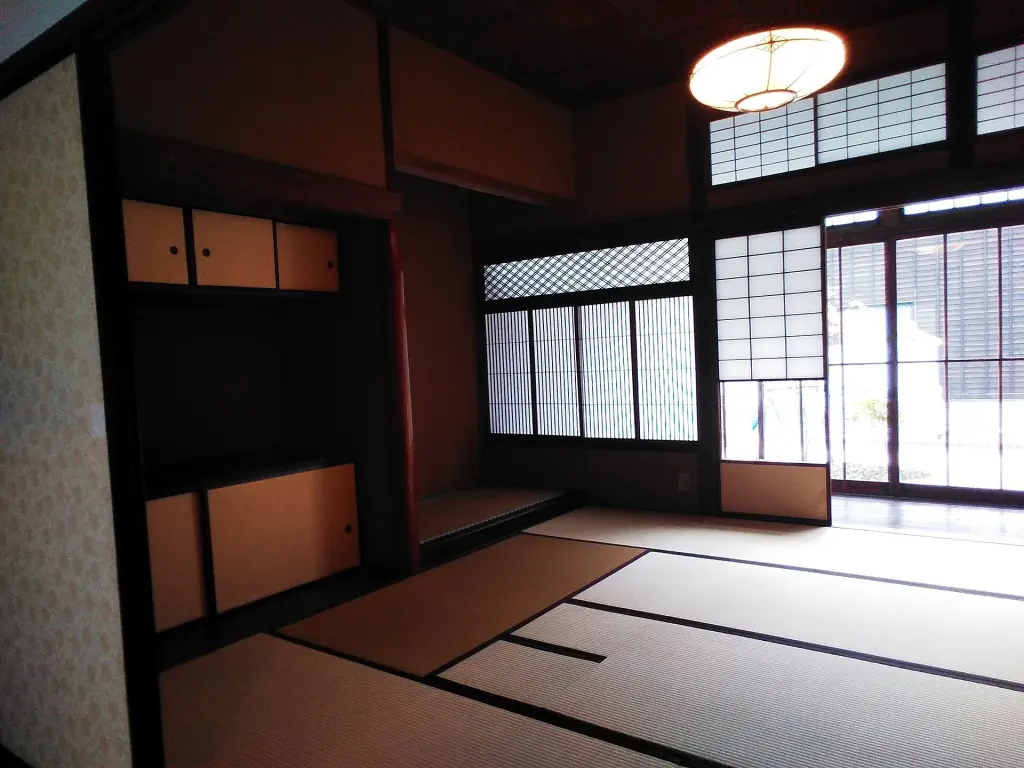
Image: 妖精書士 / Wikimedia Commons · CC0 1.0
Tatami are modular floor mats closely associated with Japanese-style rooms. A traditional mat has a compressed core, a woven rush surface, and fabric edging, although modern cores and borderless forms are also common. Tatami began as movable seating or sleeping mats and later came to cover entire rooms in elite and then broader domestic settings. Their dimensions vary by region and period, yet mats also function as a practical unit for describing room size. Tatami affect how people sit, walk, arrange furniture, receive guests, practise tea, and lay out futon. They remain a living building material rather than merely a decorative emblem of “traditional Japan.”
Overview
| Japanese | Tatami (畳) |
|---|---|
| Classification | Floor covering and spatial module |
| Traditional surface | Woven igusa rush |
| Main parts | Tatamidoko core, tatamiomote facing, and heri edging |
| Room measure | Jō or mat count, with regional size variation |
| Common settings | Washitsu, tea rooms, inns, and some martial-arts spaces |
Name and construction
The word tatami is related to the idea of folding or piling. A conventional mat consists of a core (tatamidoko), a woven surface (tatamiomote), and usually cloth edging (tatamiberi). Rice straw was long used for the core; compressed wood fibre, foam, and composite materials are now widespread. The visible surface is commonly woven from igusa rush.
Historical development
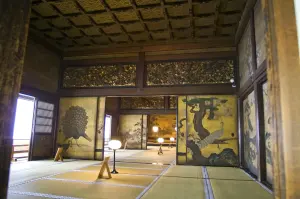
Early tatami were individual mats placed on wooden floors for seating or sleeping and stored when not required. In medieval elite residences, mats became status-marked furnishings and gradually covered larger areas. The fully tatami-covered shoin-style room became influential, while access, materials, arrangement, and room conventions continued to vary by class and period.
Size and measurement
Tatami are often approximately twice as long as they are wide, but there is no single national size. Kyōma, chūkyōma, edoma, and other regional or building conventions differ. Housing advertisements nevertheless describe rooms by mat count, such as six-jō, sometimes using standardized real-estate measurements rather than the exact mats installed in a particular room.
Room arrangement
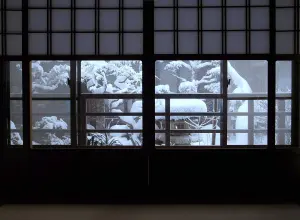
Tatami rooms often open through sliding screens toward an engawa, a boarded edge used for circulation and as an adjustable boundary with the garden.
Room dimensions, tatami layout, alcoves, and sliding shōji are coordinated parts of the Japanese-style interior rather than isolated decorative elements.
Mat layout is designed as a pattern rather than a random grid. Different arrangements may be used for ordinary or ceremonial settings, and some junction patterns are avoided by convention. Because dimensions and doorway positions influence the layout, tatami, shōji, fusuma, alcoves, and structural bays are planned together in a Japanese-style room.
Daily use and etiquette
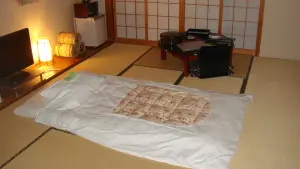
A futon is commonly laid over tatami for sleep and folded or stored during the day, though modern households also use beds and mixed bedding systems.
Tatami are normally entered without outdoor shoes and are often used without hard-soled slippers. People sit directly on the floor or on cushions, and lightweight furnishings can be moved as the room changes purpose. A futon can be laid out for sleep and stored during the day. Heavy furniture, moisture, abrasion, and direct sunlight can damage the surface.
Tea and martial arts
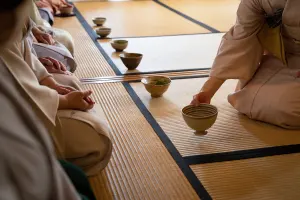
Tatami dimensions and seams help organize movement in the Japanese Tea Ceremony, where the positions of host, guests, hearth, and utensils are spatially codified. Tatami also appear in several indoor martial-arts settings, but modern training mats may be synthetic systems engineered for impact, grip, and hygiene rather than domestic rush-covered tatami.
Care and renewal
Ventilation and dry cleaning help limit mould and mites in humid conditions. The woven facing can be replaced while retaining a serviceable core, and a mat may be turned before full resurfacing, depending on its construction. New igusa changes colour from green to golden brown with light and age; deterioration, staining, and valued patina should not be confused automatically.
Contemporary use
Many apartments and detached homes combine Western-style flooring with one washitsu; others omit tatami or use compact square, borderless, or coloured mats. Ryokan, temples, tea rooms, heritage buildings, and public facilities keep the material highly visible. Its continued use depends on changing households, domestic labour, cost, craft production, and new construction systems.
Sources
- Japan Tourism Agency, Enjoying Japanese-style Rooms.
- Japan Foundation, Irodori: Rooms.
- Government of Japan, Traditional Wisdom and Technology Thriving in Modern Life.
- JICA, Notes: Japanese Houses.
- Nara National Research Institute for Cultural Properties, Shoin Style.
- Kyoto National Museum, Fusuma Paintings of Ōbai-in.
- Imperial Household Agency, Kyoto Imperial Palace Wall Paintings.
- Agency for Cultural Affairs, Kyoto Architecture Appendix.
Last updated: