Social Customs
Shōji
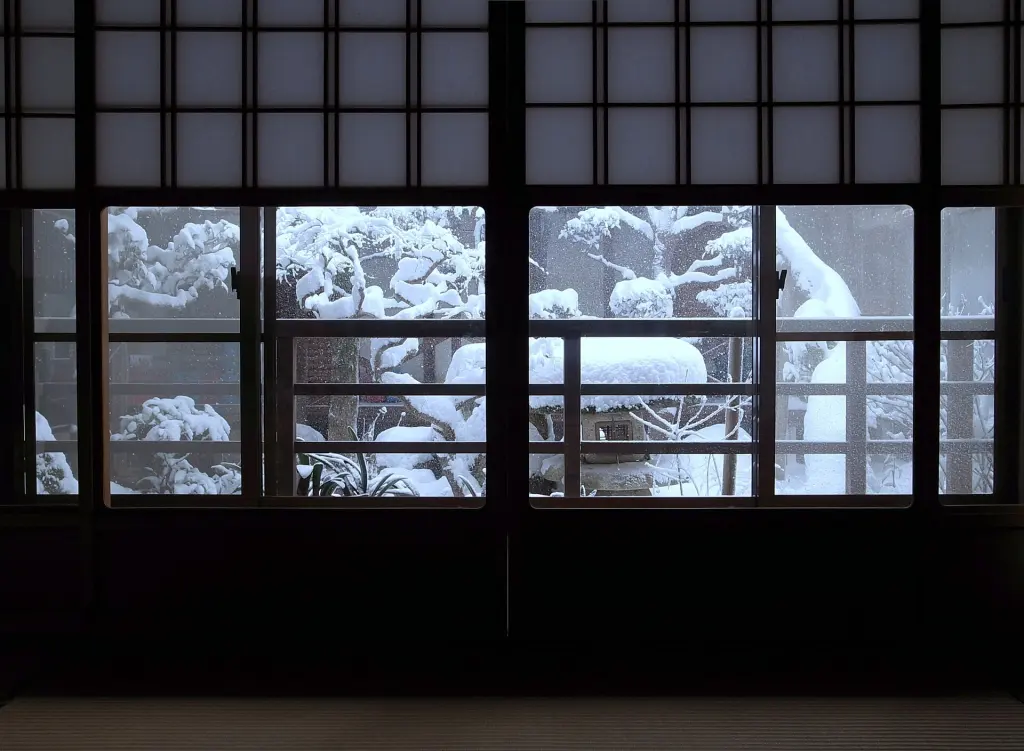
Image: Tamaki Sono / Wikimedia Commons · CC BY 2.0
Shōji are architectural fittings most commonly recognized as wooden lattices covered with translucent paper. They can serve as sliding doors, windows, or room dividers, admitting diffuse light while limiting a direct view. In historical usage, shōji referred more broadly to partitions, including forms that would later be classified differently; the modern everyday meaning is narrower. Shōji are not interchangeable with fusuma: shōji transmit light, whereas fusuma are normally opaque interior partitions. Their effects depend on construction, position, daylight, weather protection, and the adjacent spaces of the house. Contemporary examples may use reinforced paper, plastics, glass, insulation, or nontraditional patterns.
Overview
| Japanese | Shōji (障子) |
|---|---|
| Classification | Translucent architectural fitting |
| Typical construction | Wooden lattice with paper facing |
| Main functions | Diffuse light, privacy, ventilation, and circulation |
| Common movement | Sliding in tracks, though fixed forms exist |
| Distinguished from | Opaque fusuma |
Definition and terminology
In present-day English and Japanese, shōji usually means a translucent paper-faced lattice fitting. Historically, however, the word covered a wider family of movable partitions. Qualifying terms became important as buildings developed more specialized fittings. This history explains why older texts and modern architectural labels do not always use the word in exactly the same way.
Construction and materials
A conventional shōji has a light timber frame with a fine lattice (kumiko) and paper attached to one face. The paper may be handmade or machine-made washi, and modern substitutes include reinforced sheets and resin. The fitting commonly runs in upper and lower tracks. External rain shutters, glazing, or eaves protect delicate paper from weather.
Light and privacy
Paper scatters daylight, producing an even interior brightness and obscuring detail rather than creating complete visual or acoustic isolation. At night, an illuminated room can reveal silhouettes. Shōji therefore mediate degrees of exposure; their privacy depends on lighting, distance, paper, glazing, and the surrounding plan, not on an absolute separation between inside and outside.
Movement and space
Within the wider history of Japanese architecture, shōji are one of several movable elements used to adjust light, enclosure, and circulation.
Sliding panels need no swing radius and can open a broad span between posts. In a Japanese house, they may connect a tatami room to an engawa or garden view, or subdivide adjoining spaces. Their lightness supports seasonal adjustment, but it also offers less insulation, sound control, and security than a substantial wall.
Forms and variations
Shōji vary in lattice pattern, proportion, and placement. Yukimi shōji, or “snow-viewing shōji,” incorporate a vertically movable section or glazing that allows a low view while retaining screening above. Other forms combine paper with glass or place paper only on part of the panel. Terminology and details differ across period, craft tradition, and building.
Repair and replacement
Paper can tear, stain, loosen, or discolour and is periodically replaced. Repapering involves removing the old sheet, cleaning the frame, applying paste or another fastening system, tensioning the new material, and trimming it. Plastic-laminated papers improve durability but change repair methods, texture, light transmission, and disposal.
Shōji and fusuma
By contrast with translucent shōji, fusuma are opaque sliding panels used for interior separation, storage, and sometimes painting.
Shōji and fusuma both move in tracks and help make rooms adaptable, but their normal functions differ. Shōji are light-transmitting lattice fittings often used toward windows, verandas, or illuminated adjoining spaces. Fusuma are opaque panels more suited to screening rooms or storage and can carry paintings or decorative paper.
Modern use and image
Shōji remain common in heritage buildings, inns, tea rooms, and some homes, while modern glazing and insulation have changed their position in exterior walls. International interiors sometimes imitate the grid without the construction or spatial role of Japanese fittings. The motif is recognizable, but the working shōji is an architectural component, not simply a decorative pattern.
Sources
- Japan Tourism Agency, Enjoying Japanese-style Rooms.
- Nara National Research Institute for Cultural Properties, Shoin Style.
- Kyoto National Museum, Fusuma Paintings of Ōbai-in.
- Imperial Household Agency, Kyoto Imperial Palace Wall Paintings.
- Agency for Cultural Affairs, Kyoto Architecture Appendix.
- Japan Foundation, Irodori: Rooms.
- Government of Japan, Traditional Wisdom and Technology Thriving in Modern Life.
- JICA, Notes: Japanese Houses.
Last updated: