Jujutsu
Yōshin-ryū Jūjutsu

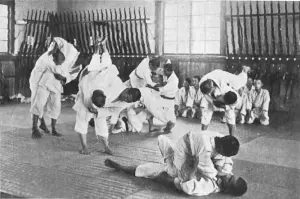
Image: Fukai Nenokichi / Wikimedia Commons · Public domain
Overview
Yōshin-ryū is best read as a lineage family, not one global syllabus.
Yōshin-ryū Jūjutsu (楊心流柔術) names an influential family of early-Edo grappling transmissions associated in surviving accounts with Akiyama Shirōbei and Ōe Senbei. Its familiar willow metaphor expresses responsive flexibility: structure bends under pressure, avoids a brittle collision, and returns at a useful moment. Curricula connected with the name combine throws, joint controls, restraints, strangulations, atemi to anatomical targets, kappō revival knowledge, and a medical understanding of the body. Yet the name does not identify one modern organisation or unchanged syllabus. Founder names, travel stories, genealogies, spellings, and technical emphasis vary across documents and branches. Totsuka-ha became prominent in the nineteenth century, and Yōshin-related material helped shape later traditions including Tenjin Shin’yō-ryū, through which part of this inheritance entered Kodokan Judo.
Multiple documents · branches · emphases
- Japanese
- 楊心流柔術
- Variant writing
- 揚心流 appears in some names and records
- Traditional founders
- Akiyama Shirōbei; early accounts also involve Ōe Senbei
- Historical frame
- 17th century onward
- Known for
- Atemi · grappling · vital-point knowledge · kappō
- Best category
- A family of related historical transmissions
01Name & scope
A shared name may signal ancestry, influence, or a reused principle.
楊心流 is the common writing. 揚心流 also appears, but the characters should not be treated as interchangeable across every lineage. Full names, teachers, and documents provide the necessary context.
Yōshin-ryū
An umbrella description for related early transmissions rather than one worldwide authority.
Full lineage name
Totsuka-ha or another qualifier can identify a particular historical route.
“Yōshin” elsewhere
The word alone cannot prove direct organisational descent or a shared modern curriculum.
02Origins & evidence
The founding story changes across the documents that preserve it.
Akiyama is described as a physician and martial artist. Versions differ over travel to China, learning from Chinese residents in Nagasaki, and the role of existing Japanese practice.
Akiyama Shirōbei
Named across influential lineage accounts, though personal-name details vary.
Ōe Senbei
Appears with different roles in early transmissions and genealogies.
China and Nagasaki
Versions disagree on travel, teachers, and the balance of Chinese and Japanese learning.
Seventeenth-century formation
Surviving scrolls point to a recognisable family of jujutsu, medical, and revival knowledge.
03Willow principle
Bending is useful because structure returns.
The snow-laden willow story is a compact teaching image. It should lead back to timing, posture, and action rather than remain a slogan about gentleness.
Recognise force before committing to a rigid answer.
Change shape, angle, or distance without simply collapsing.
Remove the support the opponent expected to meet.
Throw, control, restrain, or strike at a useful moment.
04Curriculum & body knowledge
Martial and medical knowledge meet in one view of the body.
Exact catalogues vary by line. The recurring relationship is between methods that disrupt or control the body and knowledge intended to understand, treat, or revive it.
Structure · joints · targets · breath · consciousness
Atemi & vital points
Strike or press anatomical targets to interrupt, weaken, or create an opening.
Throws & controls
Manipulate posture, joints, balance, and movement through close contact.
Kappō
Traditional methods of revival and emergency response transmitted in some lines.
Historical kappō is not a substitute for qualified modern medical care or local emergency procedures.
05Branches & influence
Use different arrows for branch, input, and shared name.
The categories below prevent a famous word from doing more historical work than the evidence allows.
Totsuka-ha Yōshin-ryū
Became a major nineteenth-century jujutsu tradition under Totsuka Hikosuke and successors.
Shin no Shintō-ryū → Tenjin Shin’yō-ryū
Yōshin-related teaching contributed to a later synthesis studied by Jigoro Kano.
Shindō, Hontai, Takagi, and Naginata lines
Shared “Yōshin” wording can mark influence, adoption, or another genealogy; it does not prove one organisation.
06Historical source method
A transmission scroll and a modern history answer different questions.
Early evidence survives largely through densho copied within lineages. Printed manuals, catalogues, institutional histories, and scholarship add dates and comparison without making every earlier claim certain.
Densho
May preserve techniques, licences, names, ethics, and medical teaching; copies can differ.
Manual or catalogue
Anchors a title, image, publisher, or practice to a specific date and object.
Modern scholarship
Tests multiple records and distinguishes tradition, inference, and independent dating.
07Present-day verification
Four identifiers tell you which Yōshin tradition you are seeing.
Contemporary groups range from classical licence-based transmissions to adapted or reconstructed curricula. The short name alone is insufficient.
- 1Full school name
Record every branch or style qualifier and the Japanese characters when available.
- 2Teacher and organisation
Identify who authorises the curriculum and where that claim is published.
- 3Lineage documents
Look for named teachers, licences, dates, or catalogued records rather than visual similarity alone.
- 4Actual curriculum
Check whether the group teaches grappling, weapons, medicine, modern self-defence, or another emphasis.
08Common misconceptions
Four claims need qualification.
Variant writing exists, but characters and genealogy must be checked case by case.
It belongs to influential origin narratives whose details differ.
The name belongs to multiple historical and modern transmissions.
Part of its influence reached Judo through later traditions; Kodokan Judo is a distinct modern system.
Sources and further reading
- Nagasaki Kōsuke, Characteristics of Jūjutsu Yōshin-ryū, Research Journal of Budō 15, no. 2.
- Nagasaki Kōsuke, Characteristics of Jūjutsu Yōshin-ryū (Part 2), Research Journal of Budō 16, no. 1.
- Nihon Kobudo Association, Yōshin-ryū Naginatajutsu.
- National Diet Library Search, Fukai Nenokichi, Ōhi Ryū-no-maki (1911).
Last updated: