People
Toyotomi Hidenaga
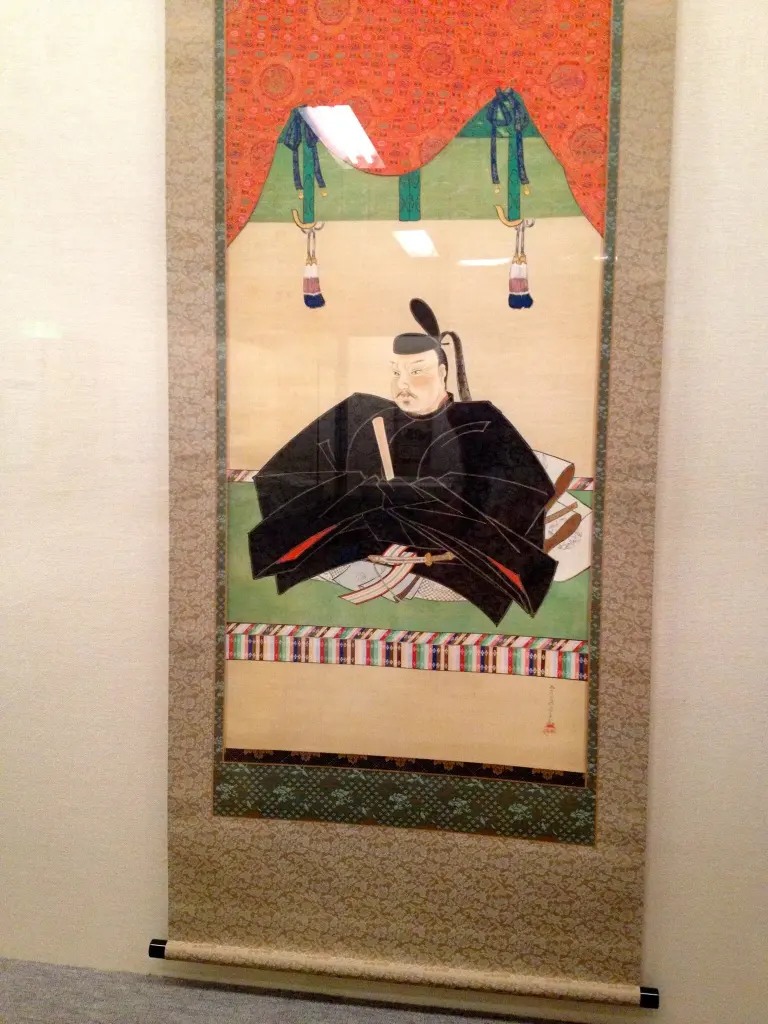
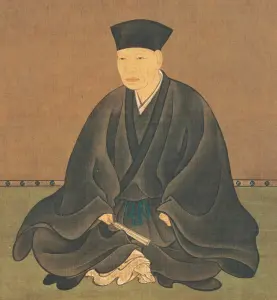
Image: Kanō Sadanobu; photograph by KKPCW / Wikimedia Commons · CC BY-SA 4.0
Overview
Kinship opened the door.
Office made the authority.
Toyotomi Hidenaga was more than Hideyoshi's younger half-brother. Command, land, court rank, negotiation, and administration placed him near the centre of the emerging Toyotomi order during its decisive decade of expansion.
Close kinship placed Hidenaga inside a political structure built on difficult personal trust.
Major campaigns in Shikoku and Kyushu show responsibility across armies and regions.
Territory, office, and proximity allowed him to carry orders and negotiate cooperation.
- Japanese name
- 豊臣秀長
- Other principal name
- 羽柴秀長 (Hashiba Hidenaga)
- Born
- 1540
- Died
- 1591
- Family
- Younger half-brother of Toyotomi Hideyoshi
- Principal seat
- Kōriyama Castle, Yamato Province
- Roles
- Commander, daimyo, negotiator, and administrator
- Court title
- Dainagon, commonly reflected in the name Yamato Dainagon
01 Names and family background
The surviving record is firmer about office than childhood character.
Hashiba Hidenaga
Appropriate for much of his service during Hideyoshi's rise.
Toyotomi Hidenaga
Reflects the clan name granted within Hideyoshi's political order.
Yamato Dainagon
A remembered name joining his province and high court office.
Hidenaga was born in 1540 in Owari Province and shared a mother with Hideyoshi. The details of the family's early status and Hidenaga's youth are less securely documented than the public careers of the brothers. Later biographies can fill this gap with retrospective stories, so claims about childhood character or an inevitable partnership require caution.
Like other warriors of the period, he used different names as rank and political position changed. Hashiba Hidenaga is appropriate for much of his career; Toyotomi Hidenaga reflects the clan name granted within Hideyoshi's regime. He was also known as Yamato Dainagon after his province and court office.
02 Service under Hideyoshi
Kinship opened proximity; command and resources made authority real.
Kinship
Access and personal trust
Command
Armies, resources, and front-line communication
Authority
Territory, court rank, and political weight
Hidenaga emerged as a trusted commander as Hideyoshi rose under Oda Nobunaga. He took part in campaigns and administered territory, carrying responsibilities that required communication between the front line, local authorities, and Hideyoshi's headquarters. A surviving 1583 letter from Hideyoshi to Hidenaga at the front before the Battle of Shizugatake gives direct evidence of this operational relationship.
The brothers' kinship mattered in a political world where loyalty had to be negotiated among former rivals and newly subordinated lords. Yet Hidenaga's position was not merely familial. Command, resources, court rank, and territorial authority made him a major lord within the developing Toyotomi structure.
03 The transition after 1582
After 1582, victory had to become coalition.
- 1582
Honnō-ji and succession struggle
Nobunaga's death opened a rapid contest for political control.
- 1583
Shizugatake
Campaign evidence includes Hideyoshi's letter to Hidenaga at the front.
- 1584
Tokugawa–Oda conflict
Military pressure and negotiation tested the developing coalition.
- 1585 onward
Regional integration
Large campaigns converted victory into a wider Toyotomi order.
Nobunaga's death at Honnō-ji in 1582 opened a rapid struggle over succession and political control. Hideyoshi defeated Akechi Mitsuhide and then confronted rival Oda and Tokugawa alignments. Hidenaga supported the campaigns through which Hideyoshi converted military victory into a wider coalition.
The 1583 Shizugatake campaign and the 1584 conflict with Tokugawa Ieyasu and Oda Nobukatsu placed unusual demands on commanders and negotiators. Hidenaga's later reception as a mediator grew from this combination of military authority and proximity to Hideyoshi, but individual settlements should be attributed only where sources identify his participation.
04 The Shikoku campaign of 1585
Shikoku shows Hidenaga as a trusted multi-front commander.
Multi-front coordination
Forces from several regions moved across sea routes and newly aligned commands.
Surrender and redistribution
Defeated lords were repositioned within a new hierarchy, not simply erased.
In 1585 Hidenaga held a leading command in Hideyoshi's invasion of Shikoku against Chōsokabe Motochika. The campaign brought together forces from several regions and required coordination across sea routes, multiple fronts, and recently allied contingents. Hidenaga's appointment indicates the scale of military trust placed in him.
Victory reduced Chōsokabe control and incorporated Shikoku into Hideyoshi's political order. The outcome involved surrender and redistribution as well as combat. Hidenaga's role therefore illustrates how unification campaigns combined force with terms that repositioned defeated lords within a new hierarchy.
05 The Kyushu campaign of 1587
Kyushu required pressure, negotiation, and settlement.
Independent major command
Hidenaga led forces through eastern Kyushu while Hideyoshi advanced elsewhere.
Pressure plus negotiation
Settlement reorganised land and obligations after military advance.
Hidenaga again commanded a major army during Hideyoshi's Kyushu campaign against the Shimazu. While Hideyoshi advanced by another route, Hidenaga led forces through eastern Kyushu and participated in the pressure and negotiations that ended resistance. Institutional exhibition records preserve materials associated with the campaign and its settlements.
The campaign extended Toyotomi authority across Kyushu, after which lands and obligations were reorganised among local and incoming lords. Hidenaga's position between supreme command and regional actors made negotiation and orderly submission as important as tactical victory.
06 Kōriyama and Yamato governance
Kōriyama joined military government to urban reorganisation.
Kōriyama Castle
A Toyotomi base and centre of a large Yamato domain.
Roads, markets, temples
Urban organisation connected defence, commerce, and administration.
Governance network
People and resources turned territorial command into daily rule.
Beyond one lord
Later institutions should not all be compressed into Hidenaga's lifetime.
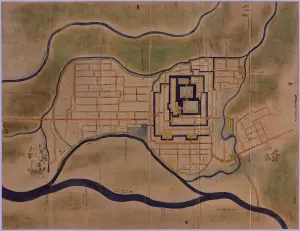
Hidenaga entered Kōriyama Castle in Yamato Province in September 1585. The town became the centre of a large domain and an important Toyotomi base in the Kinai region. Castle building, roads, temples, markets, and the organisation of retainers connected military rule with the remaking of an urban and regional landscape.
Yamatokōriyama City's historical materials associate Hidenaga with economic measures later remembered in the town, including the foundations of commercial organisation. Some institutions took their final form after his death, so the longer castle-town history should not be compressed into the work of a single lord.
07 Administration and mediation
Mediation was political infrastructure—not merely temperament.
Hidenaga managed a substantial domain while serving near the centre of the Toyotomi regime. His tasks included receiving important figures, communicating orders, supervising campaigns, and negotiating with lords whose cooperation was essential. The Tokugawa Art Museum has highlighted materials concerning Tokugawa Ieyasu's stay with Hidenaga, evidence of his role in high-level relations.
Later narratives often present him as the reasonable counterpart to an increasingly autocratic Hideyoshi. This may capture a remembered function, but it can become a moral character sketch unsupported by contemporary documents. A firmer interpretation treats mediation as political work grounded in office, kinship, land, and command.
08 Final years and death
His death removed a role that no successor simply inherited.
By the late 1580s Hidenaga held high court rank and governed one of the regime's largest domains. Illness increasingly limited his activity, and he died in 1591 at Kōriyama. His death came before Hideyoshi's invasions of Korea and before the succession crisis that followed Hideyoshi's own death.
Hidenaga left no successor able to reproduce his political position at the centre of the regime. His house and territories were reorganised within a changing Toyotomi order, underlining how much his authority had depended on his personal combination of kinship, office, land, and command.
09 Legacy and historical evidence
Evidence matters more than the counterfactual legend.
- 01
Contemporary documents
Letters and administrative objects provide the strongest direct evidence.
- 02
Institutional history
Museums, cities, and temples preserve objects and local memory.
- 03
Later portraits
The familiar image is Edo-period, not a contemporary likeness.
- 04
Modern drama
Novels and television increase visibility but do not substitute for historical evidence.
Hidenaga is remembered through Kōriyama's castle-town history, surviving letters and objects, temple traditions, portraits produced after his lifetime, museum exhibitions, and modern historical writing. The familiar portrait attributed to Kanō Sadanobu is an Edo-period representation rather than a contemporary likeness.
Modern novels and television can make Hidenaga more visible, but dramatization should be read alongside primary and institutional evidence. His historical importance rests less on a hypothetical ability to prevent every later Toyotomi failure than on documented work during a decisive decade of conquest, negotiation, and governance.
Sources
Last updated: