
Historical Figures
Sen no Rikyū
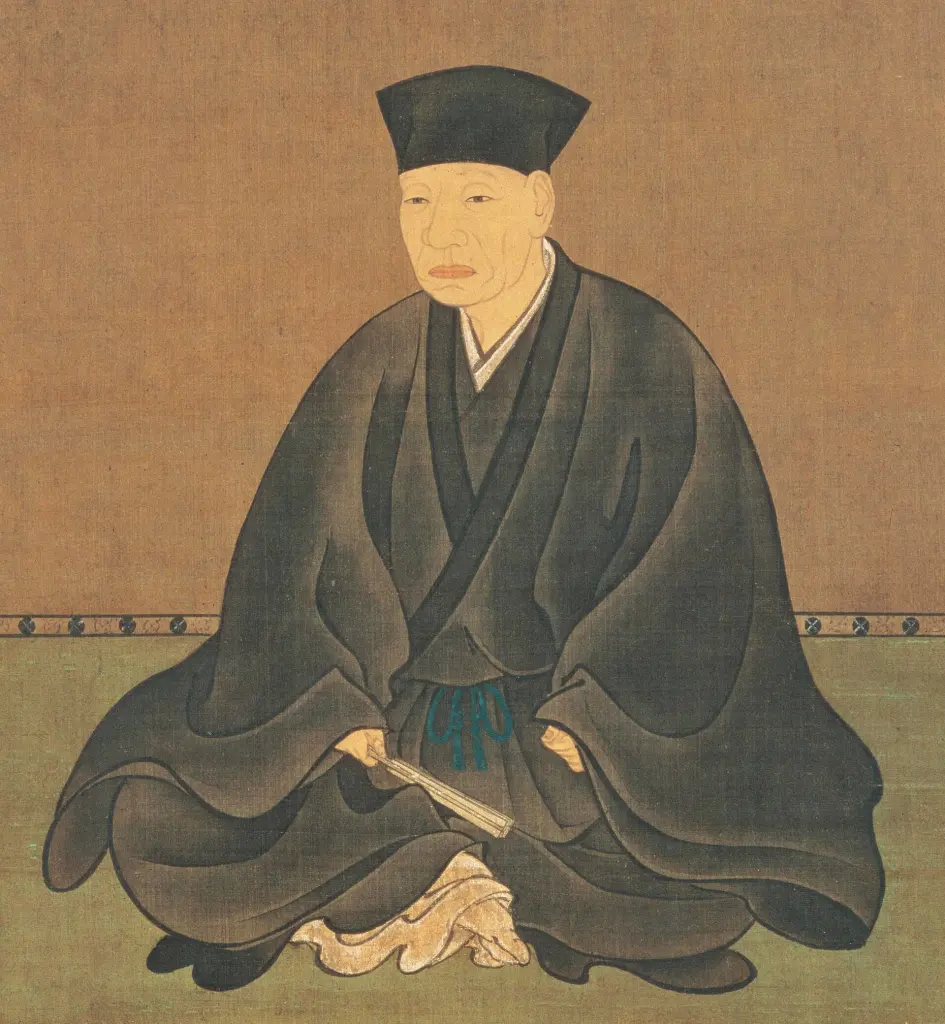
Image: Hasegawa Tōhaku; calligraphy by Shun'oku Sōen / Wikimedia Commons / Omotesenke Fushin'an Foundation · Public domain
Sen no Rikyū (千利休, 1522–1591) was a tea master from the merchant city of Sakai and the most influential historical figure in the formation of wabi-cha. Trained first in formal tea service and later under Takeno Jōō, he served the political rulers Oda Nobunaga and Toyotomi Hideyoshi. Rikyū did not invent tea practice, but he gave lasting force to small rustic rooms, bamboo utensils, Raku tea bowls, ordinary objects placed in new contexts, and a disciplined relation between host and guest. He also occupied a politically sensitive position near Hideyoshi. In 1591 Hideyoshi ordered him to die by ritual suicide; contemporary and later accounts do not establish one certain reason for the rupture.
Overview
| Japanese name | 千利休 |
|---|---|
| Childhood name | Tanaka Yoshirō |
| Born | 1522, Sakai, Japan |
| Died | 21 April 1591, Kyoto, Japan |
| Teachers | Kitamuki Dōchin and Takeno Jōō |
| Known for | Forming wabi-cha and serving Oda Nobunaga and Toyotomi Hideyoshi |
Early life in Sakai
Rikyū was born in 1522 in Sakai, an important port and merchant city. His father, Tanaka Yohee, owned a warehouse, and the boy was called Yoshirō. He later used the name Sen, connected in Urasenke accounts with his grandfather Sen’ami.
Sakai’s merchants collected Chinese objects, practised tea, and maintained ties with temples and political power. This urban environment placed Rikyū within commercial and cultural networks rather than an isolated artistic retreat.
Tea and Zen training
As a young man, Rikyū studied the formal shoin style of tea with Kitamuki Dōchin. At about nineteen he began learning from Takeno Jōō, an important advocate of the restrained approach later identified with wabi tea.
He also studied Zen in Sakai and Kyoto and received the name Sōeki. The relationship between Zen and his tea should not be reduced to a slogan: it appeared through discipline, material choices, architecture, and social conduct as well as explicit religious ideas.
Service to Oda Nobunaga
Rikyū entered the circle of Oda Nobunaga, probably by 1573. Nobunaga used tea gatherings, famous utensils, and permission to host tea as instruments of authority and reward during the unification wars.
Service placed Rikyū among rulers, warriors, merchants, craftsmen, and temple figures. His standing as a connoisseur therefore developed inside both artistic practice and the politics of celebrated objects.
Service to Toyotomi Hideyoshi
The biography of Toyotomi Hideyoshi places this patronage within his wider military and political rule.
After Nobunaga’s death in 1582, Rikyū became tea master and close associate to Toyotomi Hideyoshi. At an imperial tea gathering in 1585 he received the lay title Rikyū Kōji, the name by which he is now known.
Rikyū assisted with major political tea events, while Hideyoshi could also favour spectacular display, including gold and large public gatherings. Their relationship demonstrates that restrained wabi taste and elite power coexisted rather than occupying separate worlds.
Wabi-cha and the tea room
Rikyū brought new authority to wabi-cha, an approach developed before him by figures such as Murata Shukō and Takeno Jōō. Small rooms intensified attention to movement, sound, objects, and the temporary community of a gathering.
The two-tatami room Tai-an at Myōki-an is closely associated with his mature taste. Low entrances, a garden approach, limited display, and the removal of unnecessary objects helped make space and sequence active parts of Japanese Tea Ceremony.
Utensils and craft networks
Rikyū selected imported, Korean, and Japanese wares but also elevated bamboo, wood, iron, and objects adapted from ordinary life. His taste is closely connected with black Raku tea bowls made by Chōjirō and with bamboo scoops, flower containers, and lid rests.
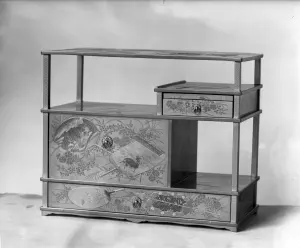
These objects were not created by a solitary designer. Potters, lacquerers, metalworkers, bamboo craftsmen, patrons, and later tea lineages participated in their production and transmission. The basic object names are explained in Chanoyu Terminology.
Disciples and networks
Rikyū’s pupils and associates included powerful warriors, merchants, temple figures, and tea specialists. Later tradition grouped several warrior disciples as the Seven Sages of Rikyū, although lists and the meaning of the label vary.
His adopted son Sen Shōan and grandson Sen Sōtan were crucial to family transmission after his death. Sōtan’s descendants became associated with the Omotesenke, Urasenke, and Mushakōjisenke head houses.
Death in 1591
Hideyoshi ordered Rikyū to commit ritual suicide. Rikyū carried out the order at his Jurakudai residence in Kyoto on the twenty-eighth day of the second lunar month of 1591, commonly converted to 21 April.
Explanations range from political influence and economic disputes to personal or aesthetic conflict, but Urasenke’s institutional history describes the decisive reasons as uncertain. A neutral biography should distinguish the documented order and death from later dramatic theories.
Legacy
Rikyū’s legacy rests in practice as much as in biography. Schools, tea rooms, named utensils, memorial observances, texts, and stories have repeatedly interpreted what his tea meant. Many practices associated with him were refined by earlier teachers or systematized by later lineages.
Modern admiration can turn “Rikyū” into a simple synonym for minimalism. His historical importance is richer: he reorganized relationships among objects, architecture, hospitality, artisan work, merchant culture, and political authority at a decisive moment in Japanese history.
Timeline
1522 — Born in Sakai. Around 1540 — Began studying with Takeno Jōō. Around 1573 — Entered Oda Nobunaga’s service. 1582 — Entered Toyotomi Hideyoshi’s service after Nobunaga’s death. 1585 — Received the name Rikyū Kōji at an imperial tea gathering. 1587 — Helped direct Hideyoshi’s Grand Kitano Tea Gathering. 1591 — Died by Hideyoshi’s order in Kyoto.
Sources
Last updated:
.jpg)