
Performing Arts
Kabuki Actors
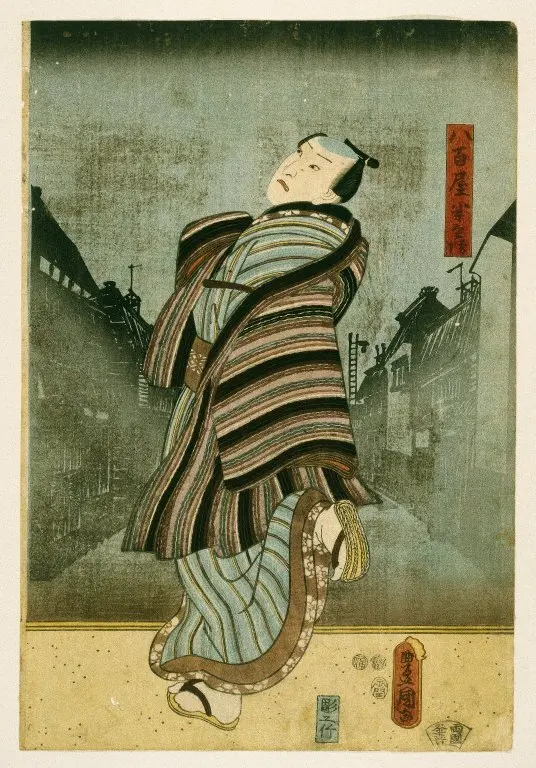
Image: Utagawa Kunisada (Toyokuni III); digital image by Brooklyn Museum / Wikimedia Commons / Brooklyn Museum · Public Domain Mark 1.0
Overview
Name, house, role.
A public identity in motion.
Kabuki places actors at the centre of a living performance system. Inherited stage names, houses, role specialisations, kata, repertory, and audience memory connect one performance to generations of interpretation.
A myōseki can pass between performers and carry a history of roles and expectations.
Yagō, crests, family arts, adoption, and apprenticeship organise affiliation.
Voice, movement, timing, costume, and kata make continuity visible through performance.
- Japanese term
- 歌舞伎俳優 (kabuki haiyū)
- Performer tradition
- Male actors perform both male and female role categories
- Stage-name system
- Myōseki names may be inherited through shūmei name-succession ceremonies
- House affiliation
- Yagō house names and crests identify actor lineages and associations
- Training
- Family and master–disciple transmission, supplemented by institutional training
- Representative role groups
- Tachiyaku, katakiyaku, and onnagata
01 An actor-centred theatre
A familiar play changes when a different actor carries it.
Kabuki performance is shaped by plays, music, choreography, scenery, costume, and stage technology, yet actors occupy a particularly visible position. Repertory survives through embodied choices: the timing of a gesture, the delivery of a line, the arrangement of a pose, and the relationship between a role and a particular acting house.
Audiences may attend to a familiar play while also comparing how a named actor interprets it. Billing, illustrated programmes, stage announcements, and actor images make identity and lineage part of reception. This actor-centred system explains why the same title can be experienced as a new event when performed by a different cast.
02 Stage names, houses, and crests
One performer can have several names—and one name can have many bearers.
Legal name
The individual's civil identity.
Stage name · myōseki
A name linked to earlier bearers, roles, and public expectations.
Yagō and crest
Spoken and visual signs connecting an actor to a theatrical house.
Many kabuki performers use inherited stage names known as myōseki. A name links its current bearer to earlier actors, roles, and performance patterns, but succession does not mean that one biological line has remained unchanged. Adoption, apprenticeship, marriage, and artistic affiliation have all helped maintain actor houses.
A yagō is a house name called out by knowledgeable spectators and printed in theatrical contexts. Crests provide another visual identifier. Stage name, house name, and legal personal name serve different functions; translating them all as a simple surname can obscure the social structure of the profession.
03 Shūmei and name succession
A celebrated name marks continuity and a new interpretation.
Public announcement
A new stage name is declared
Ceremonial repertory
Associated roles and house history return
New bearer
Continuity meets an individual body and career
Shūmei is the formal assumption of a stage name. Major successions are announced and celebrated through special performances in which the new bearer appears in roles associated with the name or house. Several members of a family or affiliated group may assume new names in a coordinated sequence.
The ceremony marks continuity and expectation rather than guaranteeing an identical style. Each actor inherits a public history but develops it through individual physique, voice, training, career circumstances, and collaboration. Dates of succession are therefore important reference points when identifying performers in reviews, prints, recordings, and cast lists.
04 Training and transmission
Transmission moves through families, masters, institutions, and careers.
Household practice
Observation, repetition, dance, voice, movement, and stage etiquette.
Master–disciple
Technique and repertory move through close practical instruction.
Institutional training
Professional paths also exist for entrants outside established kabuki families.
Continuous adjustment
New names, ages, venues, and repertory keep changing the actor's work.
Actors traditionally learn through close observation and repeated practice within households and master–disciple relationships. Children in established families may appear on stage at an early age, gradually acquiring dance, vocal delivery, movement, music, and repertory knowledge. Instruction includes both visible technique and the practical etiquette of rehearsal and performance.
Hereditary access remains influential, but institutional training has also opened routes for entrants without kabuki family backgrounds. Professional development continues throughout a career because new names, age categories, venues, and repertory demands require adjustments. Transmission is therefore structured but not mechanically fixed.
05 Role categories
Role categories organise technique, not everyday identity.
Tachiyaku
A broad field ranging from restrained figures to larger-than-life heroes.
Katakiyaku
Distinct dramatic, vocal, and physical vocabularies for antagonistic roles.
Onnagata
A codified theatrical construction made through costume, stance, movement, and voice.
Broad role groups include tachiyaku for male roles, katakiyaku for villains, and onnagata for female roles. Within them are more specialised character types based on age, status, temperament, and dramatic function. An actor's career may concentrate on one field or cross several categories.
Onnagata technique is a codified theatrical construction rather than an attempt to reproduce ordinary women without mediation. Costume, stance, movement, voice, and the conventions of a particular play work together. Likewise, male roles range from restrained figures to larger-than-life heroes, and villains can require distinct vocal and physical vocabularies.
06 Acting styles and kata
A form becomes legible through repeated difference.
Aragoto
Exaggerated heroic acting associated especially with Edo repertory.
Wagoto
Gentler movement and romantic young men associated with urban Kansai repertory.
Jitsugoto
Serious male acting shaped by restraint and composure.
Aragoto is associated with forceful, exaggerated heroic performance, while wagoto is associated with softer movement and the romantic young man of urban Kansai repertory. Jitsugoto refers to serious, controlled male acting. These labels guide attention but do not describe every scene or actor.
A kata is an established performance pattern that may organise gesture, delivery, movement, or staging. Kata allow actors to work within recognisable forms and also make variation legible to experienced audiences. They are transmitted through practice, documentation, and house repertories rather than functioning as a universal script applied without change.
07 Family arts and repertory
House repertory is authority within a collaborative theatre.
Actor houses may identify particular roles, scenes, or performance patterns as family arts. The Ichikawa Danjūrō line's Kabuki Jūhachiban, or 'Eighteen Best Kabuki Plays', is a prominent example of repertory shaped through actor lineage. Such selections construct a house's history and provide occasions for succession and revival.
Claims of family ownership should be read in theatrical rather than purely legal terms. Plays are collaborative works involving playwrights, musicians, stage personnel, other actors, and generations of revision. A house's authority rests on recognised transmission and performance practice within that larger system.
08 Actor prints and audiences
Actor celebrity was already a print culture.
- 01
Inscription
Read the printed stage name and role name.
- 02
House signs
Compare the crest and other identifiers.
- 03
Performance date
Names change, so production chronology matters.
- 04
Visual evidence
Use pose, costume, role, and print style together.
Woodblock actor prints, or yakusha-e, made performers' faces, poses, costumes, and roles visible beyond the theatre. Publishers and artists responded to current productions and audience demand, creating images that could celebrate a performance, advertise a star, or preserve a particular stage identity.
Because actors changed names, prints are also historical puzzles. Inscriptions, crests, role names, performance dates, and stylistic comparison help identify the person represented. The image record shows that actor celebrity is not a recent addition to kabuki but a long-standing part of its urban commercial culture.
09 The modern profession
Preservation keeps changing because the profession is alive.
Contemporary kabuki combines inherited practice with commercial production, cultural preservation, broadcasting, recorded performance, education, and international presentation. Actors may appear in newly written kabuki, adaptations, film, television drama, and other theatre while continuing classical repertory.
UNESCO inscribed Kabuki theatre on the Representative List of the Intangible Cultural Heritage of Humanity in 2008. That status recognises a living practice rather than freezing one historical version. Debate continues around heredity, access, gender, innovation, and preservation, all of which affect how actors sustain the form.
Sources
Last updated:
.jpg)