Karate
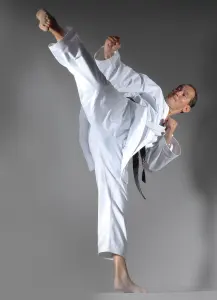
Mawashi-geri
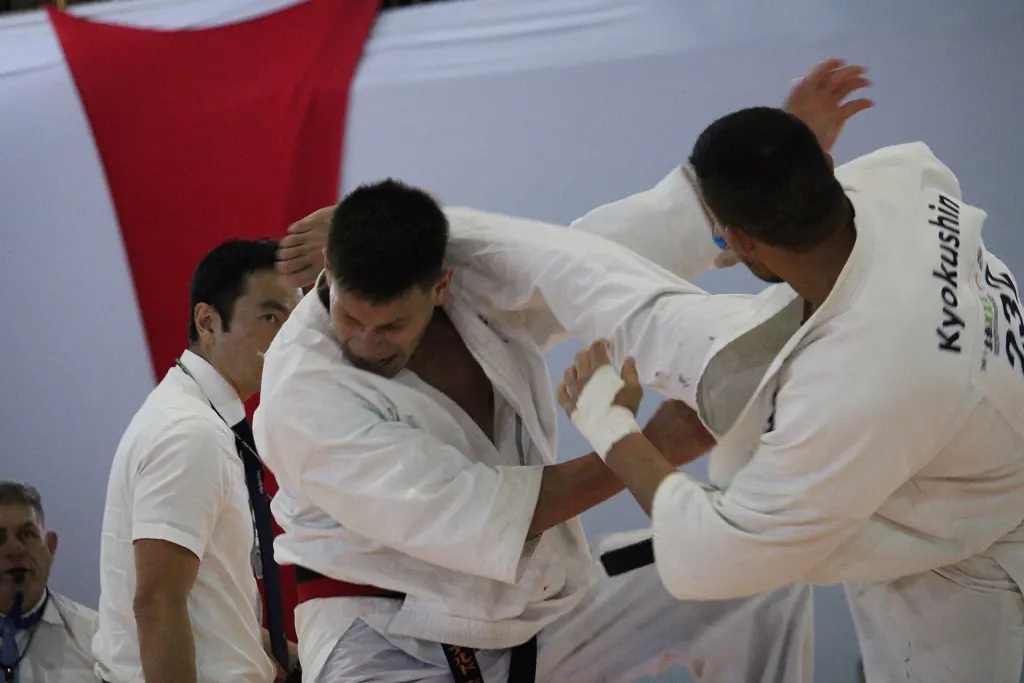
Image: Ogata Gusha / Wikimedia Commons · CC BY-SA 4.0
Overview
Mawashi-geri is defined by a curved approach from the side, not by one fixed surface.
Mawashi-geri (回し蹴り) is Karate’s roundhouse or round kick. The All Japan Karatedo Federation distinguishes it by the arc along which the kicking leg approaches an upper- or middle-level target from the side, and stresses controlled retraction. Front- and rear-leg versions, chamber height, supporting-foot turn, pelvis rotation, trunk position, contact surface, and landing all vary with school, range, equipment, and purpose. The useful constant is therefore relational: support the body on one leg, organise a curved path, meet the selected target under control, retract, and recover.
The supporting side orients the body and carries the centre.
The lower limb arrives from the side rather than straight ahead.
Control preserves balance and the next decision.
- Japanese
- 回し蹴り
- Reading
- まわしげり
- Reference meaning
- Roundhouse or round kick
- Classification
- Geri · kicking technique
- Defining path
- Curved approach from the side
- JKF target levels
- Jōdan · chūdan
01Name & meaning
The name points to turning around or approaching on a curve.
English “roundhouse” is a compact translation, not a full technical prescription.
Common spellings include mawashi geri and mawashigeri. The translation should not be used to assume one preparation, surface, angle, supporting-foot position, or finishing stance for every tradition.
02Curved approach
The arc is measured relative to the target, not by how dramatic the movement looks.
Starting stance, distance, leg choice, and target height change the visible curve.
Place the supporting side
Foot, knee, hip, and trunk prepare a side approach without sacrificing recovery.
Bring the lower limb from the side
The JKF relation distinguishes mawashi-geri from a kick travelling straight forward.
Take hiki-ashi
Retract before landing or connecting to the next action under control.
03Support, pelvis & target
One leg carries the body while the other changes plane and direction.
The supporting side enables the arc; it is not passive scenery.
Orients the base
The amount of turn depends on the person, school, range, and task.
Manage the load
Comfortable alignment supports rotation without forcing height.
Shape direction and reach
Visible rotation varies across formal and competitive versions.
Jōdan or chūdan in the JKF reference
Height changes range and balance, not the basic curved identity.
04Surface & recovery
The contact surface belongs to a version, not to the name alone.
Equipment and rules can make one endpoint look standard when it is only contextual.
Common in controlled and sporting forms
Exact ankle position and permitted contact remain organisation-specific.
Documented in other traditions and drills
Name the style, target, and protective context rather than universalising the choice.
Return the leg under control
Recovery prevents an extended limb from becoming a loss of posture.
05Compare the geri family
A curved side approach distinguishes mawashi-geri from a direct side kick.
Direction and path are more stable comparison points than one photographed endpoint.
The knee folds before the lower leg opens toward a target in front.
Sideward lineYoko-geri横蹴りA side-directed family that may separate snapping and thrusting models.
Curved approachMawashi-geri回し蹴りThe kicking leg approaches the target along an arc from the side.
Backward lineUshiro-geri後ろ蹴りThe body turns and the leg or heel drives directly behind the practitioner.
06Kihon & kumite
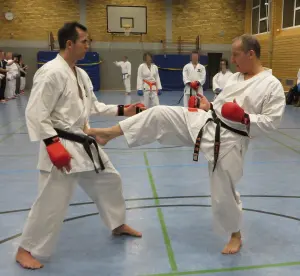
Large formal repetition and compressed contest action can share one name.
The training problem decides how visibly chamber, arc, guard, and landing are separated.
Kihon
Isolates balance, curved path, target height, surface, retraction, and left–right differences.
Kumite
Adapts range, timing, guard, commitment, and contact to a moving partner and current rules.
JKA grading material lists mawashi-geri across several levels and partner-practice requirements. That placement documents one organisation’s curriculum rather than an official sequence for all Karate.
07Research, variation & safety
Balance research can improve observation without defining a universal ideal.
Sample, age, task, equipment, and outcome decide what a study can support.
Twenty-six young male karateka
A one-week visual-feedback study compared preparation and kick positions using centre-of-pressure measures. It tested short-term balance training in one youth sample.
Surface, turn, chamber, and contact vary
Shared terminology does not guarantee identical performance, and different contact rules produce different tactical choices.
Sources and further reading
Last updated: