Aikido
Aikido
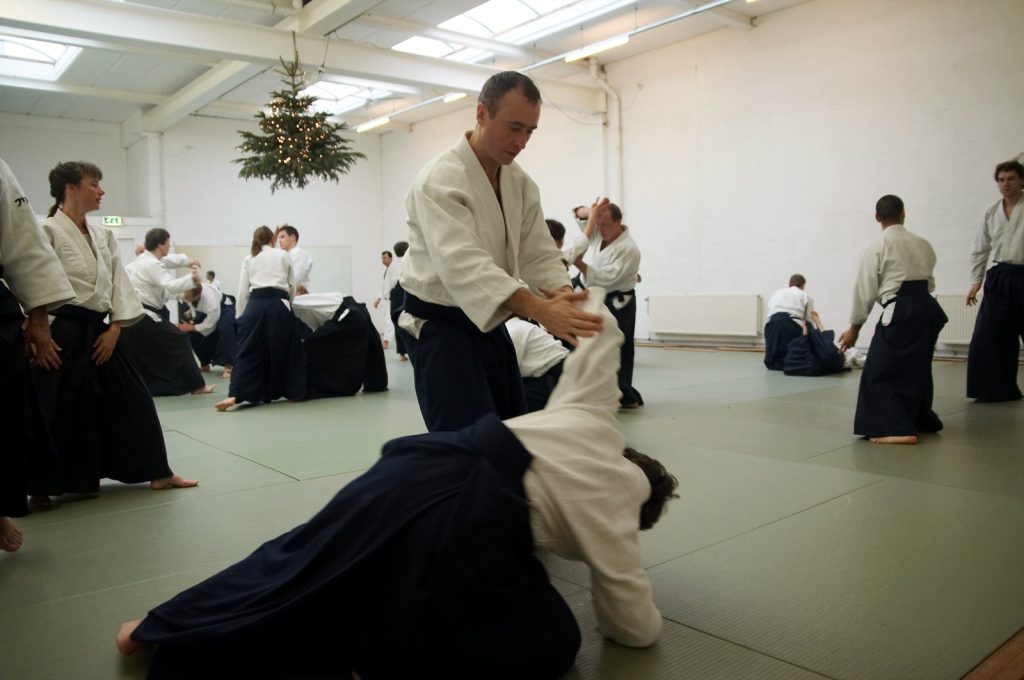
Image: Dokiai Aikido / Wikimedia Commons · CC BY-SA 2.0
Overview
Paired practice turns contact into a study of direction and control.
Aikido is the modern budō created by Morihei Ueshiba. Its technical formation is closely tied to Daitō-ryū, while its institutions, training cultures, and ethical interpretations became distinct.
Recognise distance, line, grip, or incoming action.
Move the relationship instead of colliding with force.
Guide posture and direction so resistance becomes difficult.
Complete a throw or pin while protecting both partners.
- Japanese
- 合気道
“Way of harmonising energy” - Founder
- Morihei Ueshiba
- Development
- 1920s–1940s
- Technical source
- Daitō-ryū Aiki-jūjutsu
- Practice
- Paired throws, pins, ukemi, and school-specific weapons study
- Organisation
- Several major postwar lineages rather than one uniform curriculum
01Origins
Documented training, gradual reorganisation, then postwar institutions.
Ueshiba’s Daitō-ryū study under Takeda Sōkaku is central. Aikido nevertheless developed its own name, organisations, practice cultures, and ethical language.
- 1915
Hokkaido
Ueshiba began training in Daitō-ryū Aiki-jūjutsu with Takeda Sōkaku and later received formal teaching credentials.
- 1920s
Ayabe
Teaching, physical practice, and spiritual commitments increasingly shaped Ueshiba’s own direction.
- 1927–1931
Tokyo and the Kobukan
Ueshiba moved his main activity to Tokyo; the Kobukan Dōjō opened in Shinjuku in 1931.
- 1942–1948
Name and organisation
The name Aikido was adopted during the wartime reorganisation of Japanese martial arts. The Aikikai Foundation was recognised in 1948 and became central to postwar expansion.
02Practice structure
Both partners study the technique.
Uke offers a prescribed grip or attack and learns to receive safely; tori or nage studies distance, position, balance, and controlled completion. Roles then change.
Offer & receive
Maintain an intelligible attack, follow the relationship, and develop ukemi.
Connect & guide
Use posture, movement, and contact to create a safe throw or pin.
Compare sensations
Learning both sides makes timing, structure, and responsibility observable.
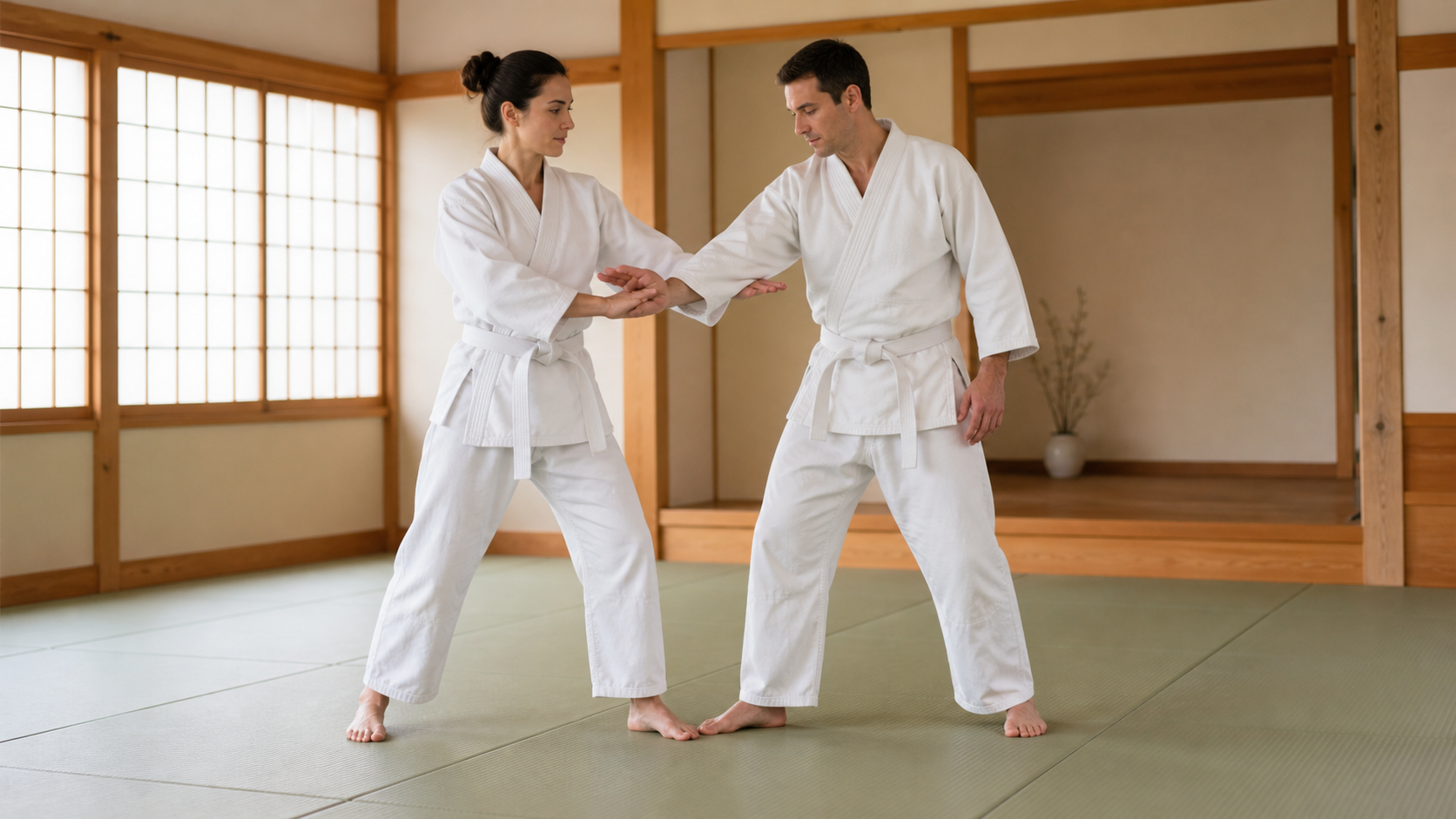
Kenji Tomiki developed a notable alternative in which formal kata is paired with rule-governed randori to examine distance, timing, and decision-making.
03Principles in motion
Five questions to ask while watching a technique.
What distance, direction, and movement must be noticed?
How does each partner maintain or lose structure?
When does movement avoid collision without becoming hurried?
How is the technique completed without abandoning the partner’s safety?
How does the receiving partner protect the body and continue learning?
04Postwar pathways
Shared roots; different institutions and teaching designs.
The cards name selected major pathways. They should not be read as identical syllabuses or as exhaustive coverage of Aikido organisations.
Aikikai
The Hombu Dōjō in Shinjuku became a central postwar teaching base under the Ueshiba family.
Yoshinkan
Founded by Gozo Shioda in 1955, with a systematic curriculum used in civilian, police, and instructor training.
Shodokan / JAA
The Japan Aikido Association, founded by Kenji Tomiki in 1974, organises rule-governed competitive practice alongside kata.
Yoseikan Budō
Minoru Mochizuki’s wider budō study connected Aikido-derived controls with throwing, striking, groundwork, and weapons.
05Terminology boundary
Aiki, Aiki-jūjutsu, and Aikido are not automatic synonyms.
The words belong to different kinds of category. Historical usage also gives aiki technical, ethical, and religious registers that cannot be collapsed into one neutral mechanism.
Aiki 合気
An older, broader term whose meaning varies across authors, schools, and historical settings.
Daitō-ryū Aiki-jūjutsu
The specific tradition central to Ueshiba’s technical formation under Takeda Sōkaku.
Aikido 合気道
A distinct modern art with its own name, institutions, training cultures, and interpretations.
See the historical study by Kudō Ryūta and Shishida Fumiaki for the changing uses of aiki.
06Wider budō context
Connection does not erase difference.
Aikido’s history includes documented Daitō-ryū study and later exchanges with Judo teachers, composite systems, and institutional budō settings.
07Dōjō reading
Courtesy is also a safety system.
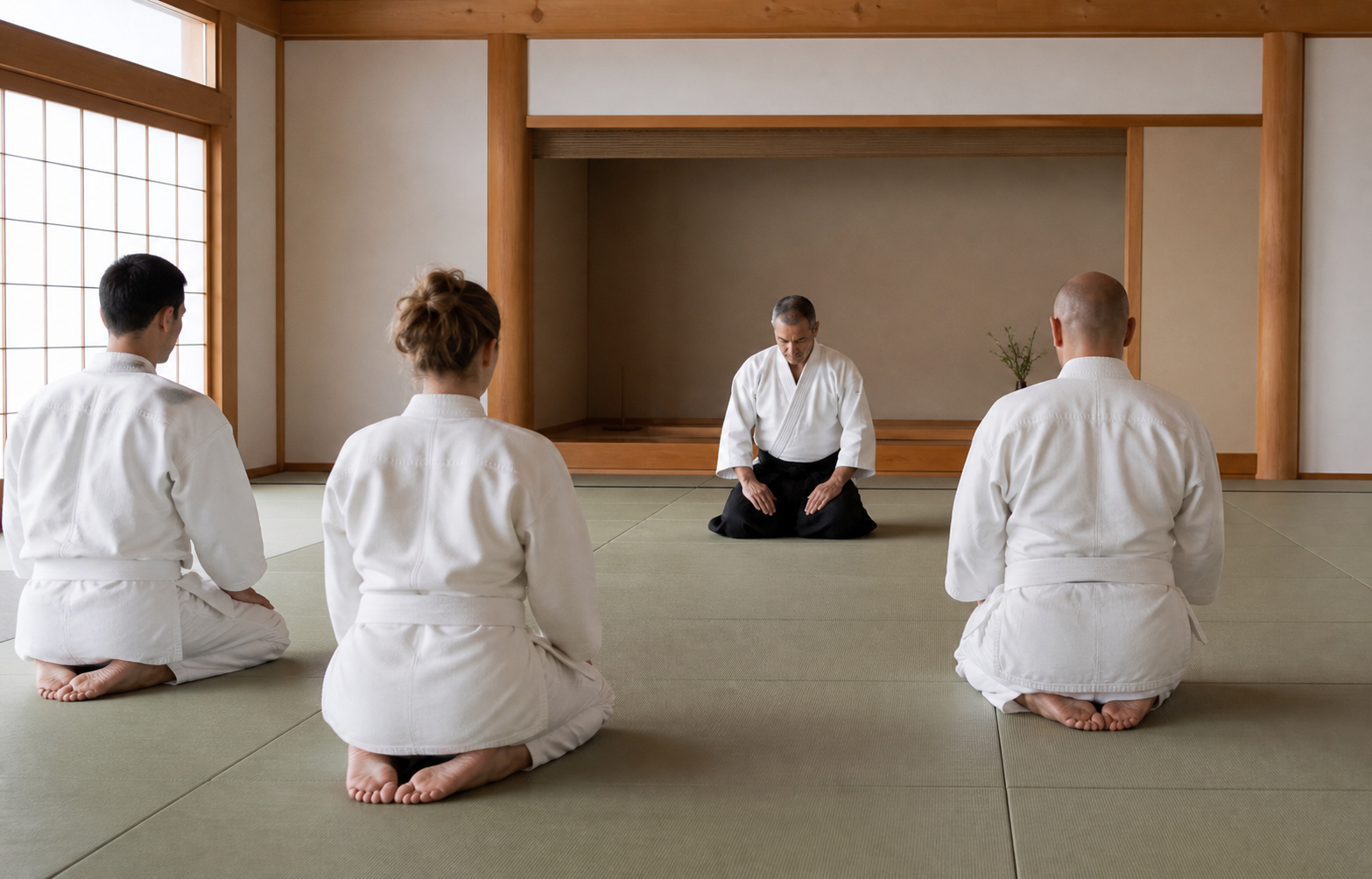
Bowing, attentive listening, appropriate speed, and gratitude help a paired practice remain focused and workable. Clothing, hakama use, weapons study, and etiquette details vary by organisation.
- Dōjō
- A place for training.
- Uke
- The partner receiving a technique.
- Tori / nage
- The partner applying a technique.
- Ukemi
- Safe falling, rolling, and receiving.
- Hakama
- A traditional divided garment used according to school custom.
- Hombu Dōjō
- The Aikikai World Headquarters dōjō in Shinjuku, Tokyo.
Sources and further reading
Last updated: