Karate
Kizami-zuki
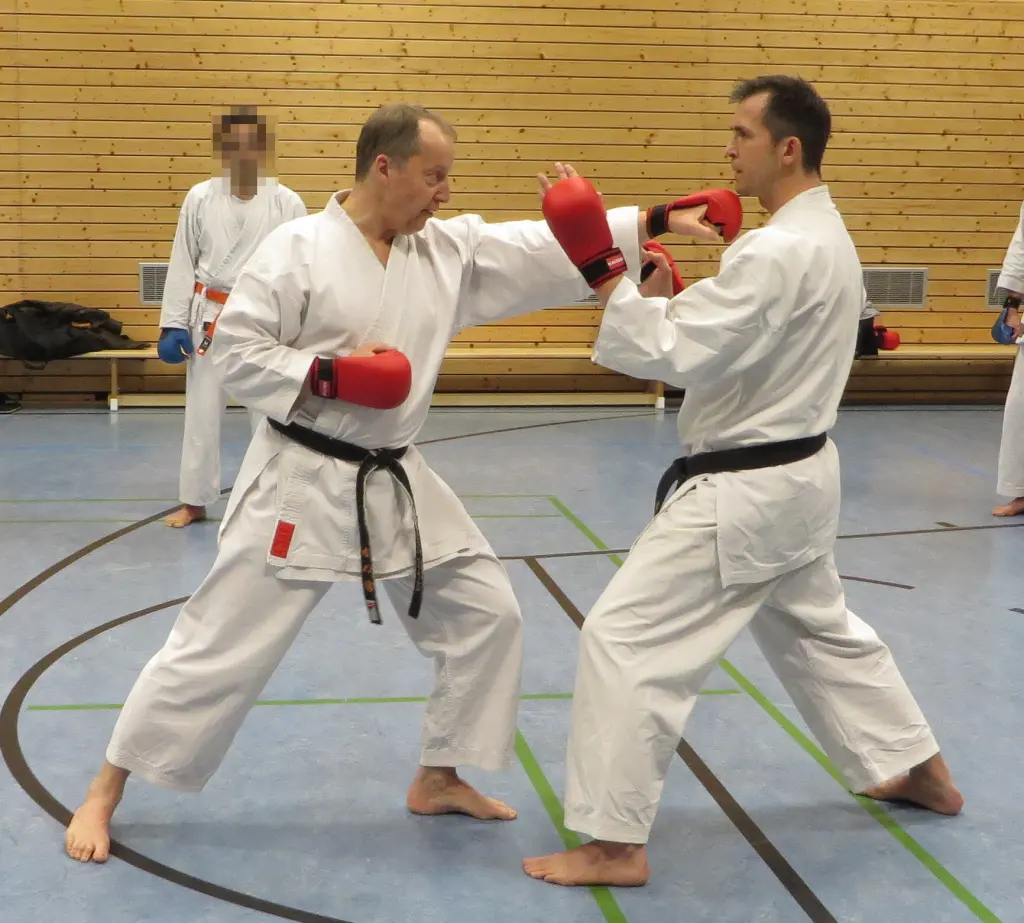
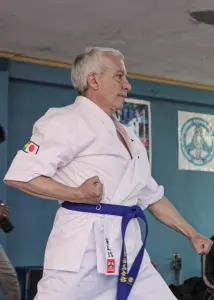
Image: Reclus / Wikimedia Commons · CC0 1.0
Overview
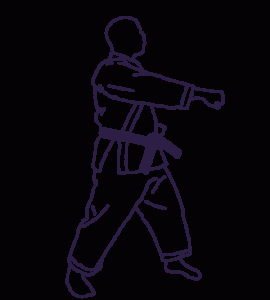
Kizami-zuki carries the leading fist into range with the foot already in front.
Kizami-zuki (刻突き・刻み突き) is a lead-hand Karate thrust. The JKF describes an upper-level attack made from guard as the front foot steps in and the rear leg quickly follows. That institutional model gives a clear reference without fixing one universal stance depth, hand position, entry distance, or rhythm. The technique is often compared with a boxing jab, but its Karate name belongs to a wider system of stance, footwork, target, control, and hand–leg relationships. Preparation, entry, contact line, rear-leg recovery, guard, and return form one continuous action.
The attacking side is already forward.
Posture and guard remain organised.
The base returns under the centre for continuation.
- Japanese
- 刻突き・刻み突き
- Reading
- きざみつき
- Reference meaning
- Lead-hand thrust or punch
- Classification
- Tsuki · hand technique
- Defining relation
- Front hand attacks with front-foot entry
- Common contexts
- Kihon · kumite
01Name & terminology
Two written forms point to the same lead-hand technique.
The JKF heading and explanatory text use different but related spellings.
刻突き
A compact written form read kizami-zuki.
刻み突き
The inflected form makes the reading more explicit.
Common Romanisations include kizami zuki, kizami-tsuki, and kizamizuki. English “lead-hand punch” is more reliable than treating one boxing comparison as the definition.
02Front-foot entry
The front foot closes distance without changing which side leads.
The rear leg follows so the new position remains usable.
Front hand and foot already lead
Starting range and the selected target define the entry problem.
Front foot and fist advance
The JKF advises against unnecessary rise in head or hip height.
Draw the rear leg in
Restore balance for withdrawal, a second action, or defensive movement.
03Whole-body coordination
A fast leading fist still depends on the legs, centre, and timing.
The arm should not outrun the position that supports it.
Reduces distance
Travel varies with range and the exercise.
Recovers the base
Following action keeps the centre from being left behind.
Preserve direction
Head and hip height, shoulder use, and non-attacking hand are contextual.
Reaches the selected line
Extension remains controlled and ready to return.
04Target, guard & recovery
The JKF model uses jōdan; practice still depends on the drill.
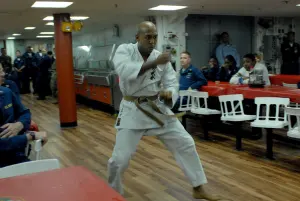
A photographed endpoint shows only one phase of preparation, entry, and return.
Upper level in the JKF definition
Exact target and permitted contact depend on age, organisation, exercise, and equipment.
Keep the other hand meaningful
The non-attacking side supports protection, distance, and the next action.
Return the fist and stance
Do not reach so far that posture, elbow, or rear-leg recovery is lost.
05Compare the tsuki family
Kizami-zuki keeps the existing lead; oi-zuki advances into a new one.
Both can finish with hand and forward leg on the same side, so the entry matters.
Names straightness rather than a fixed arm–leg relationship.
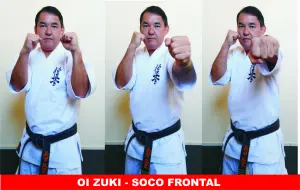
Same-side advanceOi-zuki追突きThe thrusting hand and advancing or forward leg finish on the same side.
Opposite-side relationGyaku-zuki逆突きThe thrusting hand is opposite the forward leg.
Leading-hand entryKizami-zuki刻み突きThe front hand attacks as the front foot enters and the rear leg follows.
06Kihon & kumite
Training can separate the entry, hand, and recovery before recombining them.
The learning sequence is not the timing of the finished action at speed.
07Research, variation & safety
Competition prominence and laboratory measurement describe bounded contexts.
Neither creates one performance standard for every practitioner.
Real and virtual attacks
Twenty-seven experienced athletes responded to an entry sequence from guard; the study examined response behaviour, not a universal technical prescription.
Six athletes, three trials each
Motion capture and force plates linked wrist velocity with whole-body power and timing variables. The small sample supports a mechanical case study.
Sources and further reading
Last updated: