other-martial-arts
Jutsu and Dō in Japanese Martial Arts
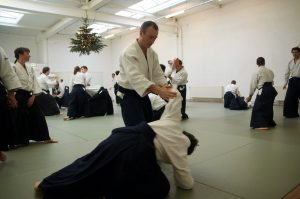
Image: Dushan Hanuska / Wikimedia Commons via Flickr · CC BY-SA 2.0
Overview
The suffix is a clue.
Context does the defining.
Jutsu (術) and dō (道) are useful signals in Japanese martial-art names, but neither word is a complete definition. Read the kanji, historical period, institution, and actual curriculum together.
Technique · art · method · organised body of skills
Way · path · a course of practice or conduct
- Jutsu
- 術 · technique, art, method, or skill
- Dō
- 道 · way or path
- English variation
- Jitsu is established in many names; jutsu is the usual romanisation of 術
- Best reading method
- Check kanji, institution, historical setting, and curriculum
01 Kanji & meaning
Start with the character—not the English gloss.
Translation gives a useful first step. Usage inside a compound and an institution supplies the working meaning.
On-reading · jutsu
A repertoire or method
In jūjutsu (柔術), kenjutsu (剣術), and sōjutsu (槍術), the character can identify an organised art or body of skills—not merely one isolated move.
Useful contrast: an individual technique is more often waza (技), although historical schools maintain their own vocabularies.
On-reading · dō
A way or course of practice
In jūdō (柔道), kendō (剣道), aikidō (合気道), and kyūdō (弓道), “way” is a useful translation. It does not by itself specify a religion, ethical code, ruleset, or teaching method.
Useful contrast: michi is the native Japanese reading of the same character 道.
02 Romanisation
Jutsu is the usual spelling. Jitsu is not automatically “wrong.”
English spellings preserve different histories of transcription, pronunciation, and institutional naming.
Do not reverse-engineer lineage from spelling. Follow a school’s official name, then use its kanji and documented history to clarify what it teaches. See Jujutsu Terminology and Judo, Jujutsu and Brazilian Jiu-Jitsu.
03 Word constellation
Martial vocabulary is a network—not a two-word switch.
Each word points to a different layer: a broad field, a lineage, a training process, a technique, or a method.
Bugei
Martial accomplishments or arts; scope varies by period and source.
Bujutsu
Martial techniques or arts; not automatically a battlefield-only category.
Budō
Martial ways, widely used for modern educational and institutional disciplines.
Ryū / ryūha
A stream, school, or lineage.
Kata
Established forms or patterns.
Keiko
Practice or training.
Waza
A technique or skill.
Hō
A method, principle, or system in context.
The same 道 appears outside martial arts in names such as shodō and sadō. Shared writing does not make their institutions or practices identical.
04 Historical model
Modernisation changed settings, aims, and names—but not in one universal sequence.
Technique was never the whole curriculum.
Schools could transmit etiquette, licences, cosmology, discipline, and social obligations alongside combative methods.
Ethical language did not replace technique.
Modern disciplines retained demanding physical skill while defining public aims through education, character, sport, recreation, or practical application.
05 Paired examples
Two famous pairs show reorganisation—not simple replacement.
reorganised→
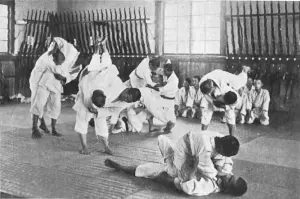
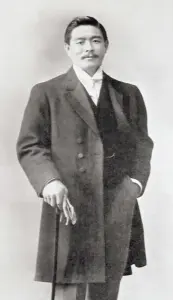
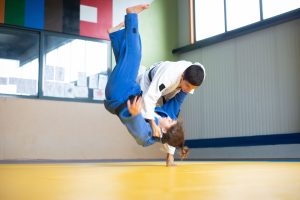
Kano Jigoro used dō to articulate physical, intellectual, and moral education. Judo nevertheless retained and reorganised throws, holds, joint controls, strangling methods, kata, and other technical knowledge.
institutionalised→
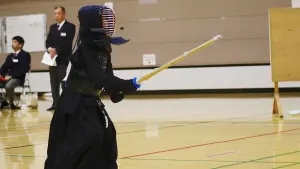
Early twentieth-century organisations brought sword-training names such as kenjutsu and gekiken under kendō. Classical schools continued separately rather than disappearing into one modern system.
06 Other naming patterns
Not every history forms a neat jutsu/dō pair.
Aikidō
The present name was adopted in 1942 after Ueshiba Morihei’s study and development of earlier traditions. The relationship cannot be explained simply by replacing aiki-jūjutsu with aikidō.
Karate / karatedō
Karate is common in English, while Japanese institutions may use karatedō (空手道). The shorter name does not imply the absence of discipline or education.
Sumō, naginata, and more
Recognised arts can use neither 術 nor 道. Jōdō, iaidō, kyūdō, naginata, sumō, and classical systems each follow their own naming histories.
07 Interpretation method
Use four checks before translating a martial-art name.
This sequence separates language from marketing and a current syllabus from a historical claim.
- 01
Read the kanji
Do not guess from Roman letters alone. Identify the actual characters and their compound.
- 02
Name the institution
Use the organisation’s official Japanese and English names.
- 03
Place it in history
Check the period, teachers, lineage evidence, and moments of reorganisation.
- 04
Inspect the curriculum
Read published techniques, rules, teaching aims, and credential structure.
A suffix is evidence about a name. It is not enough to authenticate lineage, rank, technique, philosophy, or effectiveness.
08 Common mistakes
Three shortcuts to remove from your notes.
Jutsu = only combat
Older schools may include ethical, ritual, social, and educational dimensions alongside technique.
Dō = only philosophy
Modern budō can include precise technique, resistance, competition, and practical application.
Same suffix = same family
Shared vocabulary can reflect broad cultural and institutional patterns without proving direct transmission.
For the wider historical setting, return to Japanese Martial Arts.
Sources
Last updated: