Karate
Bunkai
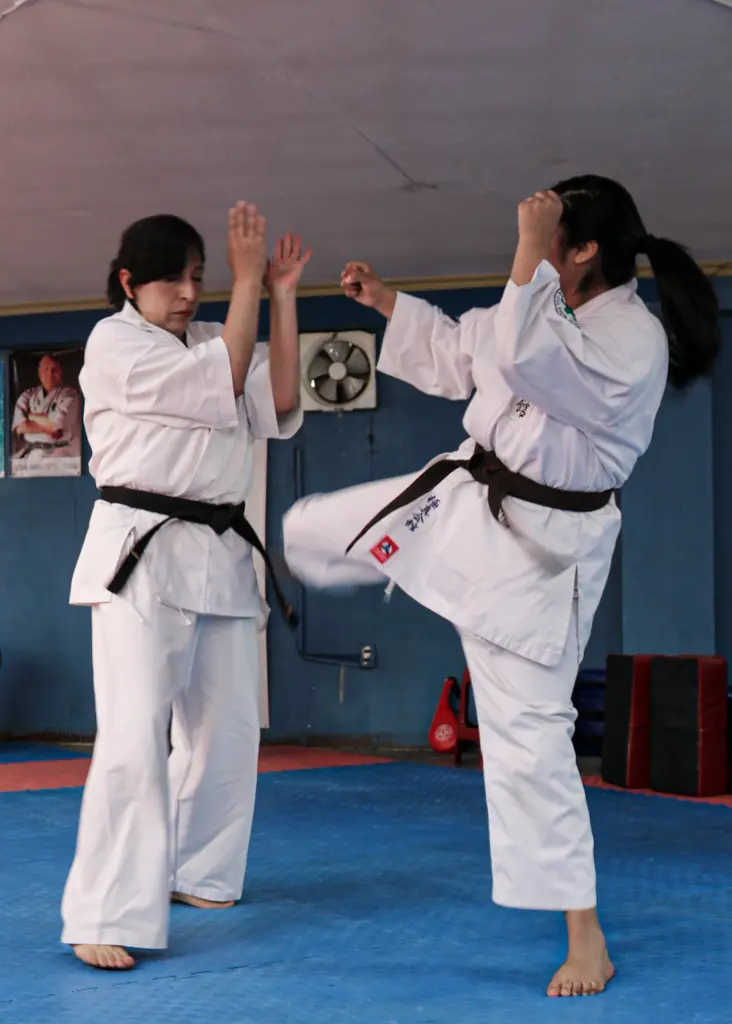
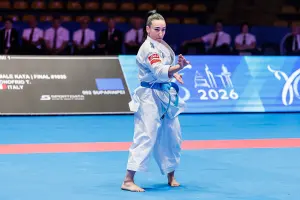
Image: Norkiña / Wikimedia Commons · CC BY-SA 4.0
Overview
Bunkai analyses kata; it does not reveal one official catalogue of hidden answers.
Bunkai (分解) is the analysis of movements contained in Karate kata. It connects prescribed form with questions of function, distance, timing, and response, often through controlled partner study. Similar motions may support more than one interpretation, while a credible application may change angle, spacing, or rhythm. Lineages, instructors, and organisations therefore preserve different readings. In present-day team kata competition, bunkai also names a formal demonstration performed after the kata; that regulated event is one expression of the concept, not its complete meaning in Karate practice.
Kata movement
Position, transition, direction, and sequence.
Analysis
What relationship or function could the movement express?
Partner study
Examine distance, angle, posture, timing, and control.
Ōyō
Apply or modify a reading within a different situation.
- Japanese
- 分解 · analysis or disassembly
- Primary object
- Kata movement and sequence
- Common method
- Explanation and controlled partner study
- Related term
- 応用 · ōyō · adaptation/application
- Important limit
- No universal application catalogue
- Competition use
- Formal team kata demonstration
01Name & meaning
The word means breaking something down for analysis.
“Application” is convenient English, but it can skip the analytical stage.
Divide
Separate a larger whole into inspectable parts.
Unravel or explain
Examine relationships and possible functions.
Analyse kata
Study individual actions, transitions, directions, and sequences.
Some schools use bunkai for the complete interpretive and practical process. Others reserve ōyō for adapting an analysis into a less fixed situation. Neither usage is universal across Karate.
02Relationship to kata
The solo sequence is a stable reference—not a literal floor plan of fixed opponents.
Direction changes and repeated actions need interpretation rather than automatic storytelling.
Recognisable order and form
Postures, transitions, direction, rhythm, and version-specific body method.
How might the relationship work?
Which action receives, controls position, creates an opening, or completes a response?
Analysis may also improve solo practice by clarifying gaze, posture, direction, and intent. The two practices inform one another without becoming identical.
03Evidence & interpretation
State what kind of claim an interpretation actually supports.
“Works in practice” and “was historically transmitted” are different conclusions.
Dated manual, archive, film, or attributable lineage record.
A named organisation or instructor preserves the reading.
Movement and partner test support it, but early transmission is unproven.
An exclusive historical claim without traceable evidence.
Official Okinawan teaching materials place kata and bunkai together, but this confirms application study as part of Karate education—not the uniqueness of every modern explanation.
04Partner study & safety
A partner makes distance and timing visible—under agreed limits.
Reference material should explain context, not provide instructions for injuring someone.
Movement and question
Name the kata version, proposed relationship, and training objective.
Angle, posture, distance
Compare the solo movement with controlled partner positioning.
Timing and response
Increase speed or resistance only within dōjō rules and instructor supervision.
05Bunkai & ōyō
Analysis and adaptation can be distinguished without forcing one vocabulary on every school.
Additional terms such as kaisai may appear in particular lineages.
Bunkai · 分解
Break the kata into parts and examine possible relationships and functions.
Ōyō · 応用
Modify or apply a reading when angle, distance, timing, or response changes.
This distinction is useful for explanation, but it is not a universal historical rule. Attribute the vocabulary to the school or organisation using it.
06Variation among styles
Different kata versions naturally produce different analytical traditions.
Variation may reflect transmission, pedagogy, body method, competition, or later development.
Longer-range examples
Organisation-specific applications connect formal stance, timing, and kumite development.
Close-range analysis
Breathing, receiving, seizing, and off-balancing differ across branches.
Broad kata inheritance
Kenwa Mabuni is important to written and transmitted links between kata and analysis.
Movement and paired form
Jujutsu-informed distance and entry affect how a sequence may be interpreted.
A difference does not prove one version false. A precise account identifies who teaches the reading and how early the evidence can be traced.
07Team kata competition
Competition bunkai is designed to be judged.
Synchronisation, control, clarity, and presentation shape the demonstration.
Three athletes · kata + bunkai
The federation describes a combined five-minute limit for the kata and its demonstration; current event rules govern exact procedure.
Demonstration is not exclusivity
Throws, falls, and dramatic level changes do not prove that one sequence is the sole traditional meaning.
Sources and further reading
- All Japan Karatedo Federation, Karate Terminology Dictionary.
- All Japan Karatedo Federation, Basic Rules of Karatedo.
- Okinawa Prefectural Archives, Shuri-te and Tomari-te Study Guide Record.
- Okinawa Prefecture, School Physical Education Karate Teaching Guide.
- Research Journal of Budo, Egawa, Theoretical Study of Kata in Karate-dō.
- National Diet Library, All Japan Karatedo Federation, Second Designated Kata Manual.
Last updated: