
Seoi-nage
背負投せおいなげ
Shoulder throw
- Te-waza
- Gokyō: Dai-ikkyō
- Nage-no-kata
Key idea
Break uke’s balance forward, turn underneath, connect uke to the back and shoulder line, and project forward over the shoulder.
Kodokan official demonstration
Kodokan technique list (opens in a new tab)YouTube (opens in a new tab)
VISUAL GUIDE
How to read the movement
Look for forward imbalance, a turning entry beneath uke’s centre, and a controlled projection over the shoulder line.
- Tori
- the person applying the technique
- Uke
- the person receiving the technique
- Red line
- main direction or point of contact
AT A GLANCE
Technique shape
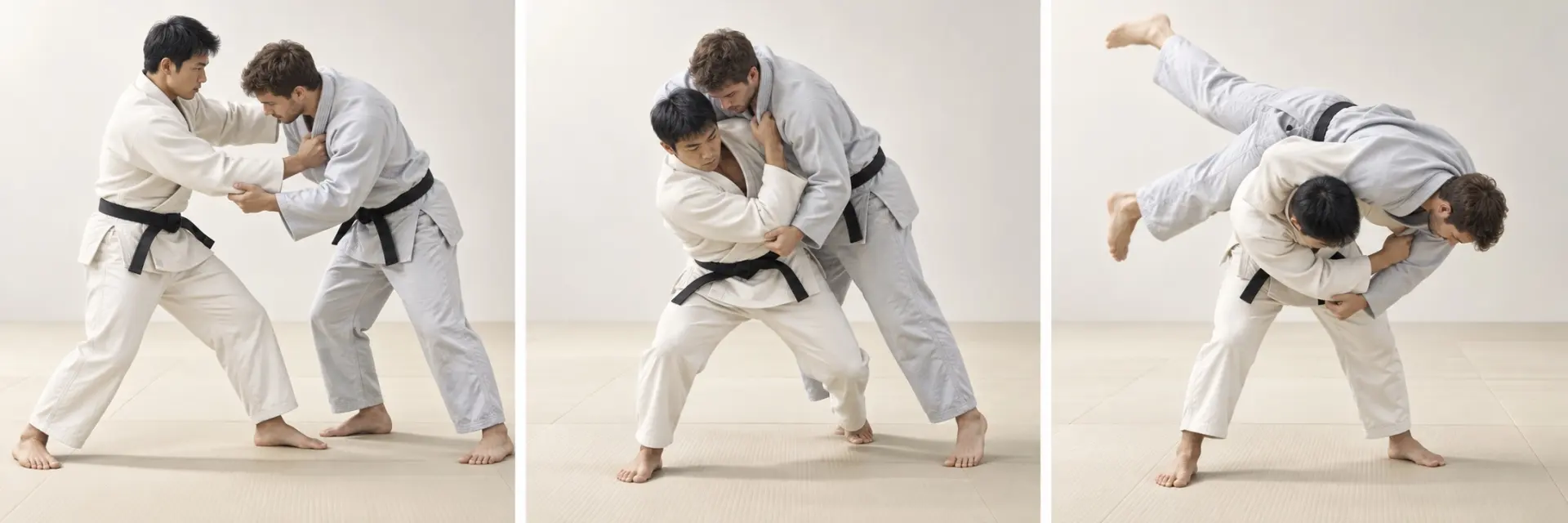
IN SEQUENCE
Three-frame concept
- 1Break balance forward
- 2Enter beneath and connect
- 3Guide forward over the shoulder
Original AI-generated educational illustration for TokyoWaltz, 2026. A simplified three-stage concept; practise under qualified instruction.
PLAY WHEN NEEDED
Watch the movement slowly
- 1Starting pointBreak balance forward
- 2Decisive actionEnter beneath and connect
- 3CompletionGuide forward over the shoulder
1 / 3Starting point— Break balance forward
Follow the red line and phase indicator. The guide does not autoplay or loop.
How it works
Seoi-nage links forward imbalance, a close turning entry, and a controlled projection over the shoulder line.
Kuzushi
Break balance forward
Direct uke forward or toward a front corner, reducing the ability to stay upright or step away. Continue the imbalance as the entry begins.
Tsukuri
Enter beneath and connect
Turn beneath uke’s centre while maintaining the hand-and-arm connection. Align the back and shoulder line closely enough that uke cannot recover through an open gap.
Kake
Project over the shoulder
Coordinate the arms, trunk rotation, and extension from the supporting base. Carry and project uke forward over the shoulder line under control.
Key points
- Continue kuzushi through the turn instead of treating it as a separate pull.
- Keep a close back-and-shoulder connection during entry.
- Coordinate the hands, trunk, and supporting base rather than relying on the arms alone.
Common mistakes
- Entering before uke is off balance. Create and maintain forward instability as the turn starts.
- Leaving space between the bodies. Enter close enough to keep the back-and-shoulder connection.
- Trying to finish with the arms alone. Link arm action to trunk rotation and the supporting base.
Similar techniques
| Technique | Japanese name | Key difference |
|---|---|---|
| Ippon-seoi-nage | 一本背負投 | 一本背負投は投げる側の腕を受の腋下へ入れて上腕を制します。代表的な背負投は両手で柔道衣を持ちます。 |
| Seoi-otoshi | 背負落 | 背負落は身体を落として引き下ろす働きで終わり、背負投は背中と肩の線に受を載せて前方へ投げます。 |
| Tai-otoshi | 体落 | 体落は受を背中へ載せず、前方への身体の落としへ導きます。 |
Technique connections
Follow-up
Seoi-nage to Seoi-otoshi
Source: British Judo Association
Why this connection?
British Judo lists this direction as a renraku-waza example in its Dan-grade skills syllabus.
Direction: Seoi-nage → Seoi-otoshi
- British Judo Association Technical Dan Grade Skills Examination FormNage-waza: renraku-waza combinationsVerified: September 3, 2026
Set-up
O-uchi-gari to Seoi-nage
Source: Judo Canada
Why this connection?
Judo Canada lists this direction as a transition skill in its national kyu grading syllabus.
Direction: O-uchi-gari → Seoi-nage
- Judo Canada National Kyu Grading Syllabus4th Kyu to 3rd Kyu: transition skillsVerified: September 3, 2026
Reference
Open the detailed source material when you need definitions, technical distinctions, training context, or references.
Official definition
Official definition
The Kodokan defines seoi-nage by breaking the opponent forward or toward a front corner, carrying the opponent on the back, and throwing over the shoulder. The definition identifies a functional relationship rather than one mandatory grip, stance, or body height.
The Kodokan page treats the familiar two-handed lapel-and-sleeve performance—often called morote-seoi-nage, eri-seoi, or nihon-seoi—as seoi-nage. It also recognises legitimate grip and leg-position variations when the underlying carrying-and-projecting action remains the same.
Technical principle
Seoi-nage couples the opponent’s upper body to a turning trunk and shoulder line. The thrower enters beneath the opponent’s centre while keeping a connected pull through the sleeve and lapel side, so that rotation and extension project the opponent forward.
Research on seoi-nage examines trunk rotation, entry height, foot placement, and the receiving partner’s posture. These variables change the visible form, but none replaces the need to connect imbalance, entry, and projection.
Name and classification
Overview
| Japanese | 背負投 |
|---|---|
| Reading | せおいなげ |
| Romanisation | seoi-nage; common search form: seoi nage |
| Meaning | Shoulder throw; literally back-carry throw |
| Martial art | Judo |
| Official classification | Kodokan te-waza |
| Gokyō no Waza | Dai-ikkyō |
| Kata | Nage-no-kata, te-waza set |
Japanese name
The name is written 背負投. Seou (背負う) means to carry something on the back, while nage (投) means throw. English descriptions often use “shoulder throw,” but the Japanese name also conveys the loading relationship between the two bodies.
TokyoWaltz uses the Kodokan-style romanisation seoi-nage. The unhyphenated form “seoi nage” is common in searches and English-language discussion, but it refers to the same technique.
Kodokan classification
The Kodokan classifies seoi-nage as te-waza, one of the three standing branches of nage-waza. This classification identifies the hand-and-arm action as central to the recognised mechanism; it does not mean that the legs, hips, or trunk are inactive.
Seoi-nage is one of the 40 throws in the Gokyō no Waza, where it appears in Dai-ikkyō. It is also the middle technique in the te-waza set of Nage-no-kata. These are syllabus and kata relationships, separate from competition rules.
Meaning of seoi-nage
The term describes the opponent being borne on the thrower’s back rather than merely being pulled past one shoulder. This helps explain why a low entry, a split stance, or a leg placed across the line does not automatically change the technique’s official name.
Names used informally in dojo can indicate a grip or entry, but the Kodokan catalogue assigns the official name according to the principal throwing action.
Detailed execution
Kuzushi
Kuzushi is usually directed forward or toward a front corner. Its purpose is not simply to pull the opponent downward, but to reduce the opponent’s ability to remain upright or step safely away from the turn.
Kuzushi may be created from the opponent’s movement, a change of direction, or an attack sequence. It commonly continues during entry rather than ending before the feet move.
Tsukuri
Tsukuri brings the thrower’s body beneath and across the opponent’s line while maintaining hand-and-arm connection. The feet may enter in several recognised patterns, and the knees may flex to match differences in height and posture.
A useful entry aligns the back and shoulder relationship without leaving a large space that lets the opponent recover. It should be studied as whole-body positioning, not as an isolated spin.
Kake
Kake completes the throw through coordinated arm action, trunk rotation, and extension from the supporting base. The opponent is carried and projected over the shoulder line under control.
The Kodokan distinction from seoi-otoshi is important here: lowering the body does not by itself make a drop technique. If the opponent is loaded, lifted, and projected—even after the thrower’s knees briefly touch—the action can remain seoi-nage.
Variations
Common forms
The common two-handed form retains sleeve and lapel control and is widely called morote-seoi-nage. Same-side lapel control, different sleeve positions, standing or low entries, and split-stance versions are also encountered.
These labels describe practical variations rather than additional official Kodokan technique names. A leg may help define the path or restrict the opponent’s step while the throw remains seoi-nage when the decisive action is still carrying and projecting over the back.
Relationship with Ippon-seoi-nage
Both techniques turn beneath the opponent and project from a back-and-shoulder relationship. The Kodokan nevertheless lists them separately. In the representative seoi-nage form, both hands continue to grip the judogi; in ippon-seoi-nage, the throwing-side arm enters under the opponent’s armpit and controls the upper arm while the other hand controls the sleeve.
The difference is therefore not simply standing versus kneeling, or high versus low. Either technique can have height and footwork variations. The recognised use of the hands and arms is the central distinction.
Relationship with Seoi-otoshi
Seoi-otoshi uses a related turning and upper-body connection but finishes by dropping and pulling the opponent down. The Kodokan states that one or both of the thrower’s knees contact the tatami in the seoi-otoshi action.
Knee contact alone is not a reliable label. If the knees touch during entry and then leave the mat as the opponent is lifted and projected, the Kodokan identifies the throw as seoi-nage rather than seoi-otoshi.
Training and safety
Training
Seoi-nage is studied through kata, Uchikomi, controlled throwing practice, and randori. Training can isolate fitting and posture, then restore movement, resistance, and combinations without treating one entry as universally correct.
Safe practice requires an appropriate surface, competent ukemi, and control of the receiving partner’s descent. Learners should not imitate low or head-first competitive entries without qualified supervision.
Competition rules
Competition
Standard seoi-nage is legal in IJF competition. Under the rules researched here—the IJF Sport and Organisation Rules dated 14 August 2026—the result is scored from the actual landing and the throw’s speed, force, back contact, and skilful control, not from the technique name alone.
Deliberately diving head-first during seoi-nage is a dangerous action punished by direct hansoku-make. Cadet rules also treat reverse seoi-nage differently: the action receives no score and is penalised with shido. National and youth rules can add restrictions, so the applicable event regulations remain controlling.
Sources
Sources
- Kodokan Judo Institute, Seoi-nage.
- Kodokan Judo Institute, Ippon-seoi-nage.
- Kodokan Judo Institute, Seoi-otoshi.
- Kodokan Judo Institute, Judo Technique Names.
- Sugaya et al., Trunk Rotation Movement in Seoi-nage, 2025.
- Ishii and Koshida, Biomechanical Factors in Seoi-nage, 2022.
- International Judo Federation, Sport and Organisation Rules, 14 August 2026.