
Ippon-seoi-nage
一本背負投いっぽんせおいなげ
One-arm shoulder throw
- Te-waza
- Gokyō: Not one of the current 40 throws
Key idea
The defining action converts forward instability into a close back-and-shoulder carrying relationship.
Kodokan official demonstration
Kodokan technique list (opens in a new tab)YouTube (opens in a new tab)
VISUAL GUIDE
How to read the movement
Ippon-seoi-nage converts forward instability into a close back-and-shoulder carrying relationship.
- Tori
- the person applying the technique
- Uke
- the person receiving the technique
- Red line
- main direction or point of contact
AT A GLANCE
Classification representative
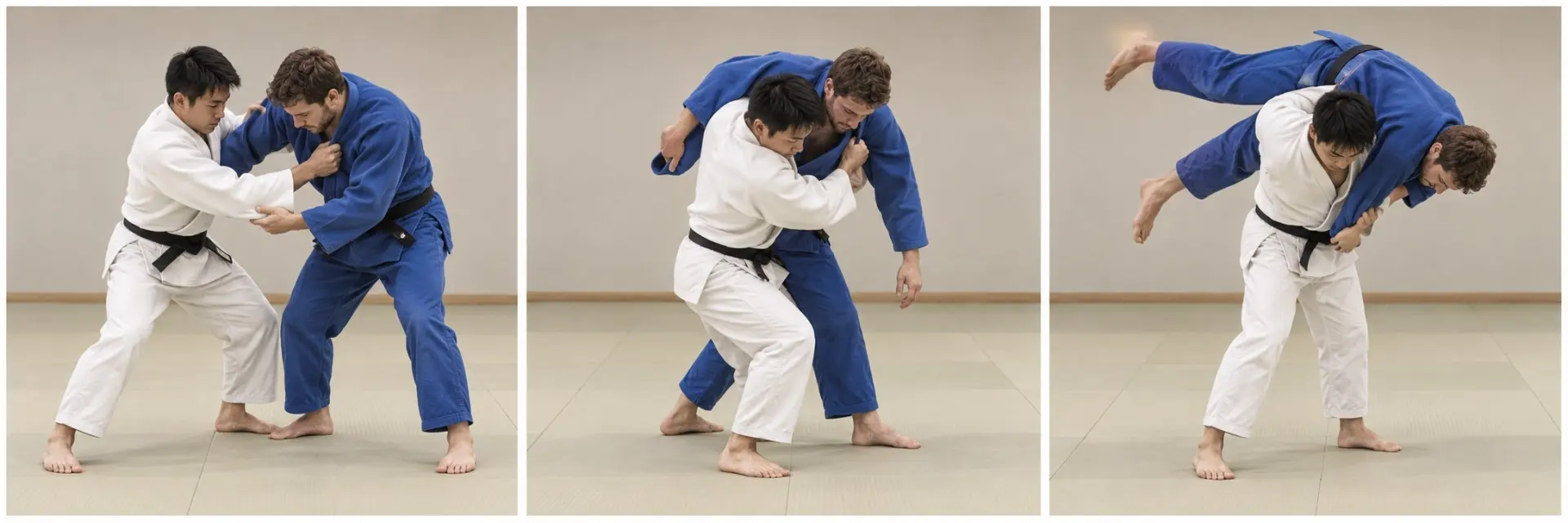
IN SEQUENCE
Three basic phases
- 1Create the imbalance
- 2Enter with control
- 3Complete the action
Original AI-generated educational illustration for TokyoWaltz, 2026. A simplified three-stage concept; practise under qualified instruction.
PLAY WHEN NEEDED
Watch the basic movement slowly
- 1Starting pointCreate the imbalance
- 2Decisive actionEnter with control
- 3CompletionComplete the action
1 / 3Starting point— Create the imbalance
Follow the red line and phase indicator. The guide does not autoplay or loop.
How it works
Ippon-seoi-nage converts forward instability into a close back-and-shoulder carrying relationship.
Kuzushi
Create the imbalance
Kuzushi is generally directed forward or toward a front corner. The sleeve action and movement of the gripping side help limit the opponent’s ability to withdraw the attacked arm or restore posture.
Tsukuri
Enter with control
During tsukuri, the throwing-side arm travels under the armpit and the body turns into a position where the opponent can be carried. The shoulder and upper arm make a secure but controlled relationship with the opponent’s arm.
Kake
Complete the action
Kake coordinates the two arms with trunk rotation and extension from the base. The opponent is projected forward over the shoulder-and-back line while the thrower retains control.
Key points
- Kuzushi is generally directed forward or toward a front corner. The sleeve action and movement of the gripping side help limit the opponent’s ability to withdraw the attacked arm or…
- During tsukuri, the throwing-side arm travels under the armpit and the body turns into a position where the opponent can be carried. The shoulder and upper arm make a secure…
- Kake coordinates the two arms with trunk rotation and extension from the base. The opponent is projected forward over the shoulder-and-back line while the thrower retains control.
Similar techniques
| Technique | Japanese name | Key difference |
|---|---|---|
| Seoi-nage | 背負投 | Seoi-nage couples the opponent’s upper body to a turning trunk and shoulder line; Ippon-seoi-nage converts forward instability into a close back-and-shoulder carrying relationship. |
| Seoi-otoshi | 背負落 | Seoi-otoshi draws uke forward across the back; Ippon-seoi-nage converts forward instability into a close back-and-shoulder carrying relationship. |
| Sukui-nage | 掬投 | Sukui-nage scoops and lifts the lower body; Ippon-seoi-nage converts forward instability into a close back-and-shoulder carrying relationship. |
Reference
Open the detailed source material when you need definitions, technical distinctions, training context, or references.
Official definition
Official definition
In the Kodokan’s representative form, the thrower breaks the opponent forward or toward a front corner, turns in, slides the throwing-side arm under the opponent’s armpit, and controls the opponent’s upper arm against the shoulder and upper arm. The other hand maintains sleeve control as the opponent is carried and projected.
The definition concerns the relationship of the arms and body. It allows right- and left-sided performance and does not require one fixed depth, stance, or knee position.
Technical principle
Ippon-seoi-nage converts forward instability into a close back-and-shoulder carrying relationship. The entering arm, sleeve hand, trunk rotation, and supporting legs work together to prevent the opponent’s upper body from separating during the turn.
Effective versions can be upright, compact, split-stance, or low. Their common feature is controlled projection through the characteristic arm connection, not a single silhouette.
Name and classification
Overview
| Japanese | 一本背負投 |
|---|---|
| Reading | いっぽんせおいなげ |
| Romanisation | ippon-seoi-nage; common search form: ippon seoi nage |
| Meaning | One-arm shoulder throw |
| Martial art | Judo |
| Official classification | Kodokan te-waza |
| Current Kodokan status | Independent official technique name |
| Gokyō no Waza | Not one of the current 40 throws |
Japanese name
The name is written 一本背負投. Ippon (一本) literally means “one” or “one piece” and here refers to the characteristic single-arm carrying form; seoi conveys carrying on the back, and nage means throw.
The Kodokan uses ippon-seoi-nage as a hyphenated romanisation. The common unhyphenated spelling “ippon seoi nage” refers to the same technique and should not be confused with an ippon score.
Kodokan classification
Ippon-seoi-nage is officially classified as te-waza. It is one of the Kodokan’s current 68 nage-waza and one of 16 hand techniques.
It is not a separate item in the current 40-technique Gokyō no Waza or in Nage-no-kata. That absence does not make it unofficial; the Gokyō and kata are selected teaching structures rather than complete lists of Kodokan throws.
Meaning of ippon-seoi-nage
“One-arm shoulder throw” is a practical translation, but it can mislead if read as meaning that only one arm is used. The non-throwing hand normally continues to control the opponent’s sleeve, while the entering arm secures the upper arm from beneath the armpit.
The name distinguishes this arm configuration from the ordinary two-handed judogi-grip form of seoi-nage.
Detailed execution
Kuzushi
Kuzushi is generally directed forward or toward a front corner. The sleeve action and movement of the gripping side help limit the opponent’s ability to withdraw the attacked arm or restore posture.
In randori, kuzushi often comes from a reaction to gripping, stepping, or a preceding attack rather than from a large preliminary pull.
Tsukuri
During tsukuri, the throwing-side arm travels under the armpit and the body turns into a position where the opponent can be carried. The shoulder and upper arm make a secure but controlled relationship with the opponent’s arm.
Entry depth and foot pattern vary with stance and direction. The important point is to preserve posture and connection rather than reaching back or relying on the arm alone.
Kake
Kake coordinates the two arms with trunk rotation and extension from the base. The opponent is projected forward over the shoulder-and-back line while the thrower retains control.
Dropping low can be part of the action, but a head-first dive is neither a defining feature nor an acceptable completion under current IJF safety rules.
Comparison with Seoi-nage
Seoi-nage and ippon-seoi-nage share forward kuzushi, a turning entry, and projection through a back-and-shoulder relationship. Both are Kodokan te-waza, and both can be performed from standing or lower positions.
The official difference lies in hand and arm use. In the representative seoi-nage, both hands retain judogi grips and the lapel-side forearm works beneath the opponent’s armpit. In ippon-seoi-nage, the throwing-side hand releases or changes its grip so that the arm enters more fully under the armpit and controls the opponent’s upper arm; the other hand controls the sleeve.
A one-knee entry is therefore not automatically ippon-seoi-nage, and a standing throw is not automatically seoi-nage. Nor does the informal term morote-seoi-nage create another official technique: the Kodokan treats it as the common two-handed form of seoi-nage.
For indexing and competition statistics, the final label should follow the action actually performed. In coaching, the distinction helps identify whether a failed entry comes from grip-and-arm connection, body position, or the later throwing phase.
Variations
Common forms
Common forms include standing and low entries, right-versus-right and right-versus-left applications, and attacks from sleeve, lapel, or less conventional legal grips. The entry may turn deeply or use a split stance to match the opponent’s movement.
Dojo labels such as “drop ippon-seoi-nage” describe an entry or height. The official technique name still depends on the arm connection and throwing mechanism, and a true downward seoi-otoshi action remains a different classification.
Relationship with Seoi-otoshi
Ippon-style arm control can also appear in a seoi-otoshi. The Kodokan separates that technique by its dropping action: one or both knees contact the mat as the opponent is pulled down, rather than being carried, lifted, and projected.
This is why labels based only on the grip can be incomplete. The arm configuration and the finishing mechanism must both be considered.
Training and safety
Training
Ippon-seoi-nage can be developed through uchikomi, controlled completion, combinations, and randori. Practice should include different stances and moving entries while retaining the distinction between secure upper-arm control and forceful trapping of the shoulder.
Because low entries can expose the head and neck, safe progression requires competent supervision, a suitable mat, and a receiving partner with reliable ukemi.
Competition rules
Competition
Ippon-seoi-nage is legal in senior IJF competition. Scoring follows the actual landing and the general throwing criteria in the IJF Sport and Organisation Rules dated 14 August 2026; the announced technique name does not itself guarantee ippon.
A deliberate head-first dive is punished by direct hansoku-make. In cadet competition, reverse seoi-nage receives no score and is penalised with shido. Organisers may apply further youth or national restrictions, which should be checked separately.
Sources
Sources
- Kodokan Judo Institute, Seoi-nage.
- Kodokan Judo Institute, Ippon-seoi-nage.
- Kodokan Judo Institute, Seoi-otoshi.
- Kodokan Judo Institute, Judo Technique Names.
- Sugaya et al., Trunk Rotation Movement in Seoi-nage, 2025.
- Ishii and Koshida, Biomechanical Factors in Seoi-nage, 2022.
- International Judo Federation, Sport and Organisation Rules, 14 August 2026.