
Tai-otoshi
体落たいおとし
Body drop
- Te-waza
- Gokyō: Dai-nikyō
Key idea
The defining action converts front-corner instability into a forward drop across a positioned body line.
Kodokan official demonstration
Kodokan technique list (opens in a new tab)YouTube (opens in a new tab)
VISUAL GUIDE
How to read the movement
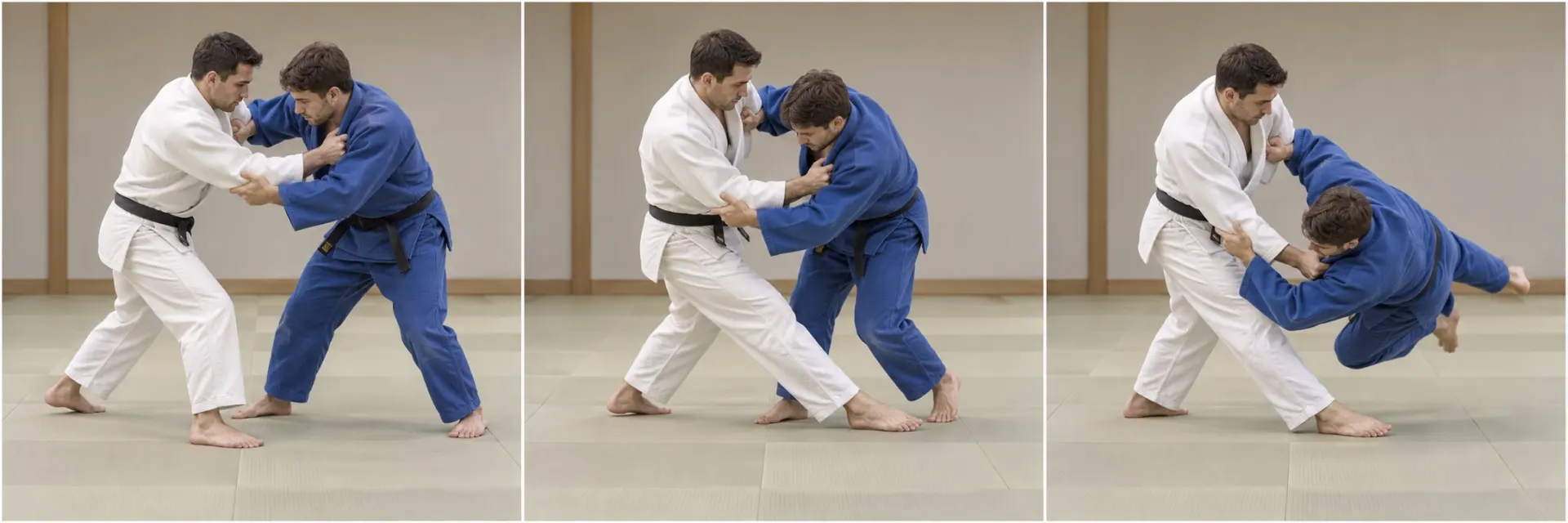
Tai-otoshi converts front-corner instability into a forward drop across a positioned body line.
- Tori
- the person applying the technique
- Uke
- the person receiving the technique
- Red line
- main direction or point of contact
AT A GLANCE
Classification representative
IN SEQUENCE
Three basic phases
- 1Create the imbalance
- 2Enter with control
- 3Complete the action
Original AI-generated educational illustration for TokyoWaltz, 2026. A simplified three-stage concept; practise under qualified instruction.
PLAY WHEN NEEDED
Watch the basic movement slowly
- 1Starting pointCreate the imbalance
- 2Decisive actionEnter with control
- 3CompletionComplete the action
1 / 3Starting point— Create the imbalance
Follow the red line and phase indicator. The guide does not autoplay or loop.
How it works
Tai-otoshi converts front-corner instability into a forward drop across a positioned body line.
Kuzushi
Create the imbalance
Kuzushi is usually toward a front corner. The opponent should become unable to settle squarely behind the foot placed across the line of movement.
Tsukuri
Enter with control
Tsukuri combines body opening with placement of the feet and continued upper-body connection. The front leg is commonly flexed rather than locked, and its line should match the direction created by the hands.
Kake
Complete the action
Kake continues the hand-led rotation and downward direction across the established line. The thrower maintains balance between the feet and controls the opponent’s descent.
Key points
- Kuzushi is usually toward a front corner. The opponent should become unable to settle squarely behind the foot placed across the line of movement.
- Tsukuri combines body opening with placement of the feet and continued upper-body connection. The front leg is commonly flexed rather than locked, and its line should match the direction created…
- Kake continues the hand-led rotation and downward direction across the established line. The thrower maintains balance between the feet and controls the opponent’s descent.
Similar techniques
| Technique | Japanese name | Key difference |
|---|---|---|
| Seoi-otoshi | 背負落 | Seoi-otoshi draws uke forward across the back; Tai-otoshi converts front-corner instability into a forward drop across a positioned body line. |
| Obi-otoshi | 帯落 | Obi-otoshi controls the front of the belt and hip from behind,; Tai-otoshi converts front-corner instability into a forward drop across a positioned body line. |
| Uki-otoshi | 浮落 | Uki-otoshi uses hand control and a sharp forward-corner pull to send uke down without loading the body onto the hip; Tai-otoshi converts front-corner instability into a forward drop across a positioned body line. |
Reference
Open the detailed source material when you need definitions, technical distinctions, training context, or references.
Official definition
Official definition
The Kodokan describes breaking the opponent toward the right front corner, opening the body to the left, placing the right foot in front of the opponent’s right foot, and pulling the opponent forward and down in the representative right-sided form.
The definition emphasises directional hand action and body opening. It does not define the throw as a reap or sweep with the extended leg.
Technical principle
Tai-otoshi converts front-corner instability into a forward drop across a positioned body line. The thrower turns without loading the opponent onto the back as in seoi-nage and without placing the hip as the central fulcrum of a koshi-waza.
The arms, trunk, and two feet form an organised base. The front leg’s position varies, but the throw remains recognisable through the directional pull and body opening.
Name and classification
Overview
| Japanese | 体落 |
|---|---|
| Reading | たいおとし |
| Romanisation | tai-otoshi; common search form: tai otoshi |
| Meaning | Body drop |
| Martial art | Judo |
| Official classification | Kodokan te-waza |
| Gokyō no Waza | Dai-nikyō |
| Technical authority | Kodokan Judo Institute |
Name and classification
Tai (体) means body and otoshi (落) means drop. The name describes the opponent’s body being directed into a drop and does not mean that the thrower sacrifices their own body as in sutemi-waza.
The Kodokan classifies tai-otoshi as te-waza. It appears in Dai-nikyō of the Gokyō no Waza but is not a named technique in Nage-no-kata.
Detailed execution
Why Tai-otoshi is classified as te-waza
The extended leg is easy to see, so tai-otoshi is often described informally as a trip. In the Kodokan representative mechanism, however, the leg does not reap through the opponent’s support as in o-soto-gari, sweep upward as in uchi-mata, or spring the opponent as in hane-goshi.
The hands direct the opponent through a front-corner drop while the thrower’s body opens and turns. The placed leg helps establish the boundary or line across which the opponent falls. Because the decisive action is attributed to the hand-and-body control, the official category is te-waza.
This does not mean the leg is unimportant. Kodokan classifications identify the principal recognised mechanism of a standard form, not the only body part active in the technique.
Kuzushi
Kuzushi is usually toward a front corner. The opponent should become unable to settle squarely behind the foot placed across the line of movement.
The opportunity may arise from forward motion, circling, or a reaction to another attack. Pulling after the opponent has already recovered makes the extended leg carry unsafe loads without producing the intended drop.
Tsukuri
Tsukuri combines body opening with placement of the feet and continued upper-body connection. The front leg is commonly flexed rather than locked, and its line should match the direction created by the hands.
The body need not fit beneath the opponent in the same way as a shoulder throw. The Kodokan comparison with same-side-grip seoi-nage notes that tai-otoshi does not use the same back contact and lifting relationship.
Kake
Kake continues the hand-led rotation and downward direction across the established line. The thrower maintains balance between the feet and controls the opponent’s descent.
The leg should not be treated as a rigid object against which the opponent’s knee is forced. Coaching and drilling should preserve safe alignment and the forward trajectory described by the technique.
Common variations
Tai-otoshi is performed with different grip configurations, entry depths, stance relationships, and angles of the extended leg. Competition versions may be low and compact or use a longer step across the opponent’s movement.
These variations remain tai-otoshi when the principal action is the front-corner body drop. If the opponent is carried over the back, reaped, or swept by a different decisive action, another official name may be more accurate.
Variations
Relationship with Seoi-nage
Tai-otoshi and Seoi-nage are both te-waza and can share a turning entry. In seoi-nage, the opponent is carried on the back and projected over the shoulder line. In tai-otoshi, the opponent is directed across the front-corner line without that loading relationship.
The Kodokan also notes that some seoi-nage forms place a leg across the opponent’s path. Leg position alone does not turn them into tai-otoshi; the carrying or dropping mechanism determines the classification.
Training and safety
Training
Uchikomi can develop coordinated body opening, foot placement, and hand direction. Controlled throwing practice should then add movement and completion while keeping the extended leg and supporting knee in safe alignment.
Partners should avoid driving sideways into a fixed knee or locking the leg in a way that prevents adjustment. Reliable ukemi and a progressive pace are essential.
Competition rules
Competition
Tai-otoshi is legal in IJF competition. The rules researched here are the IJF Sport and Organisation Rules dated 14 August 2026, under which the actual landing and general throwing criteria determine the score.
A deliberate head-first dive during tai-otoshi is punished by direct hansoku-make. Grip restrictions and youth-specific safety rules also apply according to the event.
Sources
Sources
- Kodokan Judo Institute, Tai-otoshi.
- Kodokan Judo Institute, Judo Technique Names.
- Kodokan Judo Institute, Definitions of Judo Techniques, 2022.
- Foot-pressure Study of Major Judo Throws Including Tai-otoshi.
- Biomechanical Study of Uke in Tai-otoshi, 2020.
- International Judo Federation, Sport and Organisation Rules, 14 August 2026.