Karate
Uraken-uchi
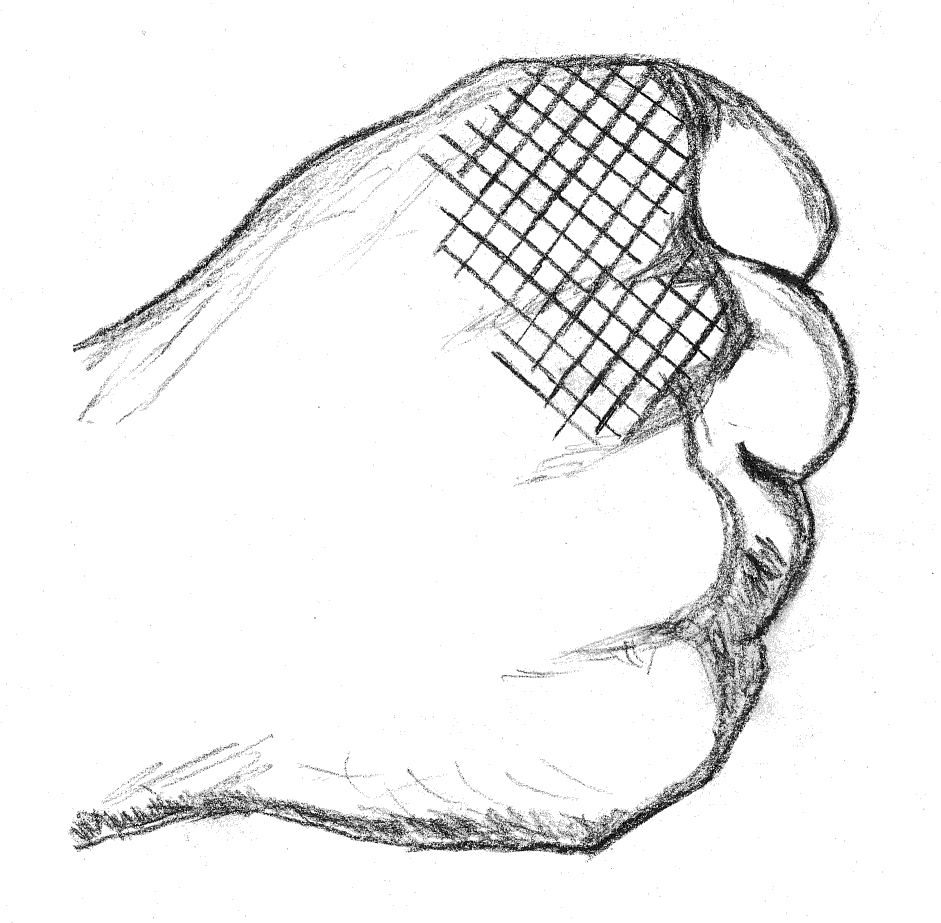
Image: Kurmis / Wikimedia Commons · CC BY 3.0
Overview
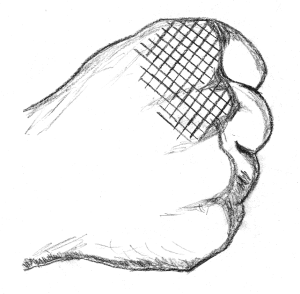
Uraken-uchi strikes with the back-fist knuckle area—not with one universal swing.
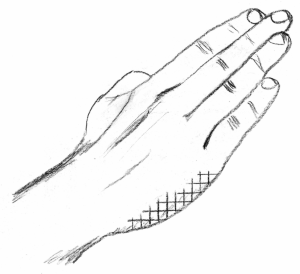
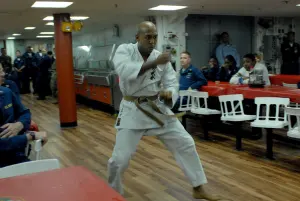
Uraken-uchi (裏拳打ち) is a Karate back-fist strike using the index- and middle-finger knuckle area on the back side of a closed fist. The All Japan Karatedo Federation defines the surface and gives several target examples; a Japan Karate Association manual documents sideways and vertical-plane paths with the elbow acting as a pivot in one model. Those sources make the surface and some named routes visible without establishing a single cross-style chamber, stance, target, or recovery. A back-fist action in kihon, kata, bunkai, or kumite should therefore be read through its specified direction, body relationship, partner task, and rules.
The back-fist surface still depends on a comfortably aligned hand.
JKA uses the elbow as a pivot in one springing half-circle model.
Direction changes target, wrist, elbow, and body relationships.
Snapping appearance must not become uncontrolled joint motion.
- Japanese
- 裏拳打ち
- Reading
- うらけんうち
- Common English
- Back-fist strike
- Contact surface
- Back side of index and middle knuckles
- Classification
- Uchi-waza · striking technique
- JKA path examples
- Sideways · vertical plane
01Name & classification
Uraken identifies the reverse or back side of the fist; uchi identifies the strike.
Sources may use uraken for the surface or action and uraken-uchi for the explicit striking role.
English forms include uraken uchi, uraken-uchi, back fist, and back-fist strike. The shared label does not guarantee identical mechanics.
02Back-fist contact surface
The contact region lies on the back side of the index and middle knuckles.
The JKF defines the surface more securely than it defines a full cross-style technique.
Form it as a stable unit
JKF relates the fist formation to seiken while changing the side used for contact.
Present the back-fist region
The index- and middle-finger joint area distinguishes it from the hammer-fist edge.
Keep hand and forearm connected
A fast return is not useful if the wrist, elbow, or shoulder leaves a comfortable line.
03One JKA path model
A springing half-circle can travel sideways or on a vertical plane.
This is a bounded organisational description, not universal Karate law.
Establish the named starting relationship
JKA’s basic exercise specifies a natural stance and one preparation; other schools can begin elsewhere.
Let the elbow organise the arc
In the cited model, the fist travels through a springing half-circle rather than a straight thrust.
Recover the fist and posture under control
The body must remain available after a sideways or vertical-plane action.
04Path, target & distinction
Direction changes the relationship among fist, elbow, target, and body.
Similar endpoints can emerge from different preparations and tactical contexts.
Uraken-uchi
The closed fist presents the back side of the index- and middle-knuckle region.
Tettsui-uchi
The fist is also closed, but the little-finger-side outer edge creates the named contact surface.
05Selected Uchi-waza family
Uraken-uchi occupies the back-fist position in this four-surface map.
After surface, compare direction, range, stance, and training role.
The little-finger side of an open hand supplies the named striking surface.
Closed fistUraken-uchi裏拳打ちBack-fist knucklesThe index- and middle-finger knuckle area is used from the back-fist side.
Closed fistTettsui-uchi鉄槌打ちHammer-fist edgeThe outer fist beside the little-finger ball creates the hammer-like surface.
Arm segmentEnpi-uchi猿臂打ちElbow regionThe elbow becomes the contact region, principally at close range.
06Kihon, kata & grading context
Named examples locate the strike without fixing every application.
Sequence and syllabus evidence should stay attached to its organisation.
Isolate fist, wrist, elbow, path, and return
JKA’s grading material includes yoko-uraken-uchi in one 1st Dan combination; other associations may teach it differently.
JKF names uraken in Gekisai Dai Ni
A right jōdan uraken-uchi appears inside a longer formal sequence and must be read with its stance and adjacent movements.
Test a declared interpretation
Striking, clearing, control, or transition readings require a named kata, lineage, partner task, and safety agreement.
07Evidence, variation, rules & safety
A single selected trial cannot define Uraken-uchi for all practitioners.
Research samples, combined tasks, and rule systems stay visible in the conclusion.
One participant, five attempts, one analysed trial
The task combined uchibarai and uraken; its measurements cannot establish a universal path, grading standard, or safe impact level.
Force and velocity findings vary by method
Cross-sport results do not transfer automatically to one back-fist model.
Control and current rules decide legality
A training label or grading exercise does not automatically make a variation legal or scoreable.
Protect fist, wrist, elbow, and shoulder
Use suitable targets, gradual progression, and agreed partner contact; avoid uncontrolled strikes to vulnerable areas.
Sources and further reading
- All Japan Karatedo Federation, Uraken.
- All Japan Karatedo Federation, Basic Rules of Karatedo.
- All Japan Karatedo Federation, Basic Kata I — Gekisai Dai Ni.
- Japan Karate Association, Technical Manual for the Instructor.
- Japan Karate Association, Dan Ranking.
- Almani, Biomechanical determinants of sweeping and Uraken in simulated Karate exercises.
- Beránek, Votápek and Stastny, Force and velocity of impact during upper limb strikes in combat sports.
Last updated: