Karate
Shutō-uke
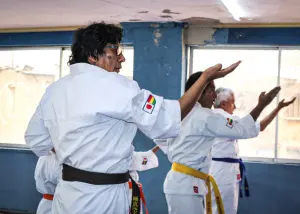
Image: Sdcsabac / Wikimedia Commons (video frame) · CC BY-SA 4.0
Overview
Shutō-uke receives with the knife-hand area, then leaves the body ready to continue.
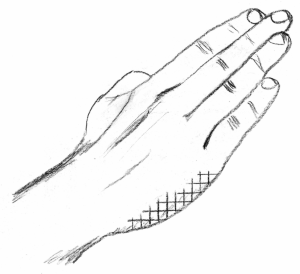
Shutō-uke (手刀受け) is an open-hand Karate receiving action identified by the knife-hand area along the little-finger side of the hand. The All Japan Karatedo Federation describes it broadly as sweeping attacks from upper through lower levels. A familiar Japan Karate Association model narrows that broad family to a middle-level action in back stance, with a second open hand held near the solar plexus. That is one documented Shotokan teaching model—not a universal finish for every school, kata, or application. Read the technique in sequence: form a safe hand, receive or redirect the line, maintain posture, and continue.
Keep the wrist aligned and the fingers together without forcing tension.
Level, angle, and contact depend on the prescribed version and drill.
The second hand, stance, and body angle complete the relationship.
- Japanese
- 手刀受け
- Reading
- しゅとううけ
- Reference meaning
- Knife-hand reception
- Classification
- Uke-waza · receiving technique
- Defining surface
- Little-finger side of the open hand
- Reference range
- Upper through lower attacks
01Name & classification
The name identifies a knife-hand receiving action—not a single fixed application.
The same hand formation can serve different technical roles.
Shutō describes the “knife-hand” shape or area; uke identifies the receiving role. Shutō-uchi uses the same broad hand formation as a strike. The distinction lies in function and movement context, not in the hand shape alone.
02Hand surface & path
A usable knife-hand begins with alignment, not stiffness.
The JKF definition permits upper, middle, and lower receiving paths.
Bring the fingers together naturally
The open hand is organised as a unit without hyperextending or clenching the fingers.
Keep the hand connected to the forearm
A bent or collapsed wrist weakens contact and can make partner work unsafe.
Match the prescribed attack level
“Shutō-uke” does not by itself require one chamber, angle, or endpoint.
03Receiving function
The open hand receives as part of a whole-body relationship.
Contact, stance, angle, and the second hand determine what becomes possible next.
Occupy a threatened line
The hand and forearm create a protective relationship to the incoming action.
Sweep rather than collide
Angle and body position can change the line with less reliance on force.
Coordinate the second hand
Guard, withdrawal, checking, or preparation belongs to the version being taught.
Leave a usable next position
Receiving is not complete if posture, awareness, or the follow-up has been lost.
04One documented Shotokan model
JKA material pairs chūdan shutō-uke with back stance and an active companion hand.
This bounded model is useful for close reading, but should not be presented as Karate-wide law.
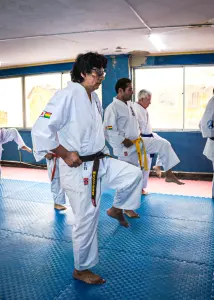
Settle into kokutsu-dachi
In the JKA model, the torso is side-on and the weight relationship supports a stable back stance.
Cut downward to about shoulder height
The wrist remains straight, the elbow keeps a working bend, and the trunk does not lean away.
Keep the companion hand open
JKA places it palm-up in front of the solar plexus, connecting naturally to a following nukite in some syllabus sequences.
05Six receiving actions
Some uke are named by level and direction; shutō-uke is named by its hand surface.
The map separates the organising cue from any single tactical interpretation.
Upper-level reception whose inner forearm rises from below.
Level + pathGedan-barai-uke下段払い受けLower-level reception organised through a sweeping action.
JKF directionChūdan soto-uke中段外受けMiddle-level action moving from the body’s inside outward.
JKF directionChūdan uchi-uke中段内受けMiddle-level action moving from the body’s outside inward.
Hand surfaceShutō-uke手刀受けOpen-hand reception identified by its knife-hand contact area.
Two-hand structureMorote-uke諸手受けA receiving action organised through the relationship of both hands.
06Kihon, kata & bunkai
Training format changes what the same visible movement is used to study.
Formal repetition clarifies structure; sequence and partner work restore context.
Isolate the coordinated shape
Observe the open hand, wrist, elbow, stance transition, companion hand, posture, and recovery. JKA grading documents kokutsu-dachi shutō-uke in its own Shotokan progression.
Read it inside a sequence
A JKA performance of Kankū Dai includes successive shutō-uke. That example locates the movement in one Shotokan kata model without defining all lineages.
Test bounded interpretations
Partner study may explore covering, redirecting, checking, clearing, controlling, or preparation. Plausibility depends on the specific kata, transition, distance, and instructor.
07Evidence, rules & safe study
Sources answer different questions and should not be made to say more than they measured.
Technical references, a cognitive study, and competition rules each have a distinct scope.
JKF breadth and JKA specificity coexist
The JKF supplies the broad knife-hand receiving category. JKA manuals and grading material document one detailed Shotokan model and progression.
Mental representation, not universal biomechanics
A study of twelve Shotokan practitioners examined the first seventeen movements of Kanku-dai and error prediction. It does not establish one optimal shutō-uke for every school.
Kata quality and kumite scoring are different questions
Kata criteria evaluate the performance as a whole. Kumite rules regulate contact and prohibit dangerous open-hand actions to the face; an isolated formal uke does not automatically score.
Control line, speed, and contact
Use an agreed target and progression, preserve wrist, elbow, and shoulder comfort, and stop when alignment or partner control deteriorates.
Sources and further reading
- All Japan Karatedo Federation, Shutō-uke.
- All Japan Karatedo Federation, Uke-waza terminology.
- Japan Karate Association, Technical Manual for the Instructor.
- Japan Karate Association, Dan Ranking and Grading Syllabus.
- Schack et al., study of mental representation and error prediction in Shotokan Kanku-dai.
- All Japan Karatedo Federation, Karatedo Competition Rules.
Last updated: