Karate
Jōdan age-uke
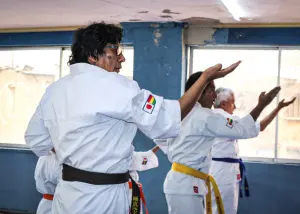
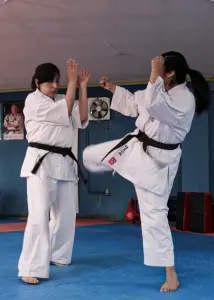
Image: Sdcsabac / Wikimedia Commons (video frame) · CC BY-SA 4.0
Overview
Jōdan age-uke receives an upper line by rising into it—not by freezing beneath it.
Jōdan age-uke (上段揚げ受け) is an upper-level rising receiving action in Karate. The All Japan Karatedo Federation describes the inner forearm lifting from below against an attack to the face, with the fist higher than the elbow when the action is completed. That description supplies a useful level and direction, but not one universal pose. Preparation, stance, forearm rotation, elbow distance, use of the other hand, and the next action vary among schools. Read the technique as a relationship: establish the line, rise to cover or redirect it, remain balanced, and continue safely.
Target, distance, guard, and partner role are established first.
The action covers or changes the line rather than chasing a fixed photograph.
Posture, vision, and the next action complete the receiving relationship.
- Japanese
- 上段揚げ受け
- Reading
- じょうだんあげうけ
- Reference meaning
- Upper-level rising reception
- Classification
- Uke-waza · receiving technique
- Reference target
- An attack directed toward the face
- Defining path
- Inner forearm rises from below
01Name & classification
The compound records level, rising direction, and receiving function.
Shorter labels such as age-uke omit the explicit upper-level qualifier.
Common spellings include jodan age uke and jōdan ageuke. “Upper-level rising block” is familiar English; “upper-level rising reception” keeps the broader meaning of uke visible.
02Upper rising path
The JKF reference defines a rising relationship, not one universal set of angles.
The relative heights of fist and elbow help distinguish the completed shape from a horizontal reception.
Establish an unobstructed path
Exact chamber and the non-receiving hand depend on the named school and exercise.
Bring the inner forearm across the upper line
The JKF describes the motion from below to above against an attack to the face.
Keep the head observable and posture recoverable
Coverage must not become a rigid endpoint that prevents continuation.
03Receiving function
An uke changes the attack relationship while preserving initiative.
A formal arm path can cover, intercept, redirect, or connect to another action.
Protect the upper line
The forearm occupies space between the attack and the face.
Change the incoming line
Angle and body position can reduce reliance on a head-on collision.
Coordinate the other hand
Hikite or guard position belongs to the wider movement, not an isolated arm.
Preserve a usable next position
The technique remains part of a sequence in kata, kihon, or partner practice.
04Posture & control
Shoulder comfort, vision, and balance matter as much as forearm height.
A larger-looking shape is not better if it loses alignment or the next action.
Rise without forcing the joint
Exact elbow distance varies; avoid lifting through pain or locking the arm.
Maintain a controlled contact surface
Rotation belongs to the prescribed version and should not strain the wrist.
Keep sight and support
Coverage should not hide the partner or pull the trunk away from its base.
05Compare the uke family
Start with target level and movement direction.
The four cards share one reference model while leaving school variation explicit.
The inner forearm rises from below to receive an upper-level attack.
Lower · sweepingGedan-barai-uke下段払い受けA sweeping relationship redirects an attack aimed broadly below the waist.
Middle · outwardChūdan soto-uke中段外受けIn JKF terminology, the arm moves from the body’s inside toward the outside.
Middle · inwardChūdan uchi-uke中段内受けIn JKF terminology, the arm moves from the body’s outside toward the inside.
06Kihon, kata & partner practice
Training format changes which part of the receiving relationship is emphasised.
Formal repetition isolates the path; sequences and partners restore timing and context.
Kihon
Studies the rising path, stance transition, other hand, posture, and recovery. JKA grading material documents age-uke from early kyu levels in its own Shotokan syllabus.
Kata and bunkai
Connects the action to turns and adjacent movements; bunkai tests interpretations without proving one exclusive historical intention.
Partner practice
Adds an agreed upper attack, distance, timing, speed, and controlled continuation.
07Research, variation & safety
A measured task can document context without defining the technique for every school.
Sample, sequence, and research question determine what a study can support.
Formal and sport contexts can change scale
A literature-based review contrasts a larger traditional path with a shorter action from guard. It does not establish one universal ideal.
Eleven participants performed a combined sequence
Jōdan age-uke was one element among several. Oxygenation and exertion findings cannot be assigned to this action alone.
Sources and further reading
- All Japan Karatedo Federation, Jōdan age-uke.
- Japan Karate Association, Dan Ranking and Grading Syllabus.
- Sopčić et al., Hand Block Techniques in Traditional and Modern Sport Karate.
- Natsume and Takaki, Pilot Study on Changes in Frontal Oxygenated Hemoglobin Levels in Beginners During Practice of Karate Forms.
Last updated: