Karate
Gedan-barai-uke
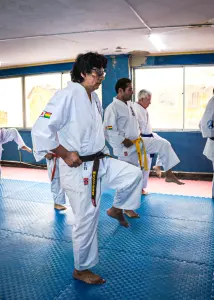
Image: Sdcsabac / Wikimedia Commons (video frame) · CC BY-SA 4.0
Overview
Gedan-barai-uke sweeps through a lower line while the whole body stays available.
Gedan-barai-uke (下段払い受け) is a lower-level sweeping receiving action in Karate. The All Japan Karatedo Federation describes a relationship with attacks directed broadly below the waist and gives mae-geri, the front kick, as one example. The name does not mean that every front kick should be met this way or that every kata occurrence has one application. Chamber, sweep angle, forearm surface, stance, withdrawing hand, and continuation vary among schools. The stable reference is a lower-level receiving relationship organised through a sweeping path.
Target, range, stance, and partner role define the problem.
Arm, stance, and body angle work as one controlled action.
The receiving action prepares the next movement rather than ending at a pose.
- Japanese
- 下段払い受け
- JKF reading
- げだんはらいうけ
- Reference meaning
- Lower-level sweeping reception
- Classification
- Uke-waza · receiving technique
- Reference level
- Broadly below the waist
- JKF example
- Mae-geri · front kick
01Name & classification
The name joins lower level, sweeping action, and reception.
Organisations may shorten the label without changing the basic reference.
Common labels include gedan-barai, gedan-uke, and “downward block”. The JKF prints the reading げだんはらいうけ, while JKA grading material uses the compact romanisation GEDAN BARAI.
02Lower sweeping path
The supported definition is a lower-level relationship, not one fixed chamber and endpoint.
Formal versions often travel diagonally downward and outward while stance and the other hand reorganise.
Organise the chamber and base
Starting height and the withdrawing hand vary by school and sequence.
Travel through the lower line
Angle, forearm rotation, and body turn combine to receive or redirect.
Keep balance after the clearance
The end position should allow a counteraction, step, or continued sequence.
03Receiving function
A lower sweep can intercept, redirect, clear, or create room to continue.
The English “block” is narrower than the possible receiving relationships.
Protect the lower line
The JKF places the reference broadly below the waist.
Change the path rather than meet it squarely
Body position can reduce the force that the arm must manage.
Coordinate guard or withdrawal
The other side belongs to posture and continuation, not decoration.
Preserve initiative
The sweep should not leave the practitioner unable to step, strike, or receive again.
04Posture, contact & recovery
The sweep is carried by a stable body, not thrown from an isolated shoulder.
Comfortable alignment matters more than maximising the visible size of the action.
Maintain a controlled arc
Avoid locking the elbow or forcing the shoulder downward.
Match surface to the named drill
Partner practice must avoid uncontrolled impact against the knee or shin.
Keep the whole task available
Do not let the upper body collapse toward the sweep or lose sight of the partner.
05Compare the uke family
Gedan-barai is the lower sweeping member of the four-way comparison.
Level and direction clarify the family before applications are debated.
The inner forearm rises from below to receive an upper-level attack.
Lower · sweepingGedan-barai-uke下段払い受けA sweeping relationship redirects an attack aimed broadly below the waist.
Middle · outwardChūdan soto-uke中段外受けIn JKF terminology, the arm moves from the body’s inside toward the outside.
Middle · inwardChūdan uchi-uke中段内受けIn JKF terminology, the arm moves from the body’s outside toward the inside.
06Kihon, kata & partner practice
Repetition, sequence, and contact each reveal a different part of the action.
No single training format exhausts the meaning of the movement.
Kihon
Studies chamber, sweeping path, stance transition, hikite, alignment, and recovery. JKA material lists GEDAN BARAI in its own early kyu syllabus.
Kata and bunkai
Places the action among steps and turns; bunkai can explore receiving, striking, clearing, or control interpretations.
Partner practice
Uses an agreed lower attack to study distance, timing, angle, and controlled continuation.
07Research, variation & safety
Technical and sensor studies illuminate bounded tasks, not a universal ideal.
Context, sample, and measurement design remain part of every conclusion.
Formal and sport versions may differ in amplitude
A literature-based paper contrasts larger traditional paths with shorter actions from guard. It does not standardise all Karate.
Fifty-three performances by four national-team athletes
Gedan Barai was one test skill in an automatic evaluation system. Its curves are not universal biomechanics or grading criteria.
Sources and further reading
- All Japan Karatedo Federation, Gedan-barai-uke.
- Japan Karate Association, Dan Ranking and Grading Syllabus.
- Sopčić et al., Hand Block Techniques in Traditional and Modern Sport Karate.
- Fathalla et al., Real-Time and Automatic System for Performance Evaluation of Karate Skills Using Motion Capture Sensors and Continuous Wavelet Transform.
Last updated: