Karate
Sanchin
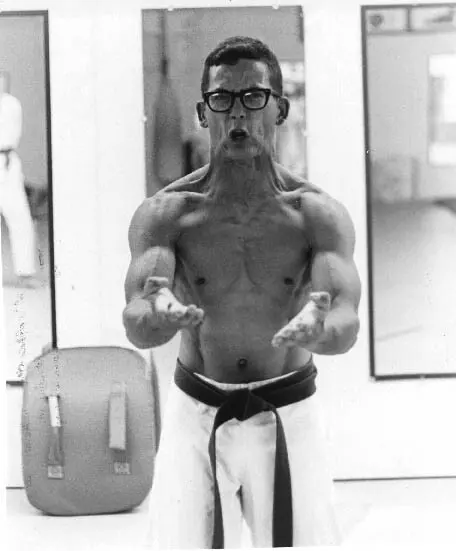
Image: Katagwa / Wikimedia Commons · CC BY-SA 3.0
Sanchin (三戦) is a Karate kata transmitted in several Okinawan traditions, especially lineages associated with Naha-te and Uechi-ryū. Its compact stepping pattern is used to study posture, breathing, attention and coordinated whole-body action. Gōjū-ryū Karate gives Sanchin a particularly visible foundational role, but Gōjū-ryū branches do not all perform or test it identically, and Uechi-ryū preserves a technically distinct version. The title is often translated as “three battles” or “three conflicts”; explanations of exactly what the three represent belong to particular teaching traditions. This article separates documented historical and organisational contexts from universal claims about breathing, tension or health.
JKF framework
Where this kata sits
Official competition placement and broader guide context are shown separately.Official JKF position
Tokui kata
- Gōjū
- Shitō
The dated JKF amendment records Sanchin in the Gōjū-ryū and Shitō-ryū Tokui lists.
Guide context
Sanchin
- Gōjū
- Uechi
Uechi-ryū is an important guide context, but it is not a fifth column in this JKF competition framework.
Overview
| Japanese | 三戦 |
|---|---|
| Reading | さんちん |
| Romanisation | Sanchin |
| Common translation | Three battles or three conflicts |
| Classification | Karate kata; foundational body-training form |
| Major associations | Gōjū-ryū, Uechi-ryū and other Naha-linked lines |
| Characteristic stance | Sanchin-dachi, with style-specific form |
| Important boundary | Breathing and tension are not universal |
Name and meaning
The characters san and chin are conventionally read as three and battle or conflict. English explanations often connect the three to body, mind and spirit, but such interpretations should be identified as teachings rather than treated as a literal historical definition.
The same name does not guarantee the same kata. Gōjū-ryū, Uechi-ryū and related traditions preserve recognisably different sequences, hand forms, breathing methods and performance emphases.
Naha-linked transmission
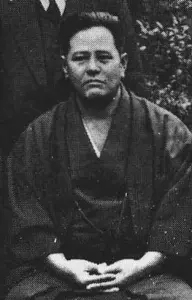
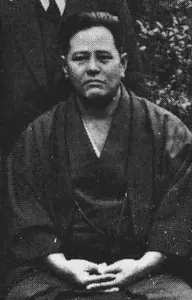
Sanchin is prominent in lineages associated with Naha and with the teaching networks linked to Kanryō Higaonna. Chōjun Miyagi placed it within the modern system now called Gōjū-ryū.
The Okinawa Karate Information Center records that Miyagi's student Shinzato Jin'an demonstrated Sanchin at the Meiji Shrine in 1930 in the episode connected with the public naming of Gōjū-ryū. This documents one modern institutional moment, not the beginning of the kata.
Gōjū-ryū and Uechi-ryū versions
Gōjū-ryū Sanchin commonly uses closed fists and strongly audible or controlled breathing in many branches. Uechi-ryū versions commonly preserve open-hand actions and a different sequence and testing culture.
Those are broad identifying tendencies. Even within one named style, organisations differ in pace, muscular engagement, breathing sound, stepping and the amount or method of external checking.
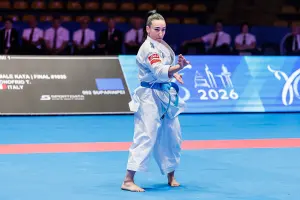
Sanchin-dachi and posture
Sanchin is closely associated with Sanchin-dachi. The JKF glossary explicitly notes that the stance differs by style, which makes one fixed set of foot angles unsuitable as a universal definition.
The kata coordinates the feet, knees, pelvis, trunk and shoulders while moving. The stance is therefore a changing support relationship rather than a shape that can be understood from a still image alone; see Karate Stances.
Breathing and muscular engagement
Sanchin practice may organise breath with stepping and hand actions, but timing, sound and muscular tension are lineage-specific. “Hard” performance should not be reduced to continuous maximal contraction.
Sports-medicine and biomechanics publications can describe measured posture or physiological response under defined protocols. They do not establish one medically superior method or replace instruction adapted to the practitioner's condition.
Checking and partner feedback
Some schools use shime, partner checking intended to give feedback on posture, attention, breathing or stability. The term and procedure vary considerably among organisations.
Checking is not an invitation for uncontrolled striking, forced breath-holding or pressure on vulnerable joints. It requires a qualified instructor, explicit consent and intensity appropriate to the learner.
Competition context
The rules for the 2nd Okinawa Karate World Tournament list Sanchin in Naha-te and Uechi-ryū appendices for several age groups. The separate listings recognise that the event groups different transmitted versions.
This establishes eligibility within that dated Okinawan tournament. It does not define the curriculum of every dōjō or convert a body-training kata into a single federation-standard performance.
How to study it safely
Learn the breathing method and stance from an instructor in the named tradition. Avoid copying dramatic tension, breath retention or partner checking from short videos without the surrounding progression.
Stop if practice causes dizziness, chest pain, sharp joint pain or numbness. People with cardiovascular, respiratory or musculoskeletal concerns should seek appropriate professional guidance before intense breath or tension training.
JKF official kata videos
Official reference
Use these federation reference films to compare named versions. Each video documents one JKF-published model for the named tradition; it does not define every dōjō or lineage.
Sources
- Okinawa Karate Information Center, Okinawa Karate and Kobudo.
- The 2nd Okinawa Karate World Tournament, Rules and Regulations.
- All Japan Karatedo Federation, Karate Terminology Dictionary.
- Yoshiharu Fujieda, Scientific Evaluating Sanchin and Tensho of Goju-ryu Karatedo Katas from the Viewpoint of Sports Medicine.
- Biomechanical and Functional Analysis of Goju-ryu Karate Stances, PubMed.
Last updated: