
Games
Pokémon
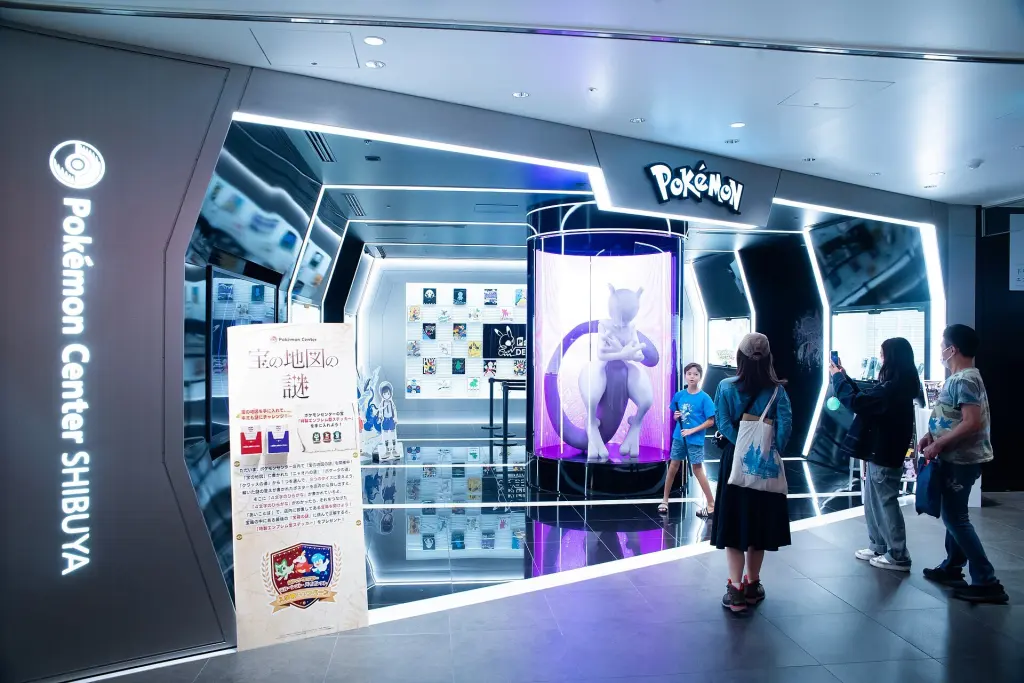
Image: Dick Thomas Johnson / Wikimedia Commons · Creative Commons Attribution 2.0 Generic
Pokémon
Games, characters and everyday places form a media culture.
Pokémon is a Japanese media franchise that began with Pocket Monsters Red and Green, released for Nintendo’s Game Boy in Japan on 27 February 1996. Designed around finding, collecting, raising, trading, and battling fictional creatures called Pokémon, the games turned the handheld system’s Link Cable into a social exchange mechanism. The property soon expanded into a trading card game, television anime, manga, films, toys, shops, competitive events, and later mobile applications. The Pokémon Company, established in an earlier form in 1998 by Nintendo, Creatures, and Game Freak and renamed in 2000, coordinates the brand across these media. Pokémon is therefore both a role-playing game series and a larger media mix whose characters move between software, print, animation, commodities, and public places. Its history should not be reduced either to Nintendo alone or to the anime adaptation.
Games
Collecting and exchange connect players.
Media mix
Recognisable characters travel across formats.
Public places
Shops and collaborations enter everyday life.
At a glance
- Japanese name
- ポケットモンスター / ポケモン
- Romanization
- Poketto Monsutā / Pokemon
- First release
- Pokémon Red and Green, 27 February 1996
- Original platform
- Nintendo Game Boy
- Original developer
- Game Freak
- Core actions
- Collect, raise, trade, and battle
- Brand manager
- The Pokémon Company
- Media forms
- Games, cards, anime, manga, films, merchandise, and apps
01
Name and scope
The Japanese title Pocket Monsters is commonly shortened to Pokémon. The accented spelling signals the intended pronunciation in international branding. Within the fiction, “Pokémon” names both the creatures and the world of activities organized around them.
As a cultural subject, Pokémon has several overlapping identities: a core series of role-playing games, a larger family of video games, a trading card game, an animated screen property, a body of manga, and a character-licensing system. No one format fully contains the others.
02
Red and Green in 1996
Game Freak developed Pocket Monsters Red and Green over several years before Nintendo released them in Japan for the Game Boy. The aging handheld’s monochrome display was technically modest, but portability and the Link Cable suited a game built around personal collections and exchange.
The paired versions did not contain exactly the same available creatures. Trading was therefore part of completion rather than an optional competitive extra. Later paired releases retained this principle while expanding regions, characters, battle systems, and hardware features.
03
Collect, raise, trade, and battle
Players travel through a region, encounter wild Pokémon, catch selected creatures, assemble a team, and battle other trainers. Experience, moves, elemental types, evolution, and statistical variation turn the collection into a strategic system rather than a static catalog.
Trading gives the collection a social boundary: one player’s game cannot supply every relationship or version-exclusive creature. The core design joins individual attachment to creatures with exchange, comparison, cooperation, and competition between players.
04
Regions, generations, and continuity
Successive core games introduce regions, local stories, additional species, and revised battle mechanics. Fans commonly group major releases into generations, but the company’s products also include remakes and titles whose relationship to the central sequence differs.
The fictional geography borrows selectively from Japanese and overseas places without reproducing them as literal maps. Persistent creatures and shared rules create continuity, while each region can support its own visual identity, ecology, characters, and localized themes.
05
From game to media mix
The Pokémon Trading Card Game launched in Japan in October 1996, and the television anime began in April 1997. Manga, films, toys, magazines, and promotional campaigns expanded the property further. These forms did more than advertise one original text: each supplied distinctive stories, rules, images, and modes of participation.
Characters provide the connective tissue. A creature can be encountered as game data, a card, an animated personality, a toy, or a public mascot while remaining recognizable. This is a strong example of Japan’s media mix, in which circulation across platforms sustains a shared fictional world.
07
Localization and global circulation
The first games reached markets outside Japan as Pokémon Red and Blue, accompanied by a coordinated expansion of animation, cards, toys, and publishing. Creature names, dialogue, rules terminology, cultural references, and marketing had to be adapted across languages while preserving cross-media recognition.
Localization did not simply remove Japan from the property. It reorganized how Japanese origins were made visible, muted, or reinterpreted in different markets. Global fans also encountered releases and promotional practices at different times, producing regional histories within the larger franchise.
08
Cards, competition, and play beyond the core games
The Pokémon Trading Card Game entry examines deck construction, illustrated collecting and the distinction between tabletop and digital play.
The trading card game turns collecting and battling into a tabletop rules system. Organized video-game and card competitions create another layer of play, with formats, eligible products, and strategic environments that change over time.
Spin-off games explore photography, puzzles, dungeons, stadium competition, pinball, movement tracking, and location-based play. These works vary in developer and genre, showing that Pokémon is a platform for game forms rather than one endlessly repeated role-playing design.
09
Stores, transport, and everyday places
Pokémon GO extends this geography into a location-based mobile game, linking Pokémon encounters and events to parks, landmarks, streets, and host cities.
Pokémon Centers developed as official retail and event spaces where products, game distribution, displays, and fan gathering converge. Character imagery has also appeared on trains, aircraft, street infrastructure, regional campaigns, and temporary exhibitions.
These uses move the franchise beyond screens and printed objects. They connect commercial characters to travel, local promotion, collecting practices, and shared urban experience, while the legal status of photographs of such displays can differ from the copyright in the underlying character art.
10
Pokémon, Yōkai Watch, and a durable form
Later Japanese franchises, including Yōkai Watch, have combined games, animation, manga, toys, and collectible systems, inviting comparison with Pokémon. Similarity at the level of media mix does not make the fictional categories or play systems identical: Pokémon constructs its own creature taxonomy, while Yōkai Watch reworks the language of yōkai and haunting.
Pokémon’s durability lies partly in balancing continuity with renewal. Collecting, trading, battling, and attachment remain legible across changing hardware and generations, while new regions, media, and communities repeatedly reinterpret what participation means.
11
Pokémon as Japanese popular culture
Pokémon can be read through three connected settings: games that organise collecting and exchange; a media mix that carries recognisable characters across formats; and public places where shops, events and collaborations make the franchise part of everyday experience. Japanese origins and international adaptation belong to the same history, while individual products and audiences retain their own contexts.
- Games
- Collecting, exchange and relationships between players.
- Media mix
- Characters moving between games, cards, animation and objects.
- Public places
- Shops, events and collaborations connecting fiction with everyday settings.
Compare Bokujō Monogatari / Story of Seasons for another game series with a changing international name, and Detective Conan for a franchise whose starting point is manga. Their different origins show why Japanese popular culture cannot be represented by one medium or one commercial model.
Sources
- The Pokémon Company, History.
- The Pokémon Company, President’s Message.
- Nintendo, Iwata Asks: Pokémon HeartGold and SoulSilver.
- Joseph Tobin, ed., Pikachu’s Global Adventure, Duke University Press.
- Johannes Koski, Producing Affection: Affect and Mediated Intimacy in Pokémon.
- Journal of Evolutionary Studies in Business, Pokémon media mix in Japan and the US.
Last updated:



.jpg)