Games
The Legend of Zelda
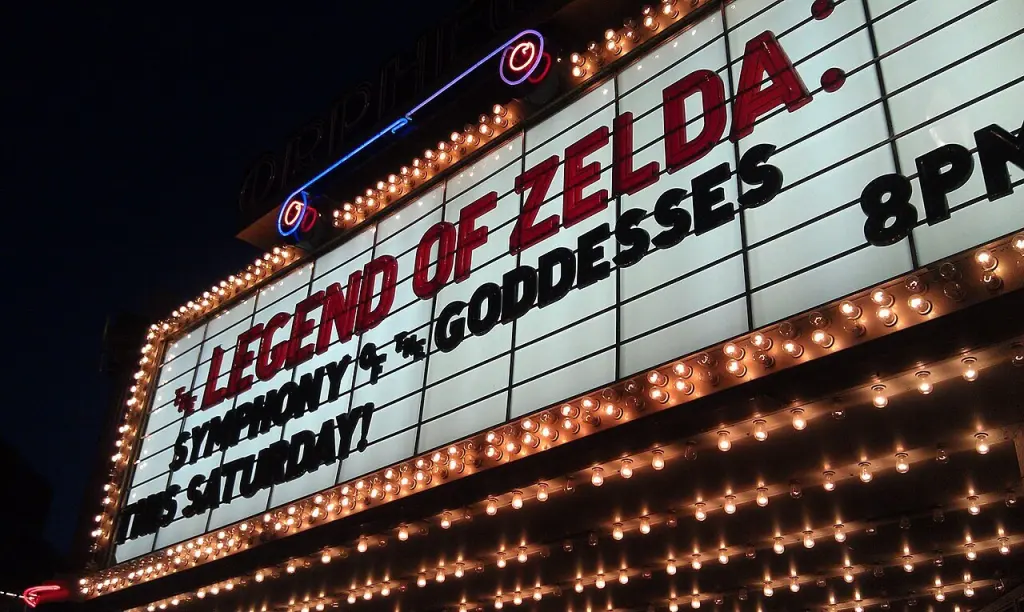
Image: Peri1001 / Wikimedia Commons · Creative Commons Attribution 3.0 Unported
The Legend of Zelda (ゼルダの伝説) is a Japanese action-adventure game series developed and published by Nintendo. Its first game appeared for the Family Computer Disk System in Japan on 21 February 1986, introducing an open field, hidden routes, dungeons, items, puzzles, and combat that rewarded curiosity rather than one fixed path. Shigeru Miyamoto and Takashi Tezuka shaped the original design, with Koji Kondo composing its music. Later games repeatedly reimagined the land of Hyrule and the figures of Link, Princess Zelda, and Ganon or Ganondorf instead of following one continuous cast through every title. The series moved from two-dimensional overhead worlds to three-dimensional navigation and, more recently, highly systemic open environments. Its name can cause a basic misunderstanding: the player character is usually Link, while Zelda is the princess whose legend gives the series its title.
Overview
| Japanese title | ゼルダの伝説 |
|---|---|
| Romanized title | Zeruda no Densetsu |
| Medium | Action-adventure video-game series |
| Developer and publisher | Nintendo |
| First release | 21 February 1986, Family Computer Disk System |
| Recurring figures | Link, Princess Zelda, and Ganon or Ganondorf |
| Core play | Exploration, dungeons, puzzles, items, and combat |
Name, scope, and the Zelda misconception
The Japanese title Zeruda no Densetsu translates directly as “The Legend of Zelda.” Zelda is usually a princess, priestly figure, scholar, or ruler connected to the kingdom of Hyrule. Link is normally the playable hero. The recurring mistake of calling Link “Zelda” arises because the title names the legend rather than the player character.
The series is broader than one storyline. Main games, remakes, multiplayer titles, and related works use different structures, and many take place in separate eras. Link and Zelda are often new incarnations who share names, visual motifs, and roles with earlier figures rather than one pair ageing through the entire franchise.
The 1986 original
Nintendo released the first game in Japan as a launch title for the Family Computer Disk System on 21 February 1986. Its world could be explored in multiple directions, with secrets hidden behind walls, beneath rocks, and inside caves. Players gathered pieces of the Triforce of Wisdom, entered dungeons, acquired tools, and gradually learned how apparently inaccessible spaces connected.
The disk format supported saved progress in Japan. For markets without the Famicom Disk System, the game appeared on an NES cartridge; the North American edition used an internal battery to retain a save file. Saving mattered because the adventure encouraged return visits, experimentation, and knowledge accumulated over many sessions.
Development and design principles
Nintendo’s retrospective interviews identify Shigeru Miyamoto and Takashi Tezuka as central designers of the original game, developed alongside Super Mario Bros. Miyamoto described its starting idea as a treasure-hunting adventure in a world of swords and sorcery. Tezuka worked on structure and visual design, while Koji Kondo created music and sound under the severe memory limits of the hardware.
The resulting design makes discovery a form of progress. A new item may work as a weapon, a key, a movement tool, or a clue about the environment. Dungeons test understanding in concentrated spaces, while the overworld invites detours and partial knowledge. The balance changes from title to title, but exploration, tools, puzzles, combat, and spatial memory remain durable elements.
Hyrule, Link, Zelda, and the Triforce
Many games are set in Hyrule, a fictional kingdom whose geography is redesigned for each project. The Triforce commonly represents power, wisdom, and courage, while Link, Zelda, and Ganon or Ganondorf repeatedly occupy positions around that symbolic triangle. Familiar peoples, monsters, objects, melodies, and place names create recognition even when history and terrain differ.
These recurring elements are narrative materials, not a rule that every game must contain all of them. Some adventures leave Hyrule, use a different antagonist, or centre another kind of crisis. The official chronology connects many titles and branches after particular events, but each game is also designed to be understandable as its own legend.
From two dimensions to three
The early games established several distinct models: overhead exploration, side-view action, and layered worlds that changed how the same places could be read. A Link to the Past, released for the Super Famicom in 1991, refined the overhead form and made movement between parallel versions of a world central to its structure.
Ocarina of Time, released for Nintendo 64 in 1998, translated exploration, sword combat, items, and dungeon puzzles into three-dimensional space. Camera control, targeting, and context-sensitive actions helped players orient themselves around enemies and objects. Later entries did not simply replace the two-dimensional tradition; handheld and console games continued to alternate and combine approaches.
Reinvention through art and systems
Visual continuity in Zelda comes from symbols and readable objects more than one fixed art style. The Wind Waker used cel-shaded characters and broad colour fields, while other games pursued storybook, miniature, painterly, or more naturalistic worlds. Music performs a similar role: new scores quote or transform themes, fanfares, and sound cues that teach players how the world responds.
Breath of the Wild, released in 2017, reorganised the series around a large environment, physics, chemistry-like interactions, climbing, weather, and many possible solutions. Tears of the Kingdom expanded that systemic approach in 2023 with construction and object-manipulation abilities. These games renewed the original emphasis on curiosity while changing the scale and vocabulary of play.
Genre and cultural influence
The wider industry context includes public and trade institutions such as Tokyo Game Show, where playable demonstrations, announcements, business meetings, and fan activity make relationships among Japanese games and global markets visible.
Zelda is commonly classified as action-adventure because movement and combat occur in real time while progress depends on exploration, tools, and puzzles. It also uses role-playing elements, but the series does not fit neatly into a single genre box. Its changing combinations have influenced how designers organise overworlds, dungeons, lock-and-key abilities, targeting, environmental clues, and player-directed routes.
The Strong National Museum of Play inducted The Legend of Zelda into the World Video Game Hall of Fame in 2016, emphasising the original game’s non-linear exploration and its influence on later action-adventure and role-playing design. Concerts, books, manga, merchandise, exhibitions, and fan practices have extended the franchise beyond game hardware, but interactive play remains its primary medium.
Japanese production and global fantasy
Zelda belongs to the wider history of Japanese video games, in which domestic production systems and global circulation have continually shaped one another.
The Legend of Zelda is a Japanese media work, but Hyrule is not a representation of historical Japan or a guide to Japanese religion. Its worlds combine European-style swords and castles, invented species and cosmologies, fairy-tale structures, and visual ideas gathered from many sources. Individual games may also incorporate motifs that feel closer to Japanese landscapes, masks, spirits, architecture, or craft.
It is therefore useful to distinguish production context from fictional setting. Nintendo’s Kyoto-based development history is part of Japanese popular culture, while the series’ mythology is deliberately composite and changeable. Similarities to kami, yōkai, or a specific religious symbol should be supported case by case rather than used to label the whole franchise as Shinto mythology.
Fortieth anniversary in 2026
The original release reached its fortieth anniversary on 21 February 2026. Nintendo’s anniversary site and a Direct presentation dated 8 September 2026 review the series and introduce commemorative projects. Nintendo announced on 9 September that a full Nintendo Switch 2 remake of Ocarina of Time is scheduled for release on 5 November 2026.
The anniversary is a current programme rather than a new definition of the series. Release plans, events, and products can change, so this date-specific information should be checked against Nintendo’s official pages when used after 2026.
Sources
- Nintendo, The Legend of Zelda 40th Anniversary.
- Nintendo, The Legend of Zelda History.
- Nintendo, The Legend of Zelda 40th Anniversary Overview, 9 September 2026.
- Nintendo, Nintendo Classic Mini: NES Special Interview—The Legend of Zelda.
- The Strong National Museum of Play, The Legend of Zelda.
- Musée de l’Imprimerie et de la Communication Graphique, The Legend of Zelda exhibition guide.
Last updated: