Anime
E-konte
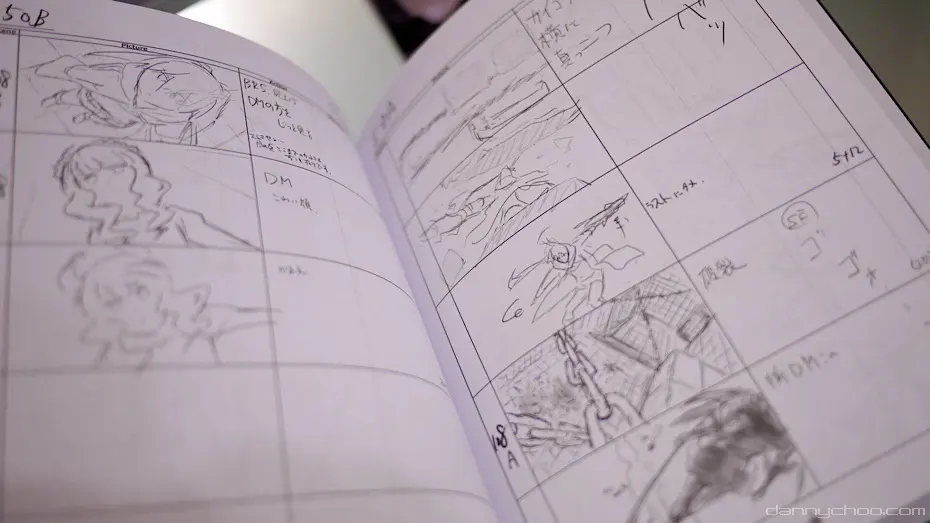
Image: Danny Choo / Wikimedia Commons; Flickr · Creative Commons Attribution-ShareAlike 2.0 Generic
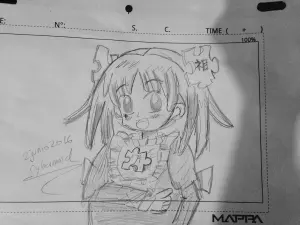
E-konte (絵コンテ) is the storyboard used to convert an anime script or narrative plan into a sequence of visual cuts. Its panels indicate composition, character action, dialogue, sound, camera movement, transitions, and approximate duration so that multiple departments can work from a shared plan. A director, series director, episode director, specialist storyboard artist, or several contributors may prepare it, depending on the production. E-konte is more operational than a set of attractive concept images: page and cut numbers, written instructions, and timing are central to its function. It is not the same as a layout, which designs a shot in greater spatial detail, or as genga, which defines animated movement. Although commonly translated as “storyboard,” Japanese formats and responsibilities vary among studios, media, periods, and individual directors.
Overview
| Japanese | 絵コンテ |
|---|---|
| Romanization | E-konte |
| Common English | Storyboard |
| Primary function | Visual and temporal blueprint for cuts |
| Typical information | Framing, action, dialogue, sound, camera instructions, and timing |
| Usual position | After script development and before detailed layout and animation |
Name and production role
E means picture, while konte is an abbreviation derived from the English word continuity. The term identifies a visual continuity script that breaks a work or episode into cuts. It turns written drama into decisions about what the audience will see and for how long.
Because later departments depend on these decisions, e-konte is both a creative interpretation and a coordination document. It gives producers and staff a basis for estimating cuts, assigning work, preparing backgrounds and designs, and discussing whether the planned episode fits its running time.
Page format and information
A common page contains numbered picture panels beside columns for dialogue, action, sound, and seconds or frames. Arrows and notes can indicate pans, tracks, zooms, focus, entrances, exits, layer movement, or transitions. Formats differ, and handwritten shorthand may reflect a director's habits.
The drawings need to communicate framing and action but need not be polished illustration. A simple sketch with exact staging and timing can be more useful to production than a detailed image that leaves the cut's operation unclear.
From script to visual sequence
The storyboard artist decides how scenes are divided, where information is revealed, how viewpoints change, and how dialogue occupies screen time. A line in the script may become several cuts, while several actions may be combined into one sustained composition.
These decisions establish rhythm before finished animation exists. The e-konte can use reaction shots, inserts, off-screen space, silence, and repeated framing to control attention. It therefore interprets the script rather than merely illustrating each sentence.
Authorship and episode direction
The series director may storyboard key episodes, while episode directors or other artists handle individual installments under an overall plan. Storyboard and episode-direction credits can belong to the same person or to different people. Films may use teams and divide sequences.
A credited storyboard artist has major influence on visual narration, but the finished episode also reflects layouts, animation, backgrounds, photography, sound, editing, retakes, and supervisory decisions. E-konte should not be treated as a complete record of sole authorship.
Layout, genga, and V-conte
A layout develops one storyboard panel into a more exact shot design, including perspective, character size, camera field, background information, and layered movement. Genga then establishes key poses and animation instructions. Boundaries between these stages vary, but e-konte normally remains the earlier sequence-level plan.
A V-conte or video storyboard arranges images and temporary sound on a timeline. It can test duration and editing more directly than paper pages. An imageboard, by contrast, explores mood, setting, or key moments without necessarily supplying a complete numbered continuity.
Revision, schedule, and approval
Storyboards may be revised for narrative clarity, source-material requirements, censorship or broadcast standards, available designs, expected workload, and episode length. A cut-heavy board increases coordination and can affect the number of layouts, backgrounds, effects, and assets required.
Production staff use the completed board to create cut bags or digital records, allocate artists, and track deliveries. Late changes can propagate through departments, which is why storyboard completion and checking are important schedule milestones.
Study, archives, and common misconceptions
Published or exhibited e-konte let viewers compare the initial visual plan with layouts, drawings, and the finished screen work. Archives preserve them as evidence of direction, timing, collaboration, and revisions, although surviving pages may not represent the final approved version.
E-konte is not simply anime concept art, a comic adaptation of the script, or the final camera composition. Nor does rough drawing indicate weak direction. Its quality lies in whether the document organizes screen time and communicates a workable visual plan.
Sources
- Association of Japanese Animations, A Manual for TV Anime Series Production Assistants.
- Agency for Cultural Affairs, Animation Production Process Working Group Minutes.
- Ministry of Health, Labour and Welfare, Anime Production Progress Management.
- Agency for Cultural Affairs, Anime Production Career Map and Workflow Report.
- Agency for Cultural Affairs, Peel-Apart TV Anime.
- Agency for Cultural Affairs, Archiving Anime Production Materials.
- Agency for Cultural Affairs, Intermediate Products in Animation.
- Agency for Cultural Affairs, Copyright Policy Committee: Anime Production Workflow Diagram.
- Agency for Cultural Affairs, Digital Anime Production and V-conte.
Last updated: