Folklore & Mythology
Kami, Yōkai, Oni and Yūrei

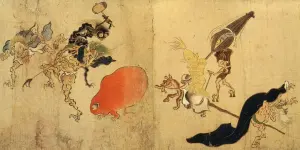
Image: Unknown artist after a medieval composition / Wikimedia Commons · Public domain
Kami, yōkai, oni, and yūrei are not four species inside one fixed Japanese supernatural system. They are overlapping categories formed in different ritual, religious, literary, artistic, and scholarly contexts. Kami are normally approached through reverence, worship, or an acknowledged sacred relationship. Yōkai broadly name uncanny phenomena and beings. Oni are powerful demonic figures with especially strong Buddhist, ritual, and heroic associations. Yūrei are spirits of the dead. A single presence may move between these descriptions when a threat is named, pictured, pacified, enshrined, or retold. The most reliable question is therefore not “What does it look like?” but “How are people relating to it in this source?”
Overview
| Purpose | Comparison of four overlapping Japanese terms |
|---|---|
| Kami | Sacred presence approached through reverence or worship |
| Yōkai | Uncanny phenomenon, presence, or fantastic being |
| Oni | Powerful demonic being; enemy, punisher, outsider, or protector |
| Yūrei | Spirit of a dead person appearing among the living |
| Key principle | Classify by relationship and context, not appearance alone |
Comparison at a glance
| Term | Central tendency | Common English rendering | Main diagnostic question |
|---|---|---|---|
| Kami | Sacred presence in a ritual relationship | Deity; spirit | Is it revered, enshrined, or worshipped? |
| Yōkai | Uncanny phenomenon or being | Monster; spirit; strange being | Does it explain or embody the strange? |
| Oni | Powerful demonic figure | Demon; ogre | Does it act as punisher, enemy, dangerous outsider, or converted protector? |
| Yūrei | Spirit of a dead human | Ghost | Is its identity grounded in a person’s death and continuing attachment? |
Kami: sacred relationship
Kami can be associated with mythic figures, natural features, places, ancestors, occupations, communities, and extraordinary powers. The term does not simply mean a morally perfect god. What most clearly distinguishes a kami in practice is a relationship of reverence, offering, festival, shrine, or ritual acknowledgement. A dangerous power can still be kami if people approach it through such a relationship.
Yōkai: the uncanny made legible
Yōkai Watch is a modern fictional reinvention of the category: it borrows the idea of yōkai while creating a commercial taxonomy of characters rather than recording a fixed body of traditional belief.
Yōkai is the broadest of the four for mysterious events and fantastic beings. A strange sound may be explained as an unseen presence, then given a name and picture. Folklore collection and illustrated catalogues make local reports comparable, but they do not create one universally agreed taxonomy. Kappa and tengu are readily called yōkai today, although local ritual may frame them differently.
Oni: power and demonization
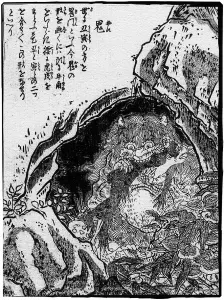
Oni have a strong later visual identity—horns, fangs, clubs, and tiger skins—but appearance is not their only criterion. Buddhist hell wardens, mountain enemies, epidemic forces, ritual outsiders, and legendary antagonists can all be oni. Defeat or conversion may redirect their power toward protection, while festivals sometimes welcome oni-like visitors rather than expelling them.
Yūrei: the dead who remain
Yūrei are distinguished principally by their relation to a dead person. They return through grief, resentment, love, promise, violence, or inadequate rites. A vengeful yūrei may be frightening enough to resemble an oni or may be grouped into a modern yōkai collection, yet its death and biography remain central. Memorial or pacification can change the relationship with the spirit.
How categories change
A feared event may first be described without a visible agent, later represented as yōkai, and eventually receive offerings at a local shrine. A dead political figure may be feared as a vengeful spirit and then pacified as a protective kami. An oni may submit to Buddhist authority and guard the teaching. These are not automatic evolutionary stages; they are possible changes produced by institutions, storytellers, ritual specialists, patrons, and communities.
Cases that cross boundaries
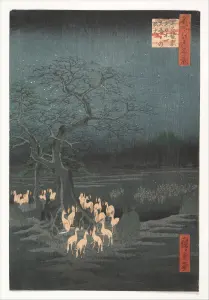
Kitsune show why context matters. A transforming fox in a folktale may be yōkai, while the white fox at an Inari shrine is a divine messenger rather than Inari Ōkami itself. Tengu can be disruptive Buddhist figures or protectors of particular mountains. Kappa are usually catalogued as yōkai but may receive local offerings. The same visual form does not guarantee the same category.
Translation and reading method
English words such as god, spirit, monster, demon, ogre, and ghost carry assumptions drawn from other histories. They are useful starting points, not exact equivalents. When reading a source, identify its period, locality, genre, and institution; ask whether the presence receives worship, whether it was once human, and what action it performs. This method preserves ambiguity without treating every term as interchangeable.
Sources
- International Research Center for Japanese Studies, Yōkai Database overview and glossary.
- University of California Press, The Book of Yōkai, expanded second edition.
- British Museum, eighteenth-century handscroll of supernatural beings.
- Noriko T. Reider, Japanese Demon Lore: Oni from Ancient Times to the Present.
- British Museum, netsuke of a reclining oni.
- British Museum, painting of a female ghost.
- University of California Press, Pandemonium and Parade.
- Fushimi Inari Taisha, FAQ on foxes and Inari.
Last updated: