Folklore & Mythology
Kitsune
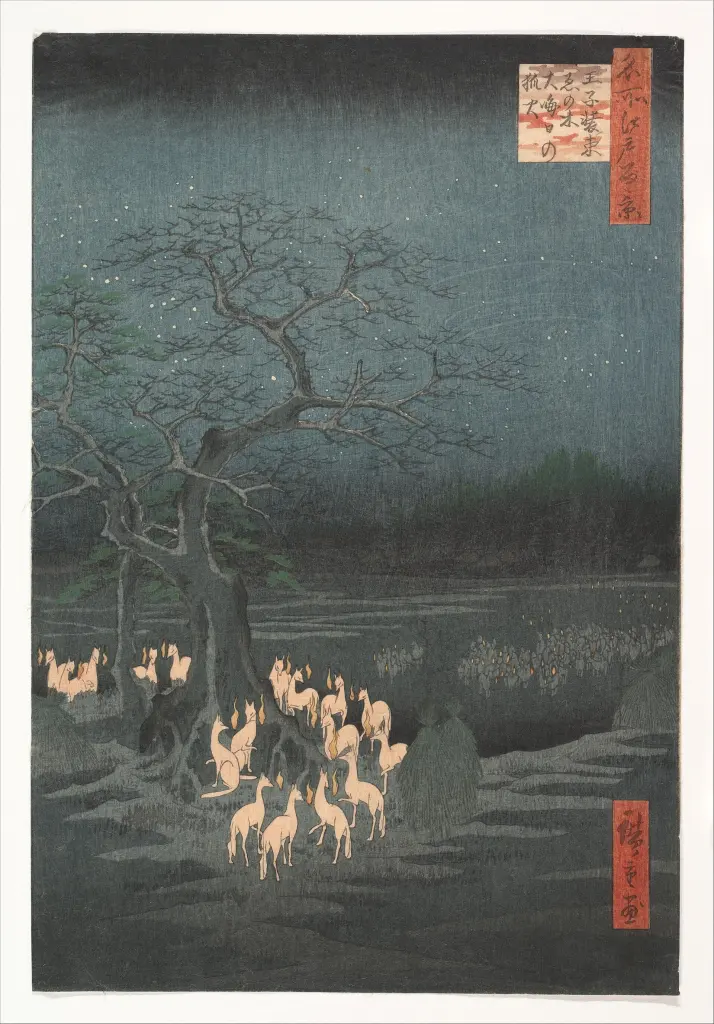
Image: Utagawa Hiroshige / Wikimedia Commons; Metropolitan Museum of Art · Public domain; digital reproduction CC0
Kitsune (狐) means fox, but in Japanese narrative and religious culture foxes can do far more than ordinary animals. They transform into human form, deceive or reward people, create strange fire, enter marriages, and in some traditions possess human bodies. Foxes are also closely associated with Inari worship. Fushimi Inari Taisha explicitly distinguishes the unseen white fox messengers from Inari Ōkami: the fox is not simply the deity. Folktales range from dangerous deception to loyalty and gratitude, so “trickster” captures only part of the tradition. Kitsune imagery draws on local observation, continental tale motifs, Buddhism, shrine practice, theatre, and print, and overlaps with the broad modern category of yōkai.
Overview
| Japanese | 狐 |
|---|---|
| Romanization | Kitsune |
| Basic meaning | Fox; also a fox acting as a supernatural agent |
| Recurring abilities | Transformation, deception, possession, and foxfire |
| Religious association | Messenger or kindred of Inari Ōkami |
| Major media | Folktale, setsuwa, shrine imagery, Kyōgen, Kabuki, and prints |
Animal and supernatural agent
Not every use of kitsune implies a spirit: it is the ordinary Japanese word for a fox. Supernatural meaning emerges from context. In stories, age, unusual colour, multiple tails, human speech, or transformation may signal exceptional power. Attempts to divide all foxes into one fixed hierarchy often combine terms from different regions, periods, and religious settings.
Transformation and marriage
Kitsune frequently take human form, often as women but not exclusively. In fox-wife tales, a human forms a household with a disguised fox, sometimes producing children before the animal identity is discovered. The resulting separation can be comic, tragic, or morally complex. Such narratives ask how kinship survives when outward appearance and inner nature do not align.
Deception, reward, and ethics
Some foxes bewilder travellers, imitate people, create false scenes, or punish hunters. Others repay kindness, keep promises, protect families, or expose human greed. Kyōgen’s Tsurigitsune centres on an old fox disguised as the monk Hakuzōsu, who warns a trapper against killing foxes but cannot resist bait himself. The comedy depends on both animal appetite and supernatural intelligence.
Possession and kitsunetsuki
Accounts of kitsunetsuki, or fox possession, have been used to explain altered behaviour, illness, speech, or conflict. Historical responses could involve religious specialists, household negotiations, or medical interpretation. Modern readers should not retroactively diagnose every recorded case, and possession beliefs should not be treated as an unchanging national custom.
Inari and white fox messengers
At Inari shrines, paired fox statues may hold keys, jewels, scrolls, or sheaves connected with the deity’s blessings and storehouses. Fushimi Inari Taisha calls the unseen messengers byakkosan, or white foxes, and stresses that Inari Ōkami is not a fox. Popular images often blur deity and messenger, but the distinction is important for understanding Shinto practice.
Foxfire and visual culture
Mysterious lights called kitsunebi are interpreted as foxfire. Utagawa Hiroshige’s 1857 print of foxes gathering beneath a tree at Ōji on New Year’s Eve made one such legend globally recognizable. Fox weddings, multiple-tailed foxes, shrine messengers, and actors playing transformed foxes supplied artists with several distinct visual types rather than a single kitsune design.
Classification and modern use
A transforming or bewitching kitsune can be treated as yōkai, while an Inari messenger belongs to a ritual relationship with kami. Modern anime, games, and mascots often combine shrine imagery, multiple tails, magic, and folktale motifs. Those designs continue a history of recombination but should be distinguished from any one local tradition.
Sources
Last updated: