Games
Japanese Video Games
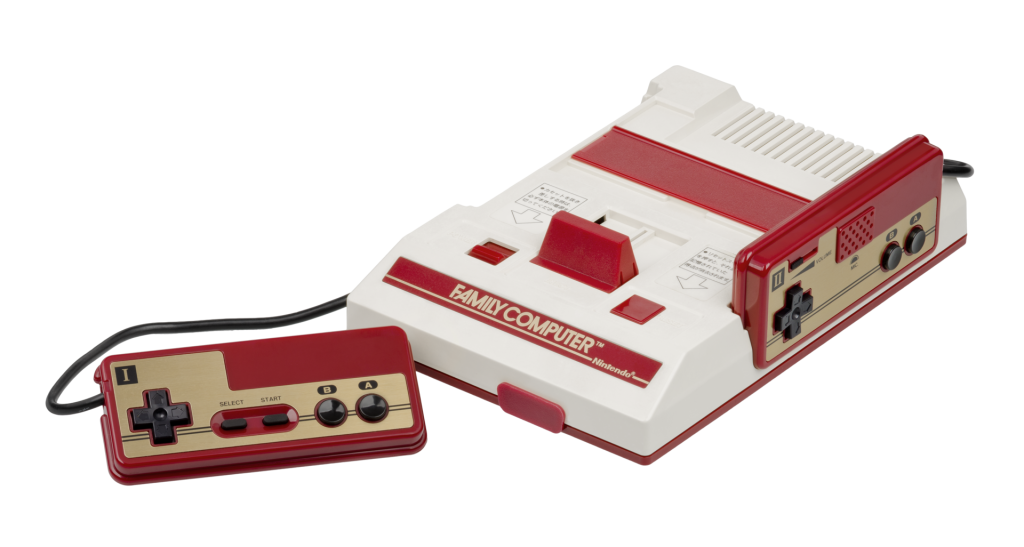
Image: Evan-Amos / Wikimedia Commons · Public domain
History · Platforms · Play
Several histories of playing.
Japanese video games belong to overlapping arcade, console, computer, handheld, mobile and independent scenes. Hardware, business arrangements and ways of playing have changed together through domestic and international exchange.
Keep three dimensions in view
Era & release
The original release, a port and a remake can belong to different moments. Record the territory as well as the year.
Platform & setting
Arcade, console, PC, handheld and mobile identify technical and social settings. They can coexist.
Play & genre
Exploration, role-playing, fighting, rhythm and other labels describe activities or conventions, not nationality.
At a glance
- Scope
- Games developed in Japan and their wider systems
- Historical turning point
- Famicom’s Japanese launch, 1983
- Platforms
- Overlapping environments, not one linear succession
- Genre
- A way to discuss design; not a national identity
A timeline of overlapping scenes
- 1970s
Electronic arcades
Coin-operated amusement businesses helped establish the commercial industry; Space Invaders appeared in 1978.
- 1980s
Home consoles & computers
The Famicom’s Japanese launch in 1983 expanded a market already containing dedicated machines and personal computers.
- 1990s
New console and handheld worlds
PlayStation launched in Japan in 1994; Pokémon Red and Green appeared for Game Boy in 1996.
- Across later decades
Networks, mobile & independent work
Online services, smartphone play and digital distribution expanded alongside continuing console, PC and arcade activity.
The dates concern Japanese releases. Nintendo, Sony, Pokémon and the historical study listed in Sources provide the platform context.
A platform does not prescribe a genre
| Setting / platform | What it organises | Examples of play |
|---|---|---|
| Arcade | Public venues, cabinets, payment and specialised controls. | Fighting, driving, rhythm and shooting; designs vary by cabinet. |
| Home console | A hardware ecosystem, controllers and licensed software. | Action, RPG, sports, puzzles and many hybrid forms. |
| Personal computer | Computer hardware, input methods and software distribution. | Role-playing, simulation, strategy, action and independent work. |
| Handheld | Portable hardware and play away from a fixed television. | Collection, exploration, puzzles, RPGs and other genres. |
| Mobile | Phone interfaces, connectivity and service arrangements. | Touch-based games, location play, puzzles and numerous other forms. |
History and scope
The category is historical and industrial, not a claim that Japanese games share an essential visual language. Researcher Martin Picard uses the term geemu to emphasise a locally formed market ecology involving technology, culture, and marketing. Japan’s industry emerged from postwar growth in consumer electronics, toys, amusement machines, and computing, while also relying on exchanges with North American firms. The result was a field that was simultaneously domestic and transnational.
For this reason, Japanese video game history includes public play in game centres, games for homes and personal computers, handheld play, mobile services, and newer independent production. It also includes the companies, creators, specialist press, events, fan communities, and localisation practices that connect those formats.
Arcade era
Japan’s commercial video game industry took shape in the 1970s through companies already active in coin-operated amusements, distribution, toys, or electronics. Sega, Taito, Namco, and Nintendo imported, licensed, imitated, and then increasingly designed electronic games for Japanese amusement spaces. Taito’s Space Invaders, released in 1978, became a decisive domestic phenomenon; Namco’s Pac-Man and Nintendo’s Donkey Kong followed with major international influence.
Arcades remained laboratories for hardware and game design even after home consoles became dominant. Dedicated cabinets supported genres and interfaces that were difficult to reproduce at home, including driving simulators, rhythm games, fighting games, and networked card systems. The arcade should therefore be understood as a continuing branch of Japanese game culture, not merely a preliminary stage before consoles.
Famicom and the console era
Nintendo released the Family Computer in Japan in 1983. Its cartridge-based platform, expanding software library, and third-party publishing system helped make the home console a central site of play. The overseas Nintendo Entertainment System was related to the Famicom but entered markets with different hardware styling, release schedules, licensing arrangements, and cultural conditions.
The Famicom did not create Japanese home gaming from nothing: dedicated television-game machines, Epoch’s Cassette Vision, and Japanese personal computers preceded it. Its importance lies in how it reorganised the scale and expectations of the console market. Later systems made generational hardware transitions, exclusive software, controller design, and platform licensing recurring features of the business.
Nintendo, Sega, and Sony
Nintendo, Sega, and Sony represent different routes into platform-making. Nintendo moved from playing cards and toys into electronic amusements, arcades, Game & Watch, and the Famicom. Sega developed from jukeboxes and commercial amusement operations into arcade hardware and consoles such as the SG-1000, Mega Drive, Saturn, and Dreamcast. Sony entered the console market through Sony Computer Entertainment and launched the original PlayStation in Japan in 1994.
Their rivalry helped shape hardware cycles, publishing relationships, game storage, three-dimensional graphics, online services, and the international marketing of Japanese software. It should not obscure other makers and publishers—including Taito, Namco, Capcom, Konami, Square Enix, SNK, Koei Tecmo, Bandai Namco, and many smaller studios—whose work crossed arcade, console, computer, and mobile markets.
Japanese role-playing games
Japanese role-playing game, commonly abbreviated JRPG, is a retrospective and international genre label rather than a formal category applied uniformly inside Japan. Early Japanese computer RPGs adapted ideas from games such as Wizardry and Ultima. Designers then reworked menu-based combat, party formation, exploration, and serial storytelling for Japanese computers and consoles.
Dragon Quest, released for the Famicom in 1986, made computer-RPG conventions accessible to a broad console audience. Final Fantasy, Megami Tensei, Ys, SaGa, and later Pokémon demonstrate how varied the category became. Turn-based combat is common but not required, and a game is not a JRPG simply because its developer is Japanese.
Read a particular release within a franchise
| Example | Historical / platform context | Design question |
|---|---|---|
| The Legend of Zelda | Began on Famicom Disk System in 1986. | How do exploration, spatial puzzles and tools structure progress? |
| Pokémon | Red and Green: Game Boy, Japan, 1996. | How do collecting, training, battling and trading connect? |
| Pokémon GO | A smartphone and location-based development of the franchise. | How do movement and location change the organisation of play? |
Pokémon, Zelda, and franchise worlds
Pokémon GO shows how a Japanese game franchise can be reorganised through a global location platform, smartphone movement, and city-scale live events.
Pokémon began with paired Game Boy role-playing games in 1996 and made collecting, trading, and battling the foundation of a cross-media world.
The Legend of Zelda began on the Famicom Disk System in 1986 and developed a long-running vocabulary of exploration, spatial puzzles, tools, and revisited settings. Pokémon Red and Green followed on Game Boy in Japan in 1996, combining collection, training, battle, and communication through trading. The Pokémon Company describes the video games as the foundation from which its card games, animation, films, and other products expanded.
These series show two different forms of continuity. Zelda repeatedly reinterprets a set of names, symbols, and design problems, while Pokémon connects software to a coordinated media and merchandise system. Neither formula represents Japanese games as a whole, but both demonstrate how game mechanics, characters, hardware features, and media circulation can sustain a franchise across decades.
Game development in Japan
Japanese indie games add a distinct history of home-computer hobbyists, dōjin circles, solo creators, and small studios; indie and dōjin overlap without being synonymous.
Development in Japan ranges from large platform-holder studios to publisher-owned teams, independent companies, individual creators, doujin circles, and contractors specialising in art, audio, programming, localisation, or quality assurance. Production structures differ by company and era; familiar labels such as director, producer, planner, and designer do not always map neatly onto overseas credits or organisational charts.
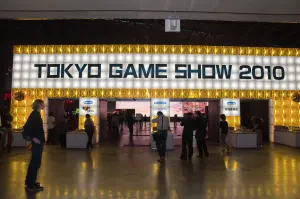
Industry institutions make parts of this ecosystem visible. The Computer Entertainment Supplier’s Association was established in 1995, Tokyo Game Show began in 1996, the CESA Awards—later the Japan Game Awards—followed, and the Computer Entertainment Developers Conference began in 1999. These institutions connect promotion, professional exchange, market research, awards, and policy concerns without encompassing every creator or form of play.
Tokyo Game Show
The Japan Game Awards provide a related institution for recognising games; award categories, eligibility windows and ceremony arrangements depend on the edition.
Tokyo Game Show is an industry exhibition organised through CESA and associated partners. It combines business meetings, public exhibition days, announcements, demonstrations, stage programmes, competitions, and online distribution. The show provides a recurring view of how Japanese publishers present software to domestic and international audiences, but it is not a complete census of development in Japan.
The event also illustrates changes in the industry: console software appears alongside PC, mobile, virtual-reality, independent, merchandise, streaming, and esports activity. Tokyo Game Show therefore functions as both a trade platform and a public spectacle within the broader history of Japanese video games.
Global circulation and boundaries
Japanese games have always circulated through translation, licensing, regional hardware, imports, ports, emulation, fan communities, and international production partnerships. Overseas success changed design and business decisions inside Japan, just as Japanese hardware and software influenced studios elsewhere. Contemporary projects may involve multinational teams even when a Japanese company owns or directs the work.
Accordingly, Japanese video games are best studied through specific production histories rather than stereotypes about graphics, narrative, difficulty, or national character. The category helps connect institutions and lineages; it does not erase differences between arcade shooters, role-playing games, visual novels, rhythm games, simulations, mobile titles, experimental work, and globally co-produced blockbusters.
Sources
- The Foundation of Geemu: A Brief History of Early Japanese Video Games — Game Studies
- Corporate Information: Company History — Nintendo
- History — SEGA Corporation
- 第2部 第9章 プレイステーション — Sony Group History
- 沿革 — Computer Entertainment Supplier’s Association
- Wizardry, Dragon Quest, and the Japanese Role-Playing Video Game — The Strong National Museum of Play
- History — The Pokémon Company
Last updated: