Karate
Heian Sandan
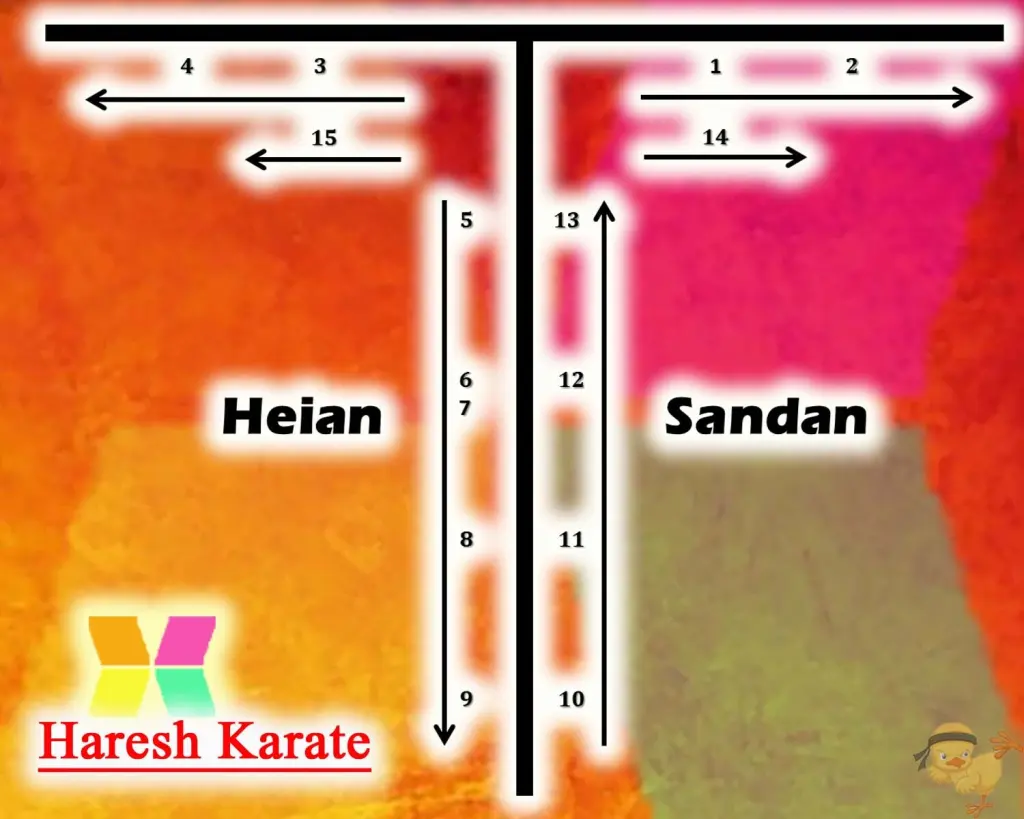
Image: Haresh karate / Wikimedia Commons · CC BY-SA 4.0
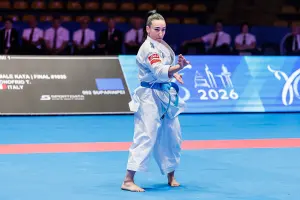
Heian Sandan (平安三段) is the third named form in the Heian sequence used by the Japan Karate Association and many other Shotokan organisations. The JKA records 20 movements and places the kata at 5th kyū in its grading guideline effective 1 April 2022. These facts identify one current organisational version, not a universal count or rank. Heian belongs to the wider Heian and Pinan family associated with Itosu Ankō and later transmitted through different schools, publications and institutions. Sandan is most useful as a study of how directions, stances and techniques connect across a continuous pattern. Its technical details should be learned from the named curriculum rather than reconstructed from the numeral, an embusen diagram or a performance from another style.
JKF official kata videos
Official reference
Use these federation reference films to compare named versions. Each video documents one JKF-published model for the named tradition; it does not define every dōjō or lineage.
Shōtōkan-ryū松濤館流
Heian Sandan
Karate Kihon Kata #3
Shitō-ryū糸東流
Heian Sandan
Karate Kihon Kata #2
JKF framework
Where this kata sits
Official competition placement and broader guide context are shown separately.Official JKF position
Basic kata
- Shōtōkan
- Shitō
The JKF Basic Kata reference places the five Heian forms in both the Shōtōkan-ryū and Shitō-ryū columns.
Guide context
Heian / Pinan
- Shōtōkan
- Shitō
Heian and Pinan are historically related name families. Modern sequence, numbering and execution remain version-specific.
Overview
| Japanese | 平安三段 |
|---|---|
| Reading | へいあんさんだん |
| Romanisation | Heian Sandan |
| Series position | Third in the Heian name sequence |
| Classification | Karate kata; Heian / Pinan family |
| Common association | Shotokan and related mainland curricula |
| JKA movement count | 20 movements |
| JKA grading position | 5th kyū, effective 1 April 2022 |
Name and scope
Sandan means third level in the Heian naming sequence. It identifies the form within that series; it does not claim that every curriculum ranks or performs the same material in the same way.
When comparing Heian Sandan with a Pinan form, begin with the stated school and organisation. Related history can coexist with differences in ordering, stance, count, timing and application.
Historical transmission
The JKF describes Heian and Pinan as a five-form Shuri-te teaching family associated with Itosu Ankō. Funakoshi's mainland teaching and publication helped establish the Heian name in Shotokan contexts.
Modern kata were also shaped by institutional instruction and published standards. A documented present version should therefore be compared through sources, not treated as a transparent copy of one original sequence.
The JKA reference
The JKA instructor manual gives Heian Sandan a count of 20 movements. JKA also places all five Heian forms in the first volume of its current kata book series.
Counting depends on how an organisation divides linked actions. The number is a checking tool for the JKA model, not a standard that can be imposed on every related Heian or Pinan performance.
Transitions and structure
Read the kata as connected changes of direction, stance and technique rather than twenty isolated endpoints. The body must reorganise between positions while preserving balance, gaze and a clear line of travel.
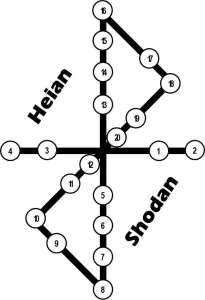
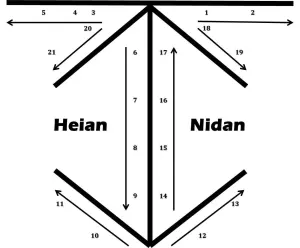
An embusen shows where the performer moves but not how weight, posture, breath or tempo are coordinated. Those details belong to the named technical model demonstrated by an instructor or official reference.
Comparing the Heian sequence
In the current JKA grading path, Sandan follows Heian Nidan and precedes Heian Yondan. Its place helps students compare how the same foundational ideas are reorganised across several kata.
Progression is not simply a linear increase in difficulty. A useful comparison asks what changed in direction, transition and rhythm, then checks those observations against the local syllabus.
Bunkai and evidence
Bunkai can test how movements relate to distance, angle, grips and partner response. More than one training interpretation may fit the same visible solo action.
Similarity is not proof of a single historical function. Label the teacher and version, agree on contact and resistance, and distinguish a useful practice method from a documented origin claim.
Grading and competition context
JKA's guideline assigns Heian Sandan to 5th kyū. This placement is current for that organisation and should not be converted automatically into another association's belt colours or examination order.
Tournament categories and permitted kata lists change by event and date. A competition performance also reflects judging criteria that need not reproduce a dojo's entire teaching purpose.
How to study it safely
Mark a clear practice area and learn each turn at controlled speed. Keep stance depth within comfortable knee and hip range, then add rhythm only after the directional pattern is reliable.
Use the JKF videos to compare named versions, not to blend them. Questions about stance width, timing or application should return to a qualified instructor who knows the curriculum being practised.
Sources
- All Japan Karatedo Federation, Heian / Pinan.
- Japan Karate Association, Technical Manual for the Instructor.
- Japan Karate Association, Dan Ranking and Kyu / Dan Grading Guideline.
- Japan Karate Association, KARATE-DO KATA books.
- Tooru Kadekaru, The origins of the modern kata in karate-do.
- National Diet Library, Funakoshi Gichin, Karate-do Kyohan.
Last updated: