Karate
Heian Nidan
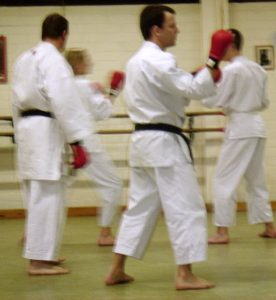
Image: Haresh karate / Wikimedia Commons · CC BY-SA 4.0
Heian Nidan (平安二段) is a Karate kata in the five-form Heian family used by many Shotokan organisations and related curricula. The Japan Karate Association records 26 movements and assigns the kata to 6th kyū, but both facts describe the current JKA reference rather than every school. The wider Heian tradition is historically related to the Okinawan Pinan forms associated with Itosu Ankō. Shared names and ancestry do not make modern Shotokan, Shitō-ryū, Wadō-ryū or other versions mechanically identical. This guide therefore treats the title, movement count, grading place, embusen and technical interpretation as evidence attached to named institutions, while showing how Nidan extends the study path opened by Heian Shodan.
JKF official kata videos
Official reference
Use these federation reference films to compare named versions. Each video documents one JKF-published model for the named tradition; it does not define every dōjō or lineage.
Shōtōkan-ryū松濤館流
Heian Nidan
Karate Kihon Kata #3
Shitō-ryū糸東流
Heian Nidan
Karate Kihon Kata #2
JKF framework
Where this kata sits
Official competition placement and broader guide context are shown separately.Official JKF position
Basic kata
- Shōtōkan
- Shitō
The JKF Basic Kata reference places the five Heian forms in both the Shōtōkan-ryū and Shitō-ryū columns.
Guide context
Heian / Pinan
- Shōtōkan
- Shitō
Heian and Pinan are historically related name families. Modern sequence, numbering and execution remain version-specific.
Overview
| Japanese | 平安二段 |
|---|---|
| Reading | へいあんにだん |
| Romanisation | Heian Nidan |
| Series position | Second in the Heian name sequence |
| Classification | Karate kata; Heian / Pinan family |
| Common association | Shotokan and related mainland curricula |
| JKA movement count | 26 movements |
| JKA grading position | 6th kyū, effective 1 April 2022 |
Name and numbering
Heian is commonly rendered as peaceful mind, while nidan identifies the second level in this named series. The numeral is a curriculum label, not a universal measure of age, authenticity or technical difficulty.
The JKF treats Heian and Pinan as a five-form family linked with Itosu Ankō. Modern schools may use different names, ordering conventions and details, so a reader should identify the style and organisation before comparing two performances.
The Heian and Pinan family
The family developed through Okinawan teaching associated with Itosu and later mainland presentation, including Funakoshi Gichin's use of the Heian name. Printed books, school instruction and organisational syllabuses helped stabilise particular modern versions.
Kadekaru's study of modern kata formation cautions against reading a present sequence as an unchanged ancient object. Historical relationship is best documented through named teachers, texts and institutions rather than resemblance alone.
The JKA reference
The JKA instructor manual counts 26 movements for Heian Nidan and includes all five Heian forms in its first kata volume. That count is useful when checking a JKA performance or examination requirement.
Another organisation may divide actions differently or preserve a related Pinan sequence with different stance, timing or directional conventions. The JKA number should therefore remain labelled rather than presented as a definition of every Heian Nidan.
How to read the movement
A useful first pass follows direction, stance changes and the point at which each hand or foot action settles. A second pass can compare transitions, posture and rhythm without reducing the kata to a list of final poses.
The two JKF reference videos on this page document named Shotokan and Shitō-ryū models. Differences are evidence of version, not mistakes that can be resolved without knowing the curriculum being demonstrated.
Relationship within the series
Heian Nidan follows Heian Shodan in the current JKA grading sequence and precedes Heian Sandan. This creates a useful study path from a compact first form toward a wider range of transitions and combinations.
A sequence in one syllabus does not prove a universal historical order. Compare each form by its complete named version instead of assuming that a higher numeral simply adds difficulty to the preceding kata.
Bunkai and interpretation
Bunkai studies possible partner relationships within kata movement. Direction changes, paired hand actions and changes of level can support more than one application when distance and contact are specified.
The solo sequence does not prove one original application. A responsible explanation names the teacher or lineage, distinguishes training convention from historical evidence, and uses controlled partner practice.
Grading and competition context
The JKA grading guideline effective 1 April 2022 assigns Heian Nidan to 6th kyū. This is a dated organisational requirement, not a rank equivalence for every Shotokan association or national federation.
Competition lists may group Heian or Pinan forms as basic kata under event-specific rules. Eligibility and judging criteria should always be checked against the current rules for the named event.
How to study it safely
Learn the local count, direction and stance dimensions from a qualified instructor before adding speed. Use enough floor space for every turn and keep the knees and hips within a comfortable range.
Official videos are comparison references, not substitutes for correction. Pause on one transition at a time, note which named version is shown, and take questions back to supervised practice.
Sources
- All Japan Karatedo Federation, Heian / Pinan.
- Japan Karate Association, Technical Manual for the Instructor.
- Japan Karate Association, Dan Ranking and Kyu / Dan Grading Guideline.
- Japan Karate Association, KARATE-DO KATA books.
- Tooru Kadekaru, The origins of the modern kata in karate-do.
- National Diet Library, Funakoshi Gichin, Karate-do Kyohan.
Last updated: