Karate
Heian Godan

Image: Gr0uch0mars / Wikimedia Commons · CC BY-SA 4.0
Heian Godan (平安五段) is the fifth named form in the Heian family used by the Japan Karate Association and many Shotokan organisations. The JKA instructor manual records 23 movements, describes the Heian set as a bridge toward later kata, and its grading guideline effective 1 April 2022 assigns Godan to 3rd kyū. Those are organisation-specific reference points. The Heian forms are historically related to the Okinawan Pinan teaching tradition associated with Itosu Ankō, but present versions vary across styles and institutions. Completing the numbered sequence does not make Godan a universal endpoint or prove one technical interpretation. This guide uses the form to organise comparison—family, count, direction, rhythm and bunkai—while keeping each claim attached to the version that supports it.
JKF official kata videos
Official reference
Use these federation reference films to compare named versions. Each video documents one JKF-published model for the named tradition; it does not define every dōjō or lineage.
Shōtōkan-ryū松濤館流
Heian Godan
Karate Kihon Kata #3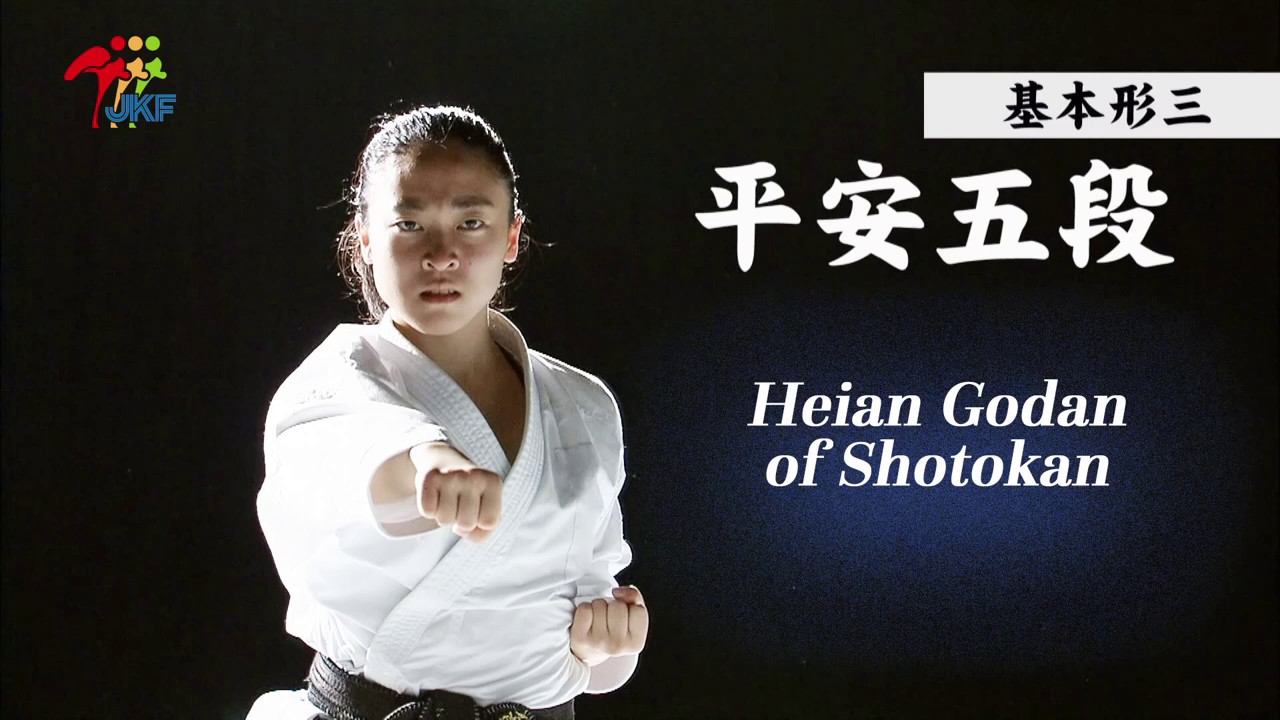
Shitō-ryū糸東流
Heian Godan
Karate Kihon Kata #2
JKF framework
Where this kata sits
Official competition placement and broader guide context are shown separately.Official JKF position
Basic kata
- Shōtōkan
- Shitō
The JKF Basic Kata reference places the five Heian forms in both the Shōtōkan-ryū and Shitō-ryū columns.
Guide context
Heian / Pinan
- Shōtōkan
- Shitō
Heian and Pinan are historically related name families. Modern sequence, numbering and execution remain version-specific.
Overview
| Japanese | 平安五段 |
|---|---|
| Reading | へいあんごだん |
| Romanisation | Heian Godan |
| Series position | Fifth in the Heian name sequence |
| Classification | Karate kata; Heian / Pinan family |
| Common association | Shotokan and related mainland curricula |
| JKA movement count | 23 movements |
| JKA grading position | 3rd kyū, effective 1 April 2022 |
Name and scope
Godan means fifth level in the series title. It marks the end of the numbered Heian set, not the end of kata study and not a universal rank shared by every Karate organisation.
The label must remain attached to a version. Related Heian and Pinan forms may share history while differing in count, stance, direction, rhythm and application.
The wider Heian family
The JKF describes Heian or Pinan as a five-form teaching family associated with Itosu Ankō. Funakoshi's mainland use of Heian became especially visible in Shotokan contexts.
Publication and organised instruction contributed to modern standardisation. Historical connection should therefore encourage source-based comparison rather than the claim that all present performances preserve one unchanged form.
The JKA reference
The JKA technical manual counts 23 movements for Heian Godan and treats the Heian set as preparation for understanding the organisation's later kata. Godan is also included in the first JKA kata-book volume.
This creates a clear JKA reference model. It does not decide how another school numbers linked actions or positions the form in its own curriculum.
Reading complexity without shortcuts
A later series number can bring denser transitions, but it should not be reduced to a simple difficulty label. Read direction, posture and hand-foot coordination separately before considering overall rhythm.
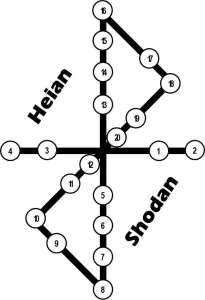
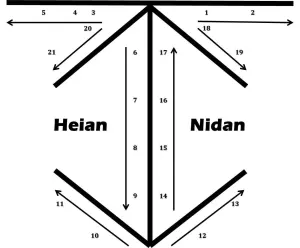
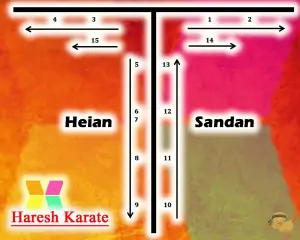
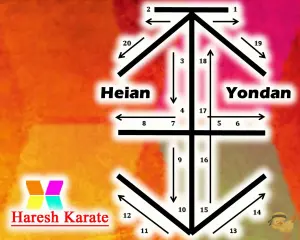
The embusen used as the stored lead illustration is only an orientation aid. It cannot record height, tempo, force, gaze or the technical conventions shown in a named performance.
Using Godan to review the series
Godan offers a point to compare all five Heian forms within one curriculum. Revisit recurring directions and foundational ideas, then identify where the fifth form reorganises them.
Keep the comparison controlled: use the same organisation, edition and instructor reference before deciding that a feature is new, shared or absent.
Bunkai and application boundaries
Bunkai can turn directional and transitional questions into supervised partner drills. Each interpretation depends on assumed distance, angle, target and response.
The solo form does not certify one historical application. A careful account names the teaching source and separates an effective drill from evidence about origin.
Grading and competition context
JKA assigns Heian Godan to 3rd kyū in the guideline effective 1 April 2022. Other organisations may use different ranks, colours or examination choices.
Competition treatment is also rule-specific. Consult the current event list and judging criteria rather than assuming that the last Heian number automatically has a fixed competitive status.
How to study it safely
Build the sequence at controlled speed and use a clear landing area for every directional change. Do not force jump, turn, stance depth or joint range beyond stable technique.
The two JKF videos provide labelled Shotokan and Shitō-ryū references. Use one version at a time and confirm local differences with a qualified instructor before partner practice or full-speed repetition.
Sources
- All Japan Karatedo Federation, Heian / Pinan.
- Japan Karate Association, Technical Manual for the Instructor.
- Japan Karate Association, Dan Ranking and Kyu / Dan Grading Guideline.
- Japan Karate Association, KARATE-DO KATA books.
- Tooru Kadekaru, The origins of the modern kata in karate-do.
- National Diet Library, Funakoshi Gichin, Karate-do Kyohan.
Last updated: