Karate
Choku-zuki
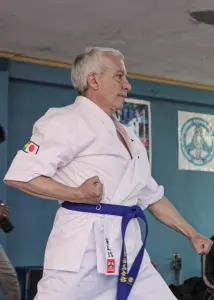
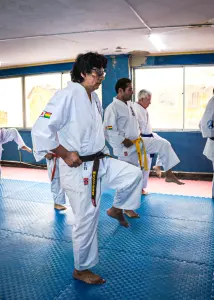
Image: Sdcsabac / Wikimedia Commons (video frame) · CC BY-SA 4.0
Overview
Choku-zuki names a direct punching path—not one compulsory stance.
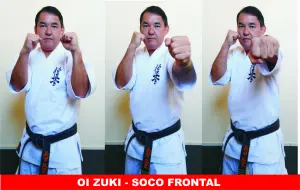
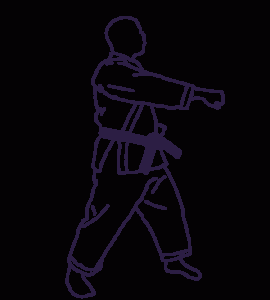
Choku-zuki (直突き) is a straight Karate thrust. The name identifies directness, unlike oi-zuki and gyaku-zuki, which distinguish the punching hand by its relationship to the advancing or forward leg. JKA material places a middle-level choku-zuki in hachiji-dachi at an early grading stage, but that is one organisation’s beginner example rather than a universal definition. A useful performance coordinates stance, posture, fist path, forearm, target, controlled extension, and recovery; the visible arm is only the endpoint of that system.
Stance and distance depend on the exercise.
Fist and forearm travel on the selected line.
The action stays available for withdrawal or continuation.
- Japanese
- 直突き
- Reading
- ちょくづき
- Reference meaning
- Straight punch
- Classification
- Tsuki-waza · hand technique
- Defining relation
- A direct punching path
- JKA beginner example
- Chūdan · hachiji-dachi
01Name & classification
The compound says “direct thrust”.
English spelling varies more than the underlying classification.
Common Romanisations include choku zuki, chokuzuki, and choku-tsuki. Research papers use both voiced and unvoiced spellings. The name distinguishes the path; it does not by itself specify target height, stance, footwork, or a single timing of fist rotation.
02Direct path
Straightness is a relationship among target, elbow, forearm, and fist.
A direct line is useful only when the hand and body remain structurally organised.
Select direction first
Target height and range establish where the thrust needs to travel.
Keep a stable relationship
Rotation may occur, but its timing and finishing angle vary among schools.
Avoid a folded joint
The hand should not collapse away from the intended line of force.
The endpoint photographed in a basic technique is only one phase. The fist must still be able to withdraw, repeat, change line, or connect to another action.
03Whole-body organisation
Feet may stay in place while the rest of the body remains active.
Posture, trunk organisation, shoulder position, and the non-punching side shape the result.
Maintain a usable centre rather than freezing the stance.
Coordinate direction without substituting excessive rotation.
Deliver the line while retaining balance and awareness.
Laboratory findings can clarify selected joint and muscle patterns, but they must be read against the tested task and participants. One punch model cannot define every Karate tradition.
04Endpoint & recovery
Completion should preserve the next movement.
Control is part of the technique, not something added after extension.
Stance, guard, and distance
Use the position prescribed for the exercise and confirm the intended target.
Path and body timing
Keep the wrist, elbow, shoulder, and trunk in a usable relationship.
Withdraw, repeat, or connect
Avoid forcing the elbow beyond a stable line or holding a rigid endpoint.
05Compare the tsuki family
Related names describe different movement relationships.
One action may receive more than one descriptor, so the source’s naming system matters.
Names straightness rather than a fixed arm–leg relationship.
Same-side advanceOi-zuki追突きThe thrusting hand and advancing or forward leg finish on the same side.
Opposite-side relationGyaku-zuki逆突きThe thrusting hand is opposite the forward leg.
Leading-hand entryKizami-zuki刻み突きThe front hand attacks as the front foot enters and the rear leg follows.
06Kihon & partner practice
Basic practice enlarges the pathway so it can be observed.
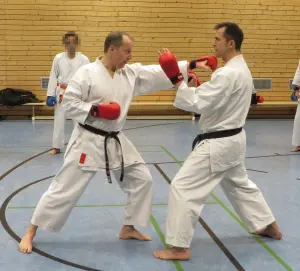
Partner and contest contexts may shorten the guard, change distance, and compress the motion.
Chūdan choku-zuki in hachiji-dachi
The 10th-kyu listing documents one beginner progression, not a worldwide belt requirement.
Target and guard change with the drill
Large hikite and clear rotation can expose coordination; partner work requires agreed contact and immediate recovery.
07Research, variation & safety
Measurement distinguishes tasks; it does not create a universal ideal.
Two studies help show how narrowly experimental results should be read.
Experienced and untrained groups
Eighteen experienced Portuguese national-team karateka and nineteen untrained participants showed different arm and forearm patterns in a specific action lasting about 400 milliseconds.
Choku-tsuki and oi-tsuki
Seven karateka performed ten repetitions of each task; oi-tsuki took longer and varied more in the selected landmarks. The small study did not measure fighting effectiveness.
Sources and further reading
Last updated: