Buddhism
Buddhism in Japan
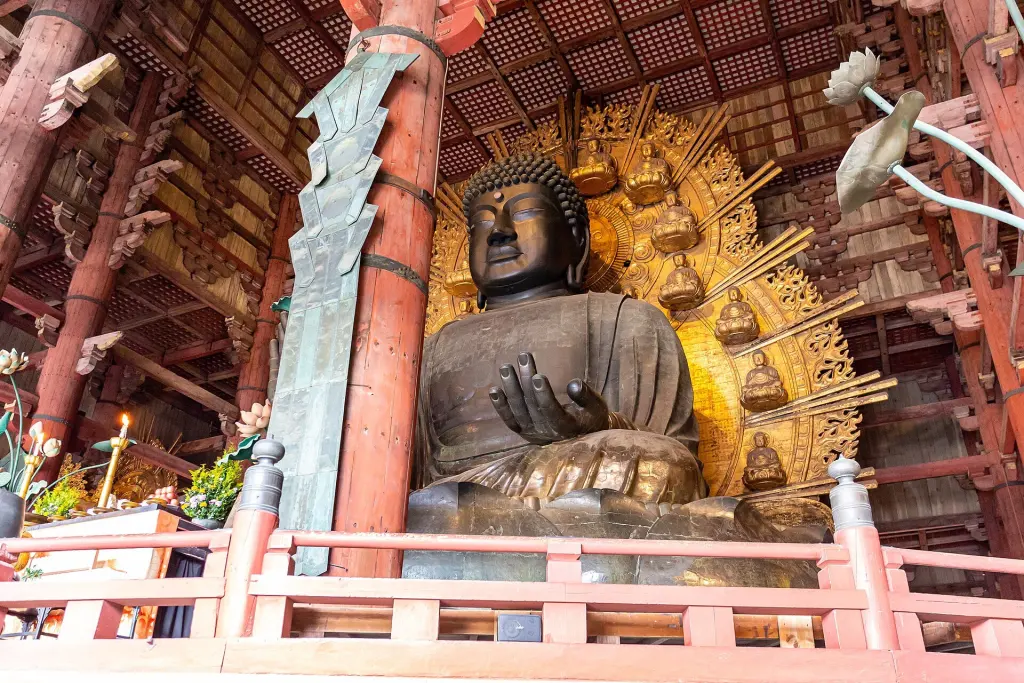
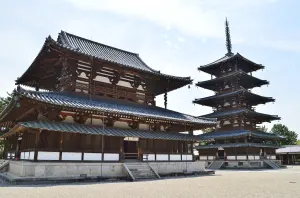
Image: Balon Greyjoy / Wikimedia Commons · CC0 1.0
History · Traditions · Practice
Many traditions. Shared landscapes.
Buddhism in Japan (日本の仏教, Nihon no Bukkyō) comprises different teachings, institutions and communities. Its history includes court patronage, mountain centres, household rites, art and changing relations with kami worship. No single school or practice represents the whole.
A history of overlapping traditions
New movements did not simply replace older ones. This timeline follows changes in institutions and practice, rather than a single line of doctrinal progress.
- 6th–7th centuries
Transmission
Korean and Chinese networks bring teachings, images and institutions. Traditional court-introduction dates differ: 538 or 552.
- 8th century
Nara institutions
Court patronage, major temples, ordination and learning link Buddhism with government.
- Early 9th century
Heian centres
Saichō and Kūkai develop influential Tendai and Shingon institutions.
- 12th–13th centuries
Medieval diversification
Pure Land, Zen and Nichiren movements emerge alongside older traditions.
- Early modern period
Temples & households
Parish ties, registration and memorial rites shape many community relationships.
- 1868 onwards
Separation & reorganisation
Government separates kami and Buddhist institutions; later communities adapt through new organisations and practices.
At a glance
- Transmission
- Mid-sixth century court accounts; wider East Asian networks
- Traditions
- Nara, Tendai, Shingon, Pure Land, Zen and Nichiren traditions, among others
- Settings
- Temples, households, communities and training centres
- Institutions
- Multiple independent religious organisations
Compare traditions and schools
Selected traditions are grouped here for orientation, not ranked or presented as an exhaustive list. Shared terms can carry different meanings across schools; individual temples also differ.
| Tradition | Historical context | Emphasis & practice | Distinction / further reading |
|---|---|---|---|
| Nara traditions | Ancient centres of study and ritual; historical schools were learned lineages, not modern membership groups. | Temple learning, ritual and cultural heritage. | Do not treat all Nara temples as one denomination. |
| Tendai | Associated with Saichō and Mount Hiei. | Lotus Sūtra teaching, meditation, precepts and esoteric practices. | Its range cannot be reduced to a single practice. |
| Shingon | Associated with Kūkai and esoteric Buddhist transmission. | Ritual, mantra and mandala traditions; embodied practice. | Shingon Buddhism |
| Jōdo-shū | Hōnen’s Pure Land tradition. | Recitation of Amida’s name (nembutsu) and aspiration for birth in the Pure Land. | Distinct from Jōdo Shinshū; see Pure Land Buddhism. |
| Jōdo Shinshū | Traditions associated with Shinran. | Entrusting to Amida; nembutsu understood through gratitude and the working of the vow. | Several organisations; Hongwanji is one institutional example. |
| Zen | Includes Sōtō, Rinzai and Ōbaku traditions. | Meditation, training, liturgy and everyday conduct vary by school. | Zen is not a synonym for Japanese Buddhism. |
| Nichiren traditions | Develop from Nichiren’s emphasis on the Lotus Sūtra. | Chanting the title, Namu Myōhō Renge Kyō, and devotion to the Lotus Sūtra. | Multiple bodies interpret the tradition; Nichiren Shū is one example. |
Practice descriptions draw on the official accounts of Tendai, Kōyasan Shingon, Jōdo-shū, Hongwanji, Sōtō Zen and Nichiren Shū. These describe particular institutions, not every branch.
Where teachings meet daily life
Temple
Clergy, worship, teaching, training, funerals and festivals meet in an institution with a particular history and affiliation.
Home & family
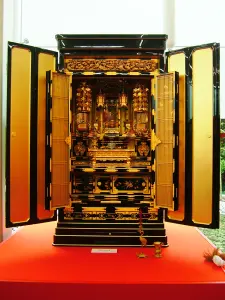
Domestic altars and memorial observances can connect family life with temple relationships.
Higan & Obon
Seasonal observances connect temple services, remembrance and community participation; forms vary by tradition and locality.
School affiliation, personal belief and participation are different measures. A person may join family memorial rites or visit a temple without identifying exclusively with one school.
Transmission and early adoption
Buddhist images and texts reached Japan through long-standing networks linking India, Central and East Asia, the Korean peninsula, and the Japanese court. Traditional chronicles assign the formal court presentation to either 538 or 552. Archaeology and art history place the decisive institutional growth in the sixth and seventh centuries. Early acceptance involved political rivalry as well as religious interest, and it did not immediately replace local ritual traditions.
Nara Buddhism and the state
During the Nara period, court-supported temples, clerical ranks, ordination, sutra copying, and provincial temple networks connected Buddhism with the protection of the realm. Tōdai-ji and its Great Buddha expressed this relationship on an exceptional scale. The so-called Nara schools were learned lineages and institutional traditions rather than modern denominations with sharply separated memberships. Temples also accumulated land, workshops, archives, and artistic knowledge.
Heian schools and mountain centres
In the early Heian period, Saichō established Tendai on Mount Hiei and Kūkai laid foundations for Shingon Buddhism at Tō-ji and Mount Kōya. Both drew on study in Tang China and developed ritual, doctrinal, and monastic systems that influenced later Japanese Buddhism. Mountain centres became places of training, pilgrimage, estate management, and interaction with local sacred landscapes.
Medieval diversification
From the late Heian through Kamakura periods, Pure Land teachers, Zen lineages, Nichiren, and reform movements within older schools expanded the range of organized Buddhist life. Hōnen and Shinran interpreted reliance on Amida Buddha in different ways; monks such as Eisai and Dōgen transmitted Chinese Chan lineages that became Japanese Zen; Nichiren centred practice on the Lotus Sutra. Earlier institutions continued to change alongside them, so the period was diversification rather than simple replacement.
Temples, parishes, and memorial rites
Higan brings several of these functions together twice each year: its seven-day equinoctial periods may include temple services, Buddhist reflection, grave care, and household remembrance.
In the early modern period, shogunal policy organized temples into supervised networks and tied many households to local temples. Registration helped the state monitor Christianity and population, while temples performed funerals, memorial services, and grave care. These functions strengthened durable parish relationships. They also contributed to the modern shorthand of Japanese Buddhism as primarily funerary, although teaching, pilgrimage, prayer, festivals, social welfare, and monastic training remained important.
Buddhism and kami
For much of Japanese history, Buddhist and kami traditions were institutionally and conceptually entangled. Kami could be interpreted as protectors or local manifestations of buddhas, and shrine-temple complexes shared land, personnel, rites, and imagery. The Meiji government ordered their administrative separation in 1868. The resulting anti-Buddhist movement damaged temples and cultural objects, yet separation did not erase earlier relationships or the continued movement of people between shrines and temples.
Modern and contemporary Buddhism
Modern schools reorganized as legally recognized institutions, founded universities and charities, served emigrant communities, translated texts, and entered global religious networks. In Japan today, temple affiliation, funerals, graves, household altars, pilgrimage, meditation, festivals, and cultural tourism coexist with secularization and demographic pressure on small temples. Self-identification surveys do not fully capture this participation: people may use Buddhist institutions without describing themselves as exclusive adherents.
Art, architecture, and cultural memory
The Tale of the Heike shows how Buddhist ideas entered literary memory: impermanence, karmic consequence, mourning, and renunciation frame the Taira clan’s fall without turning the war tale into a doctrinal manual.
Buddhist demand supported sculpture, painting, calligraphy, metalwork, lacquer, printing, garden design, and monumental architecture. Many objects now classified as national treasures were created as active ritual presences rather than as detached works of art. Museums and preservation law protect part of this inheritance, while Japanese Buddhist temples continue to negotiate the needs of worship, conservation, tourism, and local community life.
Sources
Institutional sources describe their own traditions; historical and cultural sources provide context.
- Web Japan, Religion in Japan
- Kyoto National Museum, Early Japanese Buddhist Sculptures
- Kyoto National Museum, The Origin of the National Treasures System
- Agency for Cultural Affairs, World Heritage Sites in Japan
- Tendai Buddhist Denomination, English introduction
- Kōyasan Shingon Buddhism
- Jōdo-shū, introduction (Japanese)
- Hongwanji, Teaching
- Sōtō Zen, Practice
- Nichiren Shū, Buddhism
Last updated: