Jujutsu
Takenouchi-ryū

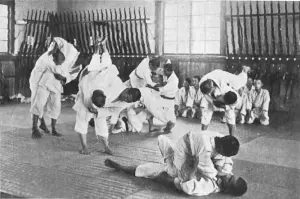
Image: Asahi Shimbun / Wikimedia Commons · Public domain
Overview
Read it as a tactical system, not a box of unarmed tricks.
Takenouchi-ryū (竹内流) is a classical Japanese martial tradition whose own records date its foundation in Mimasaka Province to 1532. Close grappling is central, but the school’s historical frame is broader than the modern word “jujutsu” may suggest: paired kata connect kogusoku and koshinomawari, arresting methods, unarmed control, short weapons, sword and staff work, and rope restraint. The foundation account of Takenouchi Hisamori’s religious retreat explains the tradition’s identity and technical symbolism; it should be read as a lineage narrative rather than as an independently witnessed event. Two associated hereditary houses later maintained related but not identical transmissions. Takenouchi-ryū is therefore an unusually early named window onto Japanese grappling, not proof that every later jujutsu school descends from one founder.
Weapons, clothing, restricted movement, and close distance shape the problem.
Grappling, striking, short weapons, and position operate together.
Throw, pin, capture, bind, disengage, or move to another weapon.
- Japanese
- 竹内流
Takenouchi-ryū - Traditional founding
- 1532 · Mimasaka Province
- Founder
- Takenouchi Nakatsukasa-daifu Hisamori
- Classification
- Classical comprehensive martial tradition
- Core lens
- Close control in an armed environment
- Transmission caution
- Sōke and sōdenke lines overlap but are not identical
01Name & category
The label changes the size of the picture.
Takenouchi-ryū is the school name. Takeuchi-ryū is another English spelling. The extended title Hinoshita Torite Kaisan Takenouchi-ryū foregrounds torite, the seizing and arresting dimension.
Jujutsu
Places the school within the history of Japanese grappling and close control.
Torite
Emphasises seizing, controlling, and arresting an opponent rather than sport grappling.
Comprehensive tradition
Keeps unarmed work, short weapons, longer weapons, and restraint in one view.
02Foundation & chronology
Separate the school’s foundation story from the historical timeline.
Both matter. The lineage narrative explains meaning and identity; dated records, family transmission, place, and later recognitions provide a different kind of historical evidence.
- 1532
Traditional foundation
The school dates Hisamori’s retreat at Sannomiya Shrine and the revelation of close-control, short-weapon, and binding methods to this year.
- 2nd–3rd generations
Systematisation
Hisamori’s son Hisakatsu and grandson Hisayoshi are identified within the tradition as major organisers of the curriculum.
- 1620 & 1663
Lineage recognitions
School histories associate these dates with court recognitions connected to the title Hinoshita Torite Kaisan.
- Later transmission
Two associated houses
The hereditary line came to be maintained through sōke and sōdenke houses with related genealogies and curricula.
Note-taking rule: phrases such as “the old man revealed” describe the tradition’s own foundation account. They should not be silently converted into modern documentary fact.
03Curriculum layers
One close-range problem opens into several technical families.
Exact catalogues vary by transmission line. The map below shows functional relationships, not a universal syllabus or teaching order.
Posture · distance · timing · weapons
Kogusoku / koshinomawari
Armed grappling and short-weapon methods at close distance.
Torite / hade
Seizing, arresting, striking, throwing, and unarmed restraint.
Weapons
Sword, short sword, staff, spear, glaive, and other line-dependent material.
Hobaku / rope restraint
Methods for securing and managing a captured person.
04Kata logic
A form stores decisions, not just movements.
Paired kata organise what happens before, during, and after a technique. Their value lies in the linked judgement that the sequence makes repeatable.
Context
Notice weapons, clothing, starting posture, distance, and the role assigned to each partner.
Timing
Manage the attack while protecting access to your own weapons and balance.
Structure
Connect strike, grip, lock, throw, and pressure as the opponent’s posture changes.
Outcome
Finish, restrain, disengage, or transition according to the tactical scenario.
05Historical significance
Its importance is clearest when modern categories are held lightly.
Takenouchi-ryū helps explain why premodern grappling vocabulary does not divide neatly into today’s unarmed arts, weapons arts, police methods, and sport.
- Kogusoku
- A term connected with light equipment, short weapons, and close grappling; context determines its precise use.
- Kumiuchi
- Close grappling or engagement, often discussed in relation to armed or armoured conditions.
- Torite
- Seizing and arresting methods directed towards control of a person.
- Yawara
- A historical term used across traditions for methods associated with flexibility, grappling, or control.
- Jujutsu
- A useful umbrella term whose modern boundaries can be narrower than an older school’s curriculum.
- Ryū
- A transmitted school or tradition, not simply a modern style selected from a menu.
06Present-day transmission
Shared ancestry does not erase branch-specific detail.
Takenouchi-ryū remains a living tradition in Japan. Public demonstrations, family records, local sites, and affiliated groups make parts of the transmission visible, while authority and curriculum remain line-specific.
Place · records · forms · oral instruction
Sōke line
Use its own official history when describing current leadership or curriculum.
Sōdenke line
Attribute its genealogy, names, and curriculum to that line rather than to every group.
07Common misconceptions
Three shortcuts that flatten the tradition.
The curriculum joins grappling with weapons, arresting, and restraint methods.
Its early documentation and influence are significant; Japanese grappling nevertheless developed through multiple institutions and lines.
Contemporary claims should identify the specific line or organisation being described.
Sources and further reading
- Nihon Kobudo Association, Takenouchi-ryū Jūjutsu Hinoshita Torite Kaisan.
- Nihon Kobudo Association, Takenouchi-ryū Jūjutsu Koshinomawari Kogusoku.
- Takenouchi-ryū official site, The Origin.
- Takenouchi-ryū Sōdenke lineage, English Introduction.
- National Diet Library, Takenouchi-ryū: The Origin of Japanese Jujutsu, expanded edition.
Last updated: